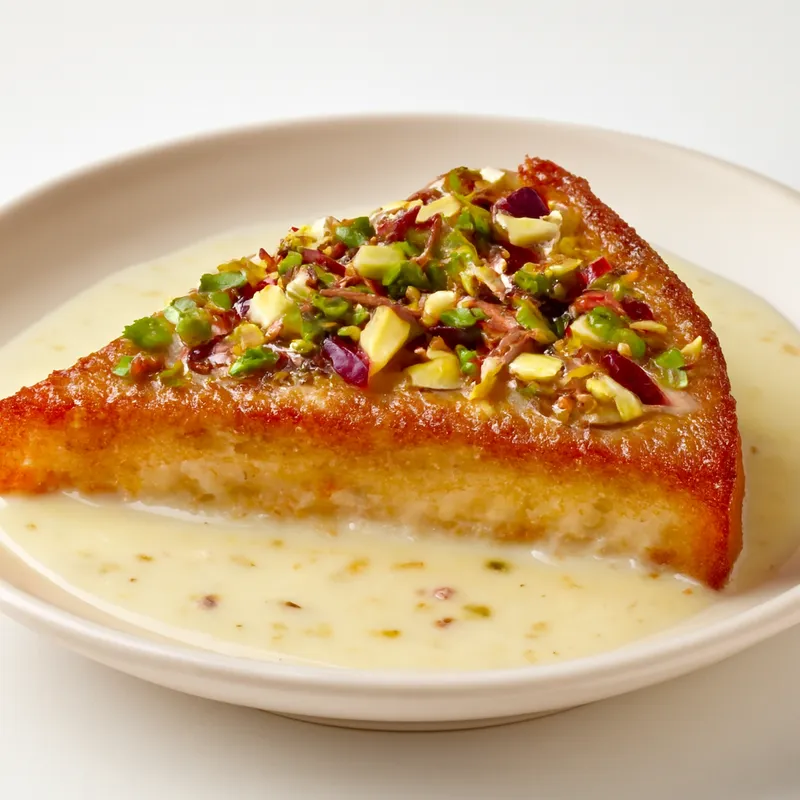
Dense, jet-black confection of Kozhikode in northern Kerala — slow-cooked from refined wheat flour, dark jaggery, and pure coconut oil for two to three hours until deeply caramelized and glossy; finished with cardamom and fried cashews. The use of coconut oil rather than ghee is the defining mark of the Calicut tradition.



Kozhikode halwa traces to the Zamorin court era (1124–1806), when the Zamorins of Calicut invited Gujarati confectioners to settle in the city and prepare sweets for royal banquets; their quarter on the street now called Mittai Theruvu (Sweet Meat Street) became the nucleus of the city's halwa tradition. The concept of halwa itself arrived along the Malabar spice route carried by Arab maritime traders who had frequented Calicut's port since at least the seventh century — the Arabic word ḥalwat denoting a class of sugar-based confections. Local artisans substituted abundant coconut oil for ghee, producing the distinctly Kerala character still upheld today. Family-run halwa shops on SM Street have operated continuously for over a century, with the jet-black wheat halwa remaining the shop-front emblem of the city.
Dense and yielding, with a glossy, slightly sticky surface; the first taste delivers deep jaggery caramel threaded with cardamom warmth, and the cashew pieces provide brief crunch in an otherwise smoothly compact body. Long after swallowing, the coconut oil leaves a clean, mellow finish.
Wheat starch gelatinizes as the maida batter heats in coconut oil (around 62–70°C), swelling and bursting to form a dense gel matrix; prolonged stirring over low heat evaporates water and allows starch chains to realign into a firm, elastic structure. The jaggery syrup undergoes sucrose inversion and extended Maillard browning across the two-to-three-hour cook, generating hundreds of flavor compounds and the jet-black pigment characteristic of the halwa. Batched additions of coconut oil create a fat-coated starch network that retards starch retrogradation, keeping the halwa pliable at room temperature rather than hardening into a brittle slab.
Variations
White halwa substitutes refined sugar for jaggery, producing an ivory-colored version sold alongside the classic black; banana-jaggery halwa (Pazham Halwa) blends ripe banana into the base for a fruity coastal variant; tapioca-starch halwa is popular for its translucent, more elastic texture and is often colored with food dye for festive occasions.
On the Palate
Where Kozhikode Halwa sits in the Indian flavor cloud
Ingredients
Serves 8How it's made
8 steps · 20 min
- 115 min
Dissolve jaggery in water, strain through a fine cloth to remove impurities, and simmer over medium heat until a thick syrup forms (about 110°C; a drop pressed between fingers forms a single thread).
Watch outSimmer the jaggery to a thick syrup — a drop pressed between fingers should pull a single thread; too thin and the halwa never sets firm.
- 25 min
Heat coconut oil in a heavy-bottomed pan — copper is traditional — over medium heat; fry cashews until golden, then remove and set aside.
- 35 min
Whisk maida with water to a smooth, lump-free batter; pass through a fine sieve and set aside.
- 420 min
Pour the maida batter gradually into the hot oil, stirring continuously over medium heat until the mixture thickens and begins to pull away from the sides of the pan.
Watch outPour the batter into the hot oil and stir without stopping until it thickens and pulls from the sides — leave it and it clumps and scorches on the base.
- 515 min
Add the jaggery syrup in four or five stages, incorporating each addition fully before adding the next; pour in the remaining coconut oil in batches, stirring without pause.
- 6150 min
Reduce to the lowest heat and continue stirring for 2–3 hours until the mass turns jet-black and glossy, releases from the pan cleanly, and a small portion pressed between fingers does not stick.
Watch outCook on the lowest heat, stirring, until it turns jet-black and glossy and a pinch no longer sticks to your fingers — this is the two-to-three-hour patience test.
- 73 min
Stir in cardamom powder and the fried cashews until evenly distributed through the mass.
- 860 min
Pour into a greased tray, smooth the surface, and leave to cool at room temperature for at least one hour until fully set; slice into portions.
Archive tool suggestions — not reviewed
These legacy suggestions have not been evidence-reviewed and are not presented as required tools.