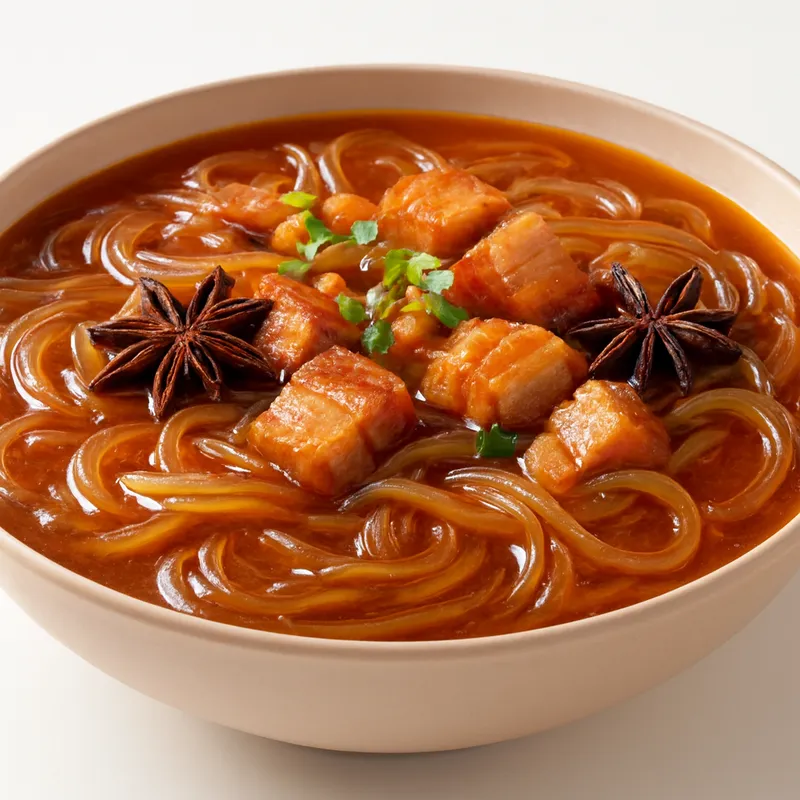
Rou Jia Mo
“Tender pork belly, slow-cooked with fragrant spices, tucked into a crispy wheat bun.”



The bite
A flat round wheat bun (白吉馍), split horizontally, stuffed with pork belly that's been red-braised for two hours and then chopped fine on a board with the cleaver — fat, lean, and skin all hashed together with a spoon of the braising liquid. The bun is dry-toasted in a clay oven so the outside cracks and the inside stays soft. Eat immediately; the bun goes soggy in 5 minutes.
Where it comes from
From Shaanxi, with the bun (白吉馍) traceable to the Qin dynasty (3rd century BCE) — Xianyang archaeological sites have ovens matching the modern shape — and the braised pork (腊汁肉) recorded in a Northern Wei agricultural treatise around 540 CE. The combination became street food in late Qing Xi'an. Often called 'the world's oldest hamburger,' though the bun isn't yeasted and the meat isn't ground.
What makes it work
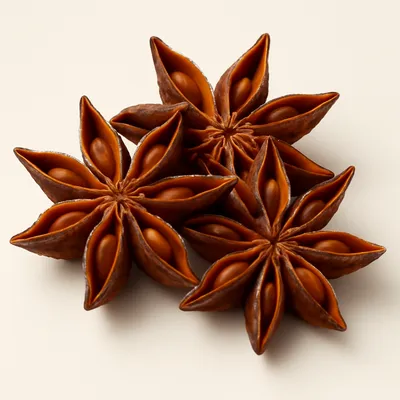
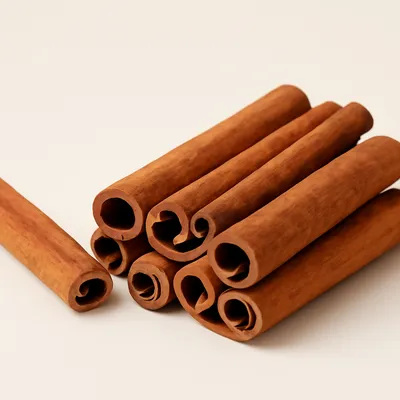
The 'la-zhi-rou' braise (腊汁肉) uses a perpetual stock — Xi'an stalls keep adding water and spice to the same pot for years, sometimes decades. Each batch of pork enriches the next. Twenty-some spices go in (star anise, fennel, cinnamon, sand ginger, dried tangerine peel, cloves), but the depth comes from the aged stock, not the fresh spice. A first-pot braise tastes thin no matter how good the recipe.
On the Palate
What goes into it
Proteins
Herbs & Spices
Grains & Staples

Sauces & Condiments

How it's made
- 1
Simmer pork belly with bay leaf, star anise, cinnamon, and Sichuan pepper.
- 2
Add soy sauce and brown sugar to create a rich braising liquid.
- 3
Cook until the pork is tender and flavors are melded.
- 4
Serve the pork in a sliced, crispy wheat bun.