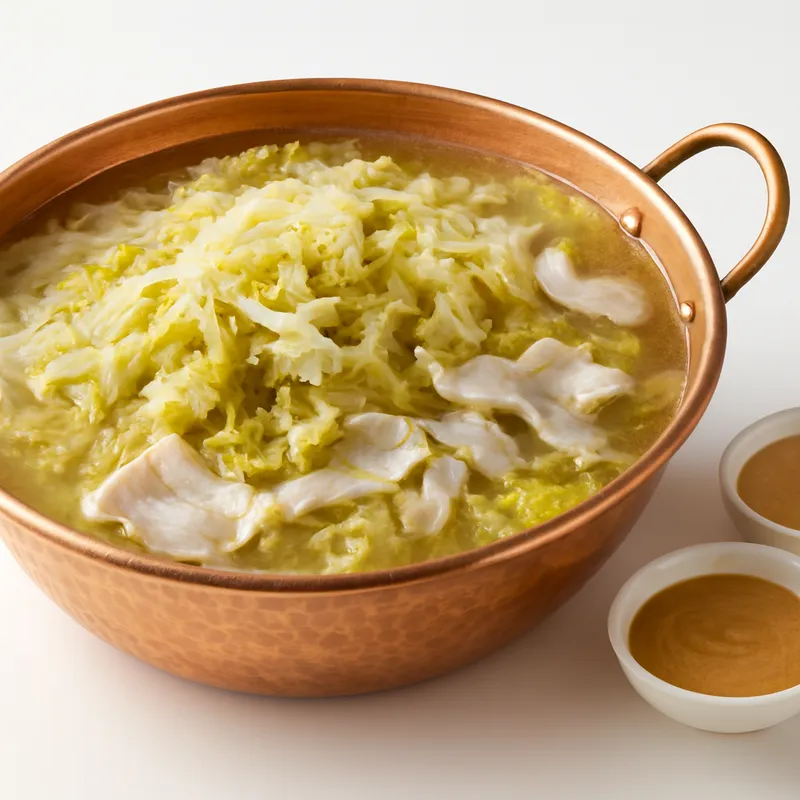
Northeast hot pot of fermented cabbage and thinly-sliced pork belly in a copper pot — sour-savory broth, no chili, eaten with sesame paste dip.





A Manchu dish from the northeast forests, formalized in the Qing imperial court — the Manchus brought their pickled cabbage and copper-pot habits to Beijing in 1644 and the dish became a winter palace fixture. The northeast village version still uses a single copper pot heated by charcoal in the chimney, with suancai fermented from late-autumn cabbages in earthenware crocks under the eaves.
Manchu dish from the northeast forests; the Manchus brought it into the Qing court in 1644 and it became a winter palace fixture. Suancai must be lactic-acid fermented long enough to tenderize the pork belly on contact — fresh sauerkraut goes limp and misses the punch.
A copper pot bubbling around its center chimney, suancai gone translucent in the broth, pork belly sheets curling like ribbon. The broth is sour-clean, no chili, no málà — closer to a sauerkraut soup than a Sichuan hotpot. Each slice goes through the sesame-fermented-bean-curd-leek-flower dip, comes out coated and pungent. Frozen tofu's job is to soak up everything else.
Two ingredients carry the dish. The suancai must be fermented long enough to develop the lactic acid that gives the broth its clean sourness and cuts the richness of the pork belly — fresh sauerkraut substitutes go limp and miss the lactic punch. The pork itself must be cooked whole then chilled before slicing; trying to slice it raw or warm gives thick uneven slabs that won't curl in the broth.
Variations
Heilongjiang village version uses charcoal-chimney copper pot; Beijing imperial form (Bai Rou Guan Zi at Sha Guo Ju) tames the sourness; Korean kimchi-jjigae is a parallel-universe cousin running spicier and hotter.
On the Palate
Where Suancai Bairou Hot Pot sits in the Chinese flavor cloud
Ingredients
Serves 4





How it's made
6 steps · 30 min
- 190 min
Simmer 800g pork belly (skin on, single block) in water with 2 slices ginger, scallion, 1 tbsp Shaoxing wine for 50 minutes until a chopstick passes cleanly. Lift out, plunge into ice water, then chill 30 minutes — cold meat slices thinner.
Watch outSimmer the pork belly until a chopstick slides through clean, then ice-bath and chill it — warm meat tears into thick slabs, cold meat slices paper-thin.
- 215 min
Slice the chilled pork belly against the grain into 1mm sheets. Each slice must show the layered fat and lean — that's the bairou.
Watch outSlice against the grain into near-transparent sheets, each showing its fat-and-lean layers — thin enough to curl and go translucent in the hot broth.
- 310 min
Rinse 600g northeast suancai (fermented Chinese cabbage) once to take the sharp edge off, then squeeze dry and shred into 3mm strips.
Watch outRinse the suancai just once to knock off the raw sharpness, then squeeze dry — over-rinse and you wash away the lactic sourness that carries the pot.
- 45 min
Mix the dipping sauce: 3 tbsp sesame paste loosened with 2 tbsp pork-cooking liquid, 1 cube fermented red bean curd mashed in, 1 tsp leek-flower paste (jiucai hua), pinch of sugar, drizzle of soy.
Watch outEnsure the sesame paste is well loosened to avoid clumping in the sauce.
- 55 min
Layer the suancai in the bottom of a copper hot pot. Lay pork belly slices on top in a tile pattern. Add a handful of frozen tofu and glass noodles. Pour in 1.2L hot pork-cooking broth.
- 610 min
Bring the pot to a boil over the burner. Once it's bubbling around the chimney, eat from the pot, dipping each slice into the sesame sauce. Top up with broth and ingredients as you go.
Watch outMonitor the heat to prevent the broth from boiling over or burning.
Archive tool suggestions — not reviewed
These legacy suggestions have not been evidence-reviewed and are not presented as required tools.