Vermont Maple Walnut Ice Cream
Vanilla custard ice cream churned with Grade A pure Vermont maple syrup and toasted walnut pieces — a year-round expression of February's sugaring season.


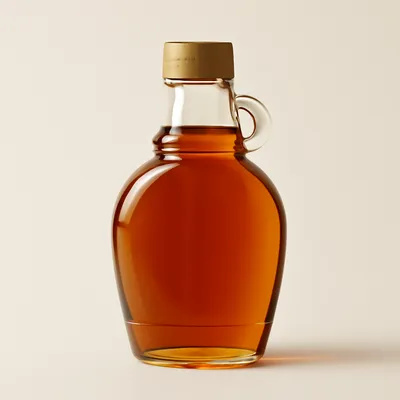
Vermont's maple sugaring season runs roughly February to early April, when freezing nights and above-freezing days drive sap up the sugar maples. The state produces about half of all US maple syrup. Maple walnut ice cream is a Northeastern parlor flavor that dates to the early 20th century — before the maple grading reform (adopted by Vermont in 2014 and the USDA in 2015 under the International Maple Syrup Institute system), the darker syrup we now call Grade A Dark Color (robust taste) — and the even darker Grade A Very Dark (strong taste) — was sold as Grade B and was the preferred cooking grade because of its stronger flavor.
Vermont produces about half of all US maple syrup. Before the 1994 USDA grade reform, what we now call Grade A Amber was sold as Grade B and was the cooking-grade everyone wanted — stronger flavor, more minerality. The walnuts have to be toasted; raw walnut tannins read bitter at freezer temperature.
Pale beige with darker maple veins, scoops cleanly but yields fast on the tongue. The first taste is cold cream and vanilla, then the maple comes through — not the corn-syrup sweetness of pancake syrup, but the woody, slightly mineral edge of real Vermont sap. Walnuts crunch through with bittersweet skin. The finish is salted-caramel-adjacent. A bad version tastes flat-sweet because it used Grade A Golden (too delicate) or imitation maple flavoring.
Sugar (sucrose, fructose, glucose) lowers the freezing point of water — that's how ice cream stays scoopable. Maple syrup is roughly 67% sugar, so substituting some of the granulated sugar with maple adds flavor but also pushes the base toward softer texture. The custard ratio (yolks-to-dairy) and quick churn time keep ice crystals small. Toasting the walnuts before folding is non-negotiable: raw walnut tannins read as bitter at freezer temperature, where flavors dampen.
Variations
Ben & Jerry's Vermont Maple Walnut (Waterbury, VT, the commercial benchmark); Strafford Organic Creamery version (small-batch, single-farm syrup); diner-counter «New England maple walnut» from Friendly's, sweeter and softer.
On the Palate
Where Vermont Maple Walnut Ice Cream sits in the American flavor cloud
Ingredients
Serves 6


How it's made
6 steps · 40 min active + 5 hours 20 min waiting
- 112 min
Heat 480ml heavy cream and 240ml whole milk in a heavy saucepan to a bare simmer (around 180°F / 82°C). Off heat. Steep with 1 vanilla bean (split, scraped) for 10 minutes.
Watch outDon't boil — milk solids will scorch on the pan bottom and the custard will taste burnt.
- 25 min
Whisk 6 large egg yolks with 50g granulated sugar until pale. Temper by streaming the warm cream into the yolks, whisking constantly. Return to the saucepan.
- 38 min
Cook over medium-low, stirring with a wooden spoon, until the custard coats the back of the spoon and registers 170-175°F (77-79°C). Strain into a bowl set over ice.
Watch outAbove 180°F the yolks scramble — pull early if you see any speckling.
- 43 min
Stir in 180ml Grade A Amber maple syrup (Vermont, dark color / robust taste preferred for ice cream) and 1/2 tsp fine salt. Cover and chill at least 4 hours, ideally overnight.
- 510 min
Toast 120g walnut halves at 350°F (175°C) for 7-8 minutes until fragrant. Cool, then chop coarsely. Toss with 1 tbsp warm maple syrup and a pinch of salt — a candied edge.
- 625 min
Churn the cold custard in an ice cream maker 20-25 minutes to soft-serve consistency. Fold in walnuts during the last minute. Pack into a chilled container, press parchment to the surface, freeze 4+ hours to firm.
Watch outMaple syrup lowers the freezing point — if you over-churn the base, the ice cream stays slushy.
Archive tool suggestions — not reviewed
These legacy suggestions have not been evidence-reviewed and are not presented as required tools.

Hand-held wire loop tool for beating eggs, whipping cream, emulsifying dressings, and incorporating air into batters. Balloon whisks (large round head) for whipping cream and meringues; French whisks (narrow tear-drop) for sauces in pots; flat whisks (gravy) for pan sauces. Stainless steel is universal; silicone-coated for non-stick pans.

Round metal pot, 14-26 cm diameter, with vertical walls and a long handle, designed for sauces, soups, oatmeal, rice, boiled vegetables. The vertical walls minimize evaporation (vs. a sauté pan). Sizes: 1 qt for melting butter, 2-3 qt for sauces, 4 qt for soups. Stainless-steel-clad aluminum or copper is best for conduction; cast-iron is too thick for delicate sauces.