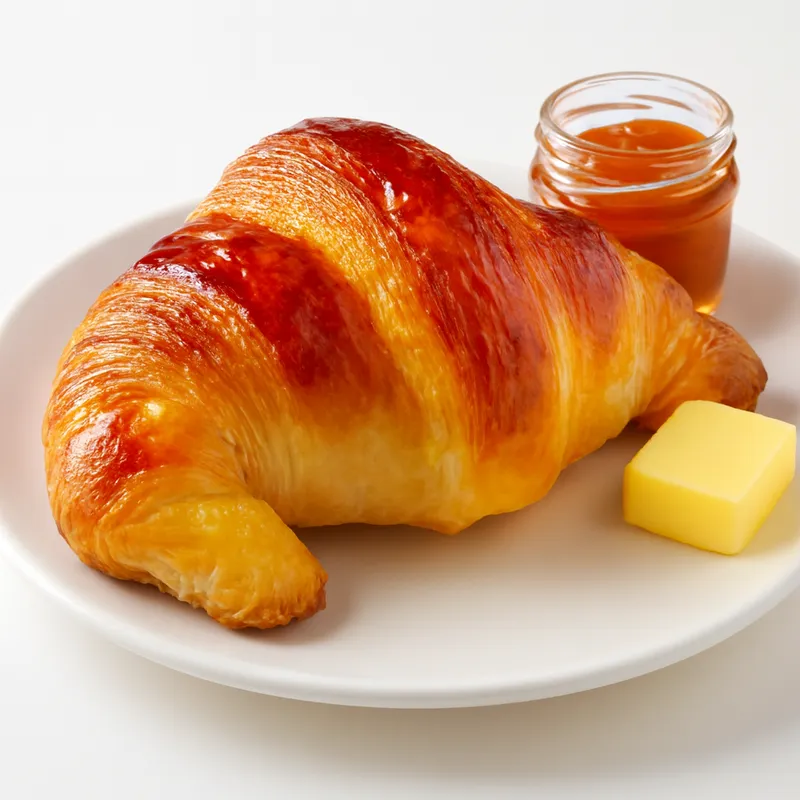
A fresh-baked pineapple bun split horizontally while still warm, with a thick cold slab of butter — around 1cm — pressed inside so it starts to melt but does not fully dissolve. The contrast between the warm, sugary crackled crust and the cold, yielding butter is the entire point of the dish.
The pineapple bun itself dates to 1960s Hong Kong bakeries; the addition of cold butter to make 菠蘿油 became widespread by the 1980s as cha chaan tengs began serving freshly baked buns as a set-meal item.
The bun arrives still warm from the oven. The top crust — a separate sugar-shortening pastry layer pressed onto the dough before baking — has crackled into a mosaic of irregular tan-gold pieces. Split horizontally, a cold butter slab is pressed inside so it sits at an angle, half-submerged. The first bite: warm, sweet, slightly caramelized crust on top; cold, resistant butter in the middle; soft bread underneath. The butter must not be fully melted — the temperature contrast is the dish.
The topping is a separate dough — flour, butter, sugar, and a small amount of egg — that is rolled, cut, and placed on the proofed bun just before baking. It does not bond to the bread; it sits on top and crackles as moisture from the bun's surface evaporates. The cold butter slab (港式黄油, gǎng shì huángyóu) is placed immediately after the bun leaves the oven, using residual heat to begin melting but not finish the job. If the butter is room-temperature, the contrast disappears. The bakery's speed — bun must be served within minutes of splitting — is the service standard.
Variations
The plain polo bun without butter is a bakery staple served with coffee or milk tea. Some shops use salted butter for a sharper contrast. Kam Wah Café (金华冰厅) in Mong Kok is often cited as the benchmark. A few shops insert a thin layer of coconut jam between butter and bread.
On the Palate
Where Polo Bun with Butter sits in the Chinese flavor cloud
Ingredients
Serves 4






How it's made
7 steps · 1 hour 30 min
- 15 min
Dissolve yeast in warm milk with 1 tsp of the sugar; let stand 5 minutes until frothy.
Watch outMilk above 45°C kills the yeast — test on the inside of your wrist; it should feel warm but not hot.
- 212 min
Combine flour, remaining sugar, and salt in a bowl; add the yeast mixture and 30g softened butter; knead by hand or machine for 10 minutes until the dough is smooth, elastic, and pulls cleanly from the bowl.
- 360 min
Cover the dough with a damp cloth and proof at room temperature until doubled in size, about 60 minutes.
- 43 min
Mix 20g sugar, baking powder, and egg in a small bowl to form a stiff cookie paste for the polo crust.
- 510 min
Punch down the dough, divide into 8 equal portions, and shape each into a smooth ball; press a thin disc of the crust paste over the top of each bun and score a crosshatch pattern with a knife or pastry scraper.
Watch outKeep the crust disc thin — a thick slab of paste will crack and slide off instead of staying draped over the bun as it expands.
- 645 min
Proof the shaped buns on a lined tray for a second rise of 30 minutes, then bake at 190°C for 12–15 minutes until the crust is pale gold and crackled.
Watch outThe polo crust burns quickly once it colours — check at 12 minutes; it should be golden, not brown.
- 72 min
Split each warm bun horizontally with a bread knife without cutting all the way through; press a cold 1cm-thick butter slab inside and serve immediately while the contrast of warm bun and cold butter is intact.