
Central-Burmese fermented bean paste — boiled horse gram beans pounded with salt and fermented into an umami-pungent dark reddish-brown paste, a Bagan-region specialty used across Burmese cooking.


Pone yay gyi (literally 'fermented bean liquid-big' in Burmese) is a foundational Burmese umami paste primarily produced in the Bagan region of central Myanmar, where it is a local specialty and cottage industry. It is made from horse gram beans (not soybeans), which are boiled, pounded with salt and fermented into a reddish-brown paste. Fermentation breaks soybean proteins into free amino acids, giving far more glutamate than the raw beans and the characteristic 'meaty' depth that Burmese cooks use to season everything from soups to stir-fries. Sold in every market in Shan State; harder to find outside Myanmar but a must for authentic Shan cooking.
A small lump of pone yay gyi added to anything transforms it: the umami hits before the salt does, with funky-pungent depth like cheese-rind crossed with miso. Used right, it's the Shan answer to fish sauce — but vegetal, drier, and warmer. Char a piece over flame, crumble onto a salad, eat with rice.
Salt-tolerant fermenting microbes break the boiled, salted horse-gram proteins down into free amino acids (especially glutamate), concentrating umami far above the raw beans. The salt suppresses spoilage organisms while flavor develops; the paste is fermented for roughly half a day, the point at which umami is full before ammonia off-notes develop.
Variations
Inle Lake version is wetter, almost paste-like; Kengtung eastern version is drier and char-toasted before storage (longer shelf life); Yunnan Yi-people version (across the border) is grainier with whole bean visible — three regional cousins of the same fermentation.
On the Palate
Where Pone Yay Gyi sits in the Burmese flavor cloud
Ingredients
Serves 30How it's made
5 steps · 1 hour 30 min active + 2 days 22 hours 30 min waiting
- 1725 min
Rinse 500g dried yellow soybeans; soak in cold water 12 hours until doubled in size.
- 2125 min
Drain, transfer to a pot with 2L fresh water. Bring to boil, then simmer 2 hours until beans are very soft (squish easily between thumb and finger). Drain.
Watch outSimmer the beans until one squishes to paste between your fingers — undercooked beans won't mash into a binder and stay grainy.
- 36 min
While still warm, mash beans coarsely with a pestle or potato masher — leave some texture, don't puree.
Watch outMash while still warm but leave some grain — a smooth puree loses the coarse body the paste is meant to have.
- 422 min
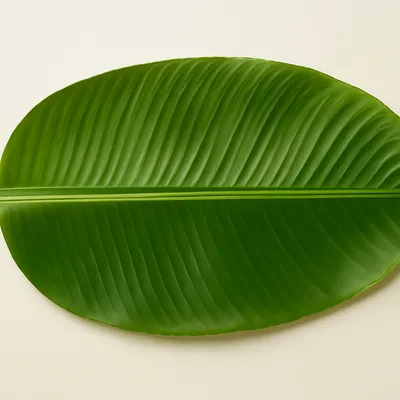
Wrap 200g portions in banana-leaf squares (wilted over a flame to soften). Bundle each into a 5cm cube; tie with twine.
- 54320 min
Place bundles in a warm spot (28-32°C — top of refrigerator or near a heater) for 3 days. The beans develop sticky strings (stretch them with a spoon to confirm fermentation), darken to deep brown, and develop a pungent umami smell. Unwrap; the paste is ready. Store refrigerated up to 1 month. To use: spread on bamboo, char over fire, then crumble into stir-fries or fold into salads.
Watch outIt's ready when the mash pulls into sticky strings on a spoon and smells sharply savory — push past that and an ammonia off-note creeps in.


