
Vienna's pounded veal cutlet — top-quality veal pounded to 4mm thinness, breaded in three stations (flour, egg, fresh breadcrumbs), then butter-fried until the breading puffs into a wavy, golden, almost-detached jacket around the meat. The defining feature is the SOUFFLÉ effect: the breading should ripple and bubble away from the surface, not stick flat. Served with lemon wedge, potato salad or parsley potatoes, and a glass of Grüner Veltliner.




Wiener Schnitzel is the most name-protected dish in Austria: under Austrian (and German) food law, the name 'Wiener Schnitzel' is legally reserved for VEAL; pork or other meats must be sold as 'Schnitzel Wiener Art' (Vienna-style) or 'Wiener Schnitzel vom Schwein' (from pork). A popular legend credits Field Marshal Radetzky with bringing the dish back from Milan in 1857, deriving it from the Italian cotoletta alla milanese — but food historians now generally reject this: linguist Heinz-Dieter Pohl traced the Radetzky link only to 1969, the alleged report-margin note has never been found in any archive, and a breaded, butter-fried cutlet already appears in an Austrian cookbook by 1831, well before Radetzky's report; no firm evidence connects it to Milan. The defining technique is the SOUFFLÉ breading effect, achieved through fresh loose breadcrumbs, the right fat temperature, and a final agitation of the pan that lets hot fat lift the crust off the meat. Two iconic Vienna restaurants serve a celebrated version: Figlmüller (since 1905, famed for plate-sized schnitzels) and Plachutta.
Wiener Schnitzel is the Viennese dish that defines Austrian cuisine. The first bite: a sharp crack as the wavy golden breading shatters; the breading is so thin and puffed it's almost weightless. Then the tender veal — pounded to a uniform thinness, just-cooked, neutral and lean. A squeeze of lemon brightens it. A bite of Erdäpfelsalat (vinegary potato salad) cuts the richness. A few capers add a salty-floral note. The dish is intentionally not heavily seasoned — the veal's natural flavor and the texture contrast are the point. Two-handed, one fork, one knife. A glass of Grüner Veltliner alongside.
The soufflé effect is the technical centerpiece. Three conditions are required: (1) Fresh, loose breadcrumbs (NOT compressed panko or stale crumbs) — these have air pockets that expand during frying. (2) Clarified butter (or lard) at roughly 175°C — high enough to immediately puff the breadcrumb-egg layer, low enough that the breading doesn't burn before the meat cooks. (3) Active pan agitation — by tilting and shaking, hot fat splashes UNDER the breading, separating it from the meat surface and creating the characteristic 'jacket effect.' The meat is so thin (4mm) that it cooks through in about 90 seconds per side, so the breading has minimum time to over-brown.
Variations
Wiener Schnitzel canonical (veal, soufflé breading, lemon + potato salad); Schnitzel Wiener Art (pork or chicken — same technique, legally distinct name); Cordon Bleu variation (with ham + cheese inside); Naturschnitzel (no breading, just pan-fried veal); Holstein style (with fried egg + anchovies on top — Berlin style, not Vienna); modern Vienna restaurants serve plate-sized schnitzels (Figlmüller's are 30cm+ across); Salzburg version uses slightly thicker pounding; the breadcrumb choice is the key technical variable.
On the Palate
Where Wiener Schnitzel sits in the Austrian flavor cloud
Fry the loosely-breaded cutlet in hot clarified butter and agitate the pan the whole time, so fat splashes under the crust and lifts it off the meat into the puffed soufflé jacket.
Ingredients
Serves 2




How it's made
8 steps · 25 min active + 10 min waiting
- 18 min
Get 4 veal cutlets (about 150g each) cut from the veal top round or leg. Place between two sheets of plastic wrap; pound with a meat mallet to 4mm thinness, working from center outward. They should be very thin but not torn.
- 24 min
Set up breading stations: (1) 200g all-purpose flour + 1 tsp salt + 1/2 tsp white pepper, (2) 3 large eggs beaten with 2 tbsp whole milk, (3) 250g fresh white breadcrumbs (NOT panko — Austrian preference for soft fresh breadcrumbs made from day-old bread, processed to coarse crumbs).
- 34 min
Bread each cutlet: pat dry; dust in flour (shake off excess); dip in egg (let excess drip); press in breadcrumbs (DO NOT press hard — gently coat both sides). Breadcrumbs should be loose, not packed.
Watch outThe crumb coat must stay loose and dry-looking, not pressed flat — this is what will float free in the pan.
- 43 min
Heat 1.5cm of clarified butter (or 50/50 clarified butter + neutral oil) in a wide heavy skillet to 175°C. Test: a breadcrumb should sizzle immediately.
- 51 min
Place schnitzel in the hot fat. As it cooks, IMMEDIATELY start agitating the pan by tilting and shaking gently — this lifts the breading off the meat (the 'soufflé' effect). The breading should ripple and puff away from the cutlet within 30 seconds.
Watch outStart shaking the pan the moment the cutlet hits the fat; within thirty seconds the crust should ripple and lift.
- 63 min
Fry 90 seconds per side. The breading should be a uniform deep golden color (Austrian standard color: 'krapfendunkel' — schnitzel-dark). The interior veal should be just-cooked, pale pink.
Watch outPull it at a deep even gold after about ninety seconds a side — the interior should be just pale pink, not gray.
- 71 min
Remove to a paper-towel-lined plate; pat the top GENTLY (do not press — would deflate the soufflé).
- 82 min
Serve immediately on a plate with: 1 lemon wedge + 2 tbsp Erdäpfelsalat (Vienna potato salad with vinegar and mustard) OR Petersilkartoffeln (parsley potatoes) + a sprinkle of paprika + a few fresh capers + a sprig of parsley.
Archive tool suggestions — not reviewed
These legacy suggestions have not been evidence-reviewed and are not presented as required tools.
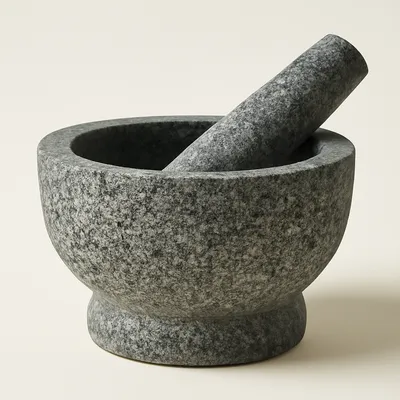
The simplest tool in any kitchen: a heavy bowl and a club to bash things in it. Different cuisines use different stones — Thai cooks pound green papaya in a tall granite mortar (krok hin); pesto Genovese requires the soft-pored Carrara marble; Indian masalas grind down on rough basalt. The bash-don't-cut motion releases volatile oils that a blade keeps sealed in the cell wall.

A heavy, single-piece cast iron pan, 25-30 cm across, weighing 1.5-2.5 kg. Once preheated, the thick mass holds 230°C+ even when a cold steak hits the surface — that's the secret to a deep crust. A well-seasoned skillet (multiple thin layers of polymerized oil baked into the iron) is essentially nonstick, gets better with use, and lasts a century. Lodge skillets from Tennessee have been in continuous production since 1896.


