


Tsukemen was put on the menu in 1955 by Kazuo Yamagishi while he worked at Nakano Taishoken in Tokyo (he later opened his own Higashi-Ikebukuro Taishoken in 1961, where the style became famous), who had been eating leftover noodles dipped in chilled broth as a staff meal and decided to put it on the menu as 'tokusei morisoba' (special morisoba) for 35 yen. The format went mainstream in the 2000s with Rokurinsha at Tokyo Station, who pushed the concentrated pork-fish-bone broth (gyokai-tonkotsu) that defines the modern style.
Taishoken's 1961 invention by Kazuo Yamagishi in Tokyo — noodles cold-rinsed and served beside a concentrated dipping broth, not in it. The broth is roughly twice as salty as ramen because it never touches the noodles.
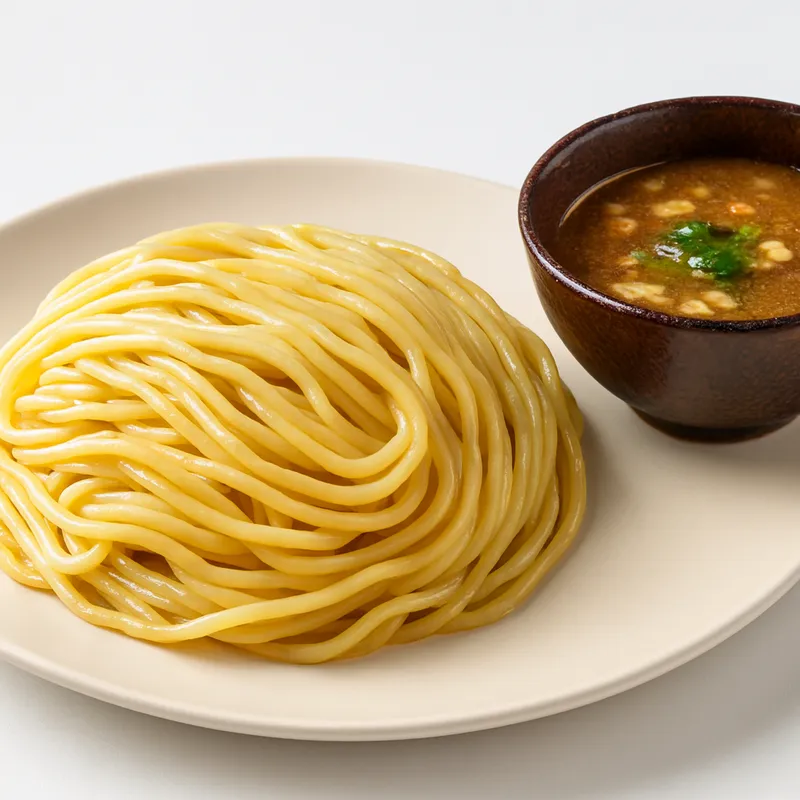
Two vessels: a bowl of cold thick noodles, washed and gloss-coated, sitting bare; a smaller bowl of opaque, viscous broth at near-boiling heat, twice as concentrated as ramen broth. Pick up noodles, dip half-deep, eat — never pour broth over noodles. Finish with sup-wari, hot dashi added to the dipping bowl to thin the leftover broth into something you can drink.
The noodle is engineered for the dip, not for soup. Tsukemen noodles are 50% thicker than ramen noodles, with higher hydration and longer kneading for a denser chew that survives the cold-water rinse — that rinse is essential, it stops cooking and removes surface starch so the broth coats rather than sticks. Without the rinse, noodles clump and the dipping action becomes impossible.
Variations
Gyokai-tonkotsu (fish-pork double soup, the Tomita/Rokurinsha lineage); spicy mazesoba-style (no broth, dressing-toss); atsumori (noodles served warm, not cold-rinsed); Tsukemen Daio's miso-tsukemen.
On the Palate
Where Tsukemen sits in the Japanese flavor cloud
Rinse the boiled noodles under cold water until fully cold — this stops the cooking, firms the chew, and strips surface starch so the concentrated broth coats each strand instead of turning to glue.
Ingredients

How it's made
4 steps · 15 min
- 15 min
Bring a large pot of water to a rolling boil. Add the ramen noodles and cook until al dente, about 4-5 minutes. The noodles should be firm to the bite.
Watch outFish one strand out at 4 minutes and bite — it should stop at a firm, slightly resistant core, not go through soft.
- 23 min
Drain the noodles and rinse under cold water until completely cool. This stops the cooking process and firms up the texture.
Watch outKeep tossing under the cold tap until the noodles feel genuinely cold and slick in your hand, not just warm-drained.
- 35 min
In a separate pot, bring the broth to a simmer and add soy sauce, miso, and bonito flakes. Stir until the miso is dissolved and the broth is aromatic.
Watch outStir until the miso fully dissolves and the broth smells savory and deep — no pasty streaks left at the bottom.
- 42 min
Arrange the cold noodles on a plate, garnishing with nori and a soft-boiled egg. Serve alongside the hot, flavorful broth for dipping.
Archive tool suggestions — not reviewed
These legacy suggestions have not been evidence-reviewed and are not presented as required tools.