Twice-fried plantains served as a crispy snack or side dish.


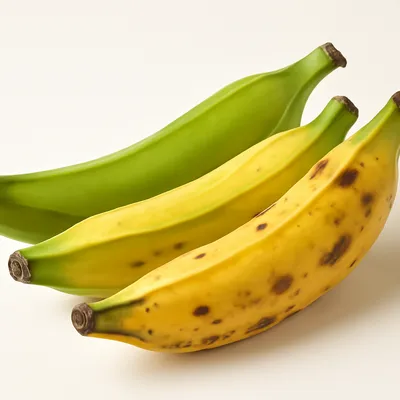


Plantains came to the Americas with the Spanish in the 16th century (via the Canary Islands), while the technique of frying, smashing, and re-frying green plantains is generally credited to West African enslaved cooks who adapted their starch-processing traditions in the Caribbean. The dish is pan-Caribbean and pan-Latin American rather than uniquely Cuban, and goes by different regional names: tostones (Puerto Rico, Dominican Republic), tachinos or chatinos (Cuba's own local term), bannann peze (Haiti), and patacones (Colombia, Venezuela, Panama, Ecuador, Costa Rica, Peru). "Tostón" derives from the Spanish tostar, "to toast"; "patacón" is borrowed from the name of a colonial-era silver coin, after the flat, round, coin-like shape of the disc.
Two-stage frying carried to the Spanish Caribbean by West African enslaved cooks from the 17th century onward. First fry at 140–150°C gelatinizes the starch so the round can be smashed without tearing; second fry at 180°C+ crisps the new surface area. Single-fry plantain is just chewy and greasy.
Green plantain rounds, fried once at low heat to soften, smashed flat between two boards or a tostonera, then fried again at higher heat until the edges curl crisp. Salt while hot. Inside stays starchy and dense like firm potato; outside snaps. Eaten with mojo (garlic-citrus) for dipping, or under a piece of stewed meat to soak the sauce.
Two-stage frying is the entire mechanism. First fry (140–150°C) gelatinizes the starch and softens the cell structure so the round can be smashed without tearing; second fry (180°C+) drives off surface moisture and crisps the now-flattened, larger surface area. Single-fry plantain is just chewy and greasy — you need the smash in between to expose new surfaces to the hot oil.
Variations
Cuban and Puerto Rican tostones are the same; Colombian and Venezuelan patacones use a thicker round and serve with hogao; Dominican tostones are smaller and salt-only; Honduran tajadas slice on a long bias and skip the smash entirely.
On the Palate
Where Tostones sits in the Cuban flavor cloud
This is two-stage frying: a gentle first fry (140-150°C) to soften the plantain so it smashes without tearing, then a hot second fry (180°C+) after flattening to crisp the newly exposed surface, single-frying only gives you chewy, greasy discs.
Ingredients
How it's made
4 steps · 23 min
- 15 min
Peel the green plantains and slice them into rounds about 1 inch thick. Heat oil in a deep frying pan over medium-high heat until it shimmers.
Watch outEnsure the oil is hot enough before adding the plantains to avoid sogginess.
- 26 min
Add the plantain slices to the hot oil, frying them for 3 minutes on each side until they are golden. Remove and drain on paper towels.
Watch outFirst fry to pale gold and just-tender, not browned; poke one, it should give softly.
- 34 min
Using a tostonera or the bottom of a flat object, press each fried plantain slice until flattened to about half its original thickness.
- 48 min
Return the flattened plantain slices to the hot oil. Fry again for 2 minutes on each side until they are crisp and golden brown. Drain on paper towels and sprinkle with salt while still hot.
Watch outOil must be properly hot for the second fry so the flattened disc crisps fast instead of soaking up grease.
Archive tool suggestions — not reviewed
These legacy suggestions have not been evidence-reviewed and are not presented as required tools.