
A street snack of the Liaodong coast, most associated with Dalian and Dandong. Sweet-potato starch (in Dalian usually cut with a little mung-bean starch) is cooked with water into a thick, glassy paste, left to set into a firm jelly, then cut into bite-size cubes and pan-fried in a flat skillet until each cube wears a crisp golden skin while the inside stays soft and translucent. Off the heat it is dressed with sesame paste thinned to a sauce, raw garlic mashed with water (蒜泥水), and soy sauce, often with a thread of chili oil; in Dandong cooks frequently fold in shrimp, squid, or fish paste for a coastal version. It is eaten hot from the pan, speared on a bamboo pick or scraped up by the plateful.


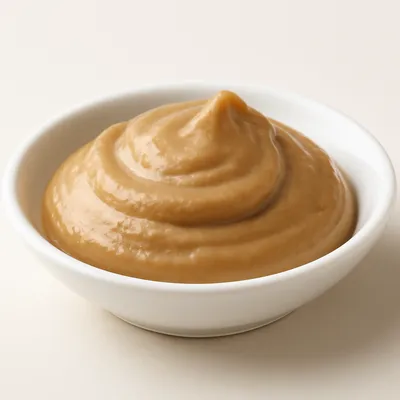


Menzi belongs to the starch-jelly snacks of the Jiaodong-to-Liaodong coast and is a fixture of the street food of Dalian and Dandong in Liaoning; the same word 焖子 names quite different snacks elsewhere (a buckwheat or sweet-potato block in Shandong, Hebei and Henan), so the dish is regional rather than singular. The exact inventor and date are not recorded. A widely repeated trade story holds that the pan-fried starch block began with two brothers surnamed Men drying starch noodles in Yantai, Shandong, who fried the unset paste during a spell of rain and dressed it with garlic; carried north across the strait with Shandong migrants during the 闯关东 movement, it took root in Dalian, where it was adapted toward a sweet-potato (and mung-bean) base. The local crisp skin earned the dialect names 焖子嘎 / 焖子隔 for the browned crust.
A good cube gives way in two stages: teeth break a thin, crackly browned skin, then sink into a soft, springy, almost translucent center that is tender but never runny. The sesame paste coats it with toasty richness, the garlic water hits sharp and cool, and the soy carries salt and a little chili heat underneath. It should be hot enough to steam, the skin still crisp when it reaches you. Done badly, the jelly is undercooked and pasty in the middle, or the cubes are flipped too soon and never form a skin, so the whole plate turns to a soft, gummy mash that the sauce just slides off.
Everything turns on the starch and on patience at the skillet. Sweet-potato starch heated with water gelatinizes — the granules swell, burst, and the chains network into a thick paste that sets, once cooled, into a sliceable jelly; a little mung-bean starch is added because its amylose sets firmer and clearer, so the cubes hold their shape under the spatula. Frying is then about surface, not interior: the cubes are laid in hot oil and left undisturbed so the contact face dries and browns through Maillard reactions into that crackly 嘎, and only flipped once the skin has set — Dalian cooks describe a deliberate 'three turns, nine rolls' (三翻九转) to crisp the faces without smashing the soft cores. The sauces go on off the heat: sesame paste must be loosened with water or stock or it stays claggy, and the garlic is mashed raw into cold water so its pungent sulfur compounds stay sharp rather than cooking off.
Variations
Within Liaoning the split is clear: Dalian menzi is the sweet-potato-and-mung-bean cube with the toasted sesame-paste, garlic-water and soy dressing, while Dandong menzi commonly works in seafood — shrimp, shredded squid, or fish paste cooked into the jelly or sauce. Some cooks add shrimp oil or fish broth to the dressing, others a heavier hand of chili oil. The word travels to wholly separate snacks: a steamed-then-fried buckwheat or sweet-potato block in Shandong (Yantai, Penglai), a starch-and-meat-stock block in Hebei (Qinhuangdao, Baoding) eaten sliced, and yam-starch versions inland. It should not be confused with cold 拉皮, the chilled mung-bean sheet that is dressed cold and never fried.
On the Palate
Where Pan-Fried Sweet Potato Starch Jelly sits in the Chinese flavor cloud
Ingredients
Serves 3


How it's made
8 steps · 30 min active + 1 hour waiting
- 15 min
Whisk sweet-potato starch (and a little mung-bean starch) with cold water into a smooth, lump-free slurry.
- 212 min
Pour the slurry into a pot over low heat and stir constantly as it thickens into a glossy, very stiff paste that pulls away from the sides.
Watch outStir the slurry constantly over low heat until it thickens into a glossy, very stiff paste that pulls from the sides — stop too soon and it won't set into a firm sliceable jelly.
- 360 min
Scrape the paste into an oiled flat container, smooth the top, and leave it to cool completely until it sets into a firm jelly, about an hour.
- 45 min
Turn the set jelly out and cut it into bite-size cubes, roughly 2-3 cm.
- 58 min
Heat a film of oil in a flat skillet, lay in the cubes in one layer, and fry undisturbed until the underside forms a crisp golden skin.
Watch outLay the cubes in hot oil and leave them undisturbed until the underside forms a crisp golden skin — flip too early and the soft center tears and the skin never sets.
- 66 min
Turn the cubes and keep frying and rolling them so several faces crisp without crushing the soft centers.
- 74 min
Meanwhile loosen sesame paste with a little cool water or stock, and mash raw garlic into cold water with a pinch of salt.
- 82 min
Plate the hot cubes and dress with the sesame sauce, garlic water, soy sauce, and a thread of chili oil; serve at once while the skin is crisp.
Archive tool suggestions — not reviewed
These legacy suggestions have not been evidence-reviewed and are not presented as required tools.


