A savory tea-meal of the Yao people of Gongcheng, in the Guilin region of Guangxi — eaten as a ritual meal, not drunk as a beverage. Green tea leaves are softened in hot water, then fried in lard with ginger and garlic and pounded to a pulp in an iron pot with a wooden mallet; water is added and boiled to draw out a sharp, faintly bitter tea liquor, which is salted and strained through a bamboo funnel over bowls. Each bowl is filled with crunchy garnishes set out in small dishes — puffed rice (米花), fried peanuts, fried soybeans, parched rice, scallion and coriander — and eaten alongside glutinous rice cakes (糍粑) and other snacks. The making is called 打油茶 ("beating oil tea"), and a host will pour round after round.





Gongcheng oil tea comes from the Yao communities of Gongcheng Yao Autonomous County in the Guilin region of Guangxi, where it is the daily meal and the rite of receiving guests; it later spread to the local Zhuang and Han as a shared custom. Its defining technique is the 'beating': popular accounts hold that in the Ming and Qing, Yao people stir-fried tea leaves with ginger, oil and salt and worked them with a wooden mallet to brew faster, and the dish is commonly said by local sources to reach back to the Tang, though no single text is cited for that antiquity, so it is best taken as tradition rather than documented date. The heritage record is firmer: the craft 油茶制作技艺(恭城油茶) entered Guangxi's second autonomous-region-level list of intangible cultural heritage in 2008, and the broader 瑶族油茶习俗 (Yao oil-tea custom) entered China's fifth national-level list in 2021; it was later recognized by UNESCO not on its own but as one sub-item of "Traditional tea processing techniques and associated social practices in China," inscribed in 2022.
The liquor comes to the bowl hot, thin and jade-cloudy, tasting first of toasted tea — green and astringent with a real edge of bitterness — then of warm ginger heat and a savory hit of garlic and lard, rounded by salt rather than sugar. It is meant to be drunk in mouthfuls between bites of the garnish: puffed rice and parched rice go soft and nutty in the hot tea, fried peanuts and soybeans stay hard and crunchy, scallion lifts it, and a piece of glutinous 糍粑 makes it a meal. Done well the tea is fragrant and clean-bitter, the ginger forward, the garnishes crisp; done badly it tastes scorched and acrid from burnt tea leaves, or flat and watery because the leaves were under-pounded and never gave up their strength.
The method turns brewing into cooking. The leaves are first steeped briefly in hot water to soften them and wash off some of the harsh smoky-bitter edge, then fried in lard with ginger and garlic so their oils and the aromatics bloom in fat; pounding them with the mallet ruptures the leaf cells, which is what lets the boiling water pull out tannins (the catechins that give the sharp astringency and bitterness) far faster and more fully than steeping ever would — this is the whole point of 'beating' the tea. Ginger contributes its pungent gingerols, garlic its sulfur compounds, and the lard both carries those fat-soluble aromas and gives the liquor body; salt seasons it as a savory broth rather than a sweet drink. Straining through the bamboo funnel holds back the pounded leaf and ginger so only the liquor reaches the bowl, where the puffed and parched grains soak it up and the fried legumes stay crisp by contrast.
Variations
Oil tea of the same 'beaten' family is drunk across the mountains of northern Guangxi, southern Hunan and eastern Guizhou by the Yao, Dong and Miao, with names like 侗族油茶 and 瑶族油茶; the Gongcheng version is the best known. Recipes differ by garnish and by how the tea is finished: some pour the salted liquor over a bowl already loaded with puffed rice, fried peanuts, parched soybeans and shredded greens, while others set the garnishes out in dishes to add by hand. Custom dictates the rounds — a guest is often pressed to take several bowls, the first plainer and later ones richer, and a sweet version exists for children. The garnish spread can extend to fried dough bits (脆果/排散), glutinous 糍粑, dried radish and pickled vegetables.
On the Palate
Where Gongcheng Oil Tea sits in the Chinese flavor cloud
Ingredients
Serves 4


How it's made
7 steps · 25 min active + 5 min waiting
- 18 min
Steep the green tea leaves in a little hot water for five to ten minutes to soften them and rinse off some of the harsh bitterness, then drain.
- 24 min
Heat a little lard in a heavy iron pot, add the ginger and garlic, then the softened tea leaves, and stir-fry over medium heat until fragrant.
Watch outFry the softened tea, ginger and garlic in lard just until fragrant — this blooming in fat is what carries the aroma before the water goes in.
- 33 min
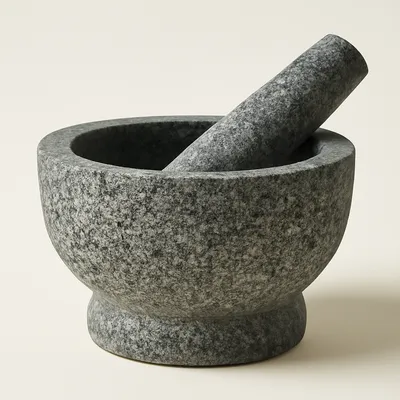
Pound the contents with a wooden oil-tea mallet against the side of the pot until the leaves, ginger and garlic are broken into a coarse pulp.
- 45 min
Add water and bring to a rolling boil, simmering for a few minutes until the liquor turns strong and savory; season with salt.
Watch outBoil hard a few minutes until the liquor turns strong and savoury — a weak, thin brew means the pounded leaves didn't release enough.
- 53 min
Set out small dishes of garnish — puffed rice, fried peanuts, fried soybeans, parched rice, chopped scallion and coriander.
- 61 min
Strain the hot tea liquor through a bamboo funnel into each bowl, leaving the pounded leaves behind in the pot.
- 71 min
Stir the garnishes into the bowls (or let each diner add their own) and serve hot, with glutinous rice cakes alongside; pour fresh rounds as the meal goes on.
Archive tool suggestions — not reviewed
These legacy suggestions have not been evidence-reviewed and are not presented as required tools.