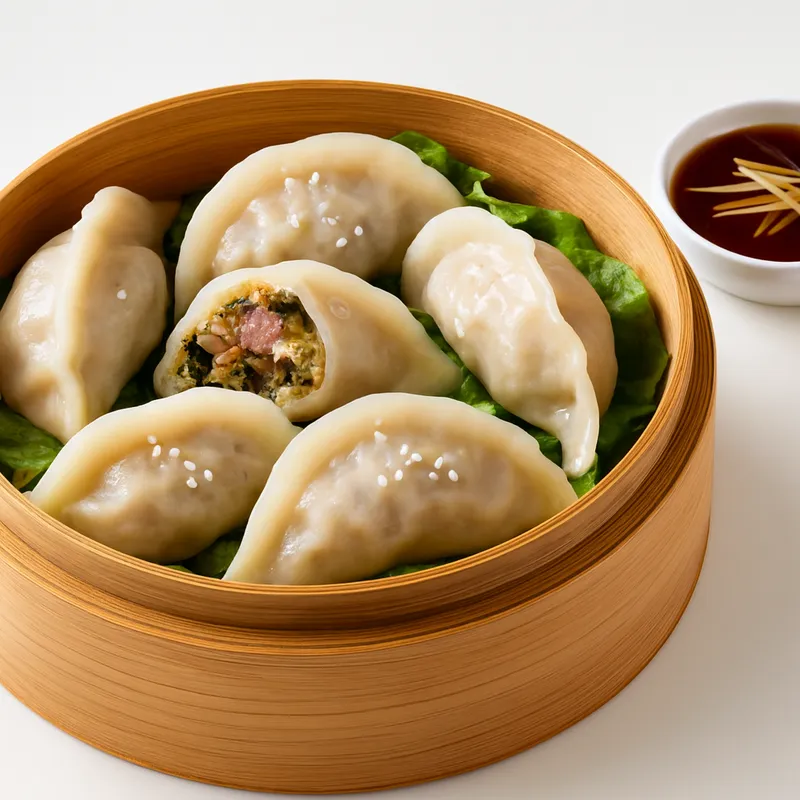
A signature of the Jiaodong coast around Qingdao and Yantai: plump boiled dumplings filled with the flesh of fresh Spanish mackerel. The fish is filleted and skinned, its meat scraped from the bone and finely chopped, then stirred one direction with scallion-ginger water and a little pork fat until it whips up into a smooth, springy paste. Garlic chives go in last for fragrance, and the dumplings are wrapped fat and boiled. They are prized for being full, sweet-fresh and tender rather than fishy. In Qingdao the fish carries a famous local rite — the 'mackerel gift' a son-in-law brings his father-in-law each spring.




Spanish-mackerel dumplings belong to the Jiaodong coast — Qingdao, Yantai and Weihai — where the spring mackerel run brings the fish in cheap and fresh. The dish is bound up with the 'Laoshan mackerel rite,' an old custom from the Shazikou area of Qingdao's Laoshan district in which a son-in-law carries fat, live mackerel to his parents-in-law in early spring as an act of filial respect; locals say 'when the mackerel leap, the father-in-law smiles.' The rite is now listed as intangible cultural heritage, at both Laoshan district and Shandong provincial level. A folk tale ties the name to an orphan who braved a spring gale to catch fish for his dying father-in-law; arriving too late, he named the fish for the old man's last muttered word. Such legends are told locally rather than documented as fact.
Bite one open and the first thing is how full it is — a thin boiled skin around a solid, pale dome of fish. The paste is springy and faintly bouncy, not pasty, and it gives up a mouthful of clear, sweet juice that tastes of the sea without a trace of muddiness or fish-funk. Pork fat rounds it; the green snap and onion-sweet lift of garlic chives cut through. A splash of vinegar with slivered ginger is the local way, but a good one barely needs it.
The springy paste is salt-soluble protein at work. Spanish mackerel is lean and tender, so the meat is scraped and chopped fine, then salted first: salt at the right strength dissolves the muscle's myosin — the protein that makes up better than half of the meat's contractile fibers and binds the most water. Stirring steadily in one direction, and adding cold scallion-ginger water in small pours so each is absorbed before the next, drags those dissolved proteins into long strands and works air and water into a loose, sticky network — what cooks call 'getting the spring up.' The mix swells until a pinch of it will float in cold water. A little pork fat lubricates and enriches. In the boil the network sets into a juicy, bouncy gel that holds its water rather than weeping it. Garlic chives go in only at the end, since salt and time would bleed them and turn them dark.
Variations
Households differ: some keep it pure fish and chives, some fold in a little fatty pork belly (a common ratio is roughly five parts fish to one part fat), some add egg white or chopped egg for a softer bite, and a few add mushroom for depth. Beyond dumplings the same mackerel paste is rolled into fish balls or sliced sea-mackerel 'tofu.' Garlic chives are standard in spring; out of season cooks switch to leek, Chinese cabbage or chives-and-egg. Whitebait-and-leek and sea-whelk dumplings are sister fillings along the same coast.
On the Palate
Where Spanish-Mackerel Dumplings sits in the Chinese flavor cloud
Ingredients
Serves 4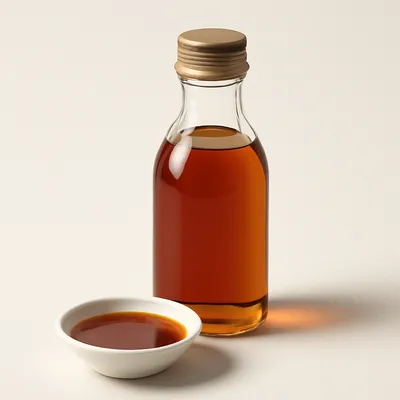

How it's made
9 steps · 55 min active + 20 min waiting
- 115 min
Make a soft dough with flour and water, knead smooth, cover and rest while you prepare the filling.
- 28 min
Fillet the Spanish mackerel; remove the skin and dark bloodline, then scrape the flesh off the backbone and any pin bones.
- 37 min
Finely chop the fish to a paste on the board, then scrape it into a bowl.
- 410 min
Add salt first and stir hard in one direction; pour in cold scallion-ginger water in several small additions, beating each time until absorbed and the paste turns sticky and springy enough to float a pinch in cold water.
Watch outBeat the salt in first and keep stirring one way until the paste turns pale, sticky and tacky enough that a pinch floats in cold water — that float is the sign the springy protein has developed.
- 54 min
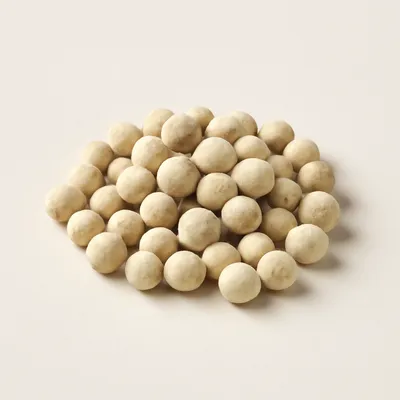
Stir in a little pork fat, white pepper and sesame oil; fold in the chopped garlic chives only at the very end.
- 68 min
Roll the rested dough into a rope, cut into pieces and roll each into a round wrapper, thinner at the edge.
- 79 min
Spoon in a generous mound of filling and pleat each dumpling shut, plump and well-sealed.
- 88 min
Boil in plenty of water, adding a splash of cold water two or three times as it returns to the boil, until the dumplings float and the skins look full and glossy.
Watch outAdd a splash of cold water each time the pot returns to a boil — this keeps the water just under a rolling boil so the skins stay whole; the dumplings are done when they bob up and the skins look full and glossy.
- 92 min
Lift out and serve hot with slivered-ginger black vinegar on the side.
Archive tool suggestions — not reviewed
These legacy suggestions have not been evidence-reviewed and are not presented as required tools.