Zhongjiang Hand-Pulled Dried Noodles come from Zhongjiang County in Sichuan's Deyang prefecture, celebrated for five qualities: immaculate white color, hair-thin fineness, silken suppleness, and a hollow core. At just 0.75 mm in diameter, the finest strands can thread a needle. Production spans 18 pure hand-crafting steps across roughly 20 hours — kneading strong-gluten local wheat flour with un-iodized well salt and deep-well water, fermenting multiple times until honeycomb micro-channels form inside the dough, then stretching thread-thin between bamboo rods and sun-drying outdoors. The hollow core is not ornamentation: it lets the noodles absorb broth deeply while holding their texture without turning mushy. In Juehuicun — renamed Noodle Village after the craft — families string silver curtains of noodles across bamboo frames each morning from October to May, the only season the temperature and humidity allow proper drying.



Zhongjiang noodles trace their documented record to the Song Dynasty, with over a thousand years of continuous production. The most-cited founding legend holds that during the Northern Song Chunhua era (990–994 CE), county magistrate Cui Gu — a northerner who loved noodles — tasked his kitchen to replicate the hand-pulled noodles of his homeland; cooks drew inspiration from mutton broth strands and produced an extremely fine result that was dried and hung. Whether or not the legend holds, by the Ming Dynasty the noodles were listed as a tribute food sent to the imperial court. The Qing-era poet Wang Langshan left a couplet: 'Zhongjiang liquor, Zhongjiang noodles — shop signs all the way to Beijing,' confirming their reach along Yangtze shipping routes and the overland road north. The oldest documented commercial shop, Jiyuyuan (积玉源), was founded on Tan Family Street by Tan Gongji in 1887; by the late Qing era there were over 100 workshops producing more than 1.8 million jin annually. The 1931 edition of the Zhongjiang County Gazetteer records the noodle's origin, qualities, and distribution markets. In 2008, the craft was named to Sichuan Province's First Batch of Intangible Cultural Heritage; in 2011 it received national geographic indication protection.
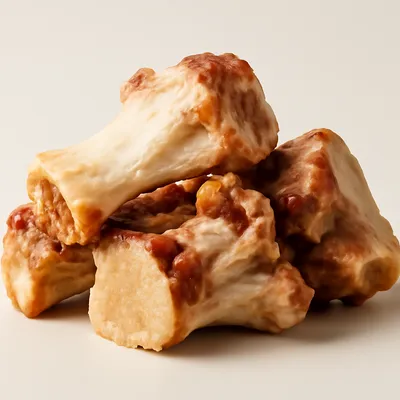
Lift a chopstick-load of Zhongjiang noodles and they drape almost transparently — impossibly fine yet unbroken. Two minutes in rolling boiling water is enough. Served the Juehuicun way: a ladleful of hot pork-bone broth, a spoonful of melted lard, a scattering of chopped scallion. The noodles absorb the soup into their hollow cores, so each bite delivers both the wheat's quiet sweetness and the broth's depth together. Leave them in the bowl longer and they hold their shape, softening without ever turning gummy — what locals call 'as good reheated as fresh.'
The hollow core is not a marketing claim but the natural outcome of a precise craft. During multiple fermentation stages, yeast-generated carbon dioxide accumulates within the dense gluten network, forming evenly distributed honeycomb micro-channels. As the dough is stretched to hair-thin strands, these channels elongate longitudinally into continuous hollow passages — in cross-section under a microscope, each strand resembles a tiny lotus root segment. The wheat matters enormously: the local heritage variety has a gluten content of 27–30%, providing the exceptional extensibility needed to stretch to 0.75 mm without snapping. Un-iodized well salt serves a dual role: it reinforces the gluten network and governs fermentation rate — iodized commercial salt inhibits yeast activity and has historically been avoided. Sun-drying on fully extended bamboo poles removes moisture gradually in natural breeze and light, locking the porous structure permanently. This is why production runs only October to May: excess heat causes over-fermentation; excess humidity prevents proper drying; either destroys the hollow architecture.
Variations
The classic presentation is clear soup: pork- or chicken-bone broth, a spoonful of rendered lard, scallion, and white pepper — nothing competes with the noodle itself. In Juehuicun, fermented black bean paste, fermented tofu, or house-made chili oil also appear as dry-dressed versions, keeping the noodle as the only protagonist. The strands hold up in hot-pot better than most thin pastas, resisting prolonged simmering without disintegrating. Recent tourism has produced novelty variants — spinach-tinted green noodles, wood-ginger-scented editions — but the plain white hollow noodle is what locals and serious eaters return to.
On the Palate
Where Zhongjiang Hand-Pulled Dried Noodles sits in the Chinese flavor cloud
Ingredients
Serves 4How it's made
7 steps · 1 hour 30 min active + 15 hours waiting
- 120 min
Dissolve un-iodized salt in cold deep-well water; pour into strong-gluten wheat flour in three additions, kneading vigorously for 20 minutes until the dough is smooth, stiff, and fully elastic — it should pull back when stretched.
Watch outKnead the stiff dough a full twenty minutes until it springs back — this builds the gluten that lets you pull it hair-thin later.
- 2360 min
Cover the dough with a damp cloth and leave at cool room temperature (18–22°C) for 4–6 hours for the first fermentation; the dough is ready when a torn cross-section shows fine, evenly distributed bubbles throughout.
- 3210 min
Roll the dough into thick ropes (开条), then coil each rope tightly into a shallow basket (盘条); cover and rest a further 3–4 hours for the second fermentation and gluten relaxation.
- 425 min
Drape the ropes between two parallel bamboo rods set 30 cm apart (上竹); over the next 20–30 minutes slowly pull the rods apart, gently shaking and easing the strands outward while continuously dusting with dry flour to prevent sticking (扑粉), until noodles extend 2–3 meters.
Watch outPull the rods apart slowly while dusting with dry flour — go too fast or skip the flour and the strands stick and snap.
- 5360 min
Mount the rods on an outdoor frame in natural sunlight and breeze; sun-dry for 4–6 hours until the noodles are completely brittle and snap cleanly — do not rush with heat or a fan, as slow evaporation preserves the hollow channels.
- 65 min
Snap or cut the dried noodles to serving length; bring a large pot of unsalted water to a full rolling boil, add noodles, stir once gently, and cook exactly 1–2 minutes until just tender — they cook faster than they look.
Watch outCook the dried noodles just one to two minutes — they're hollow and cook far faster than they look; overcook and they go soft.
- 75 min
Ladle hot pork-bone broth into bowls, lift noodles directly from the pot and place in broth; finish with a small spoonful of lard, chopped scallion, and white pepper; serve immediately while the broth is steaming.
Archive tool suggestions — not reviewed
These legacy suggestions have not been evidence-reviewed and are not presented as required tools.


