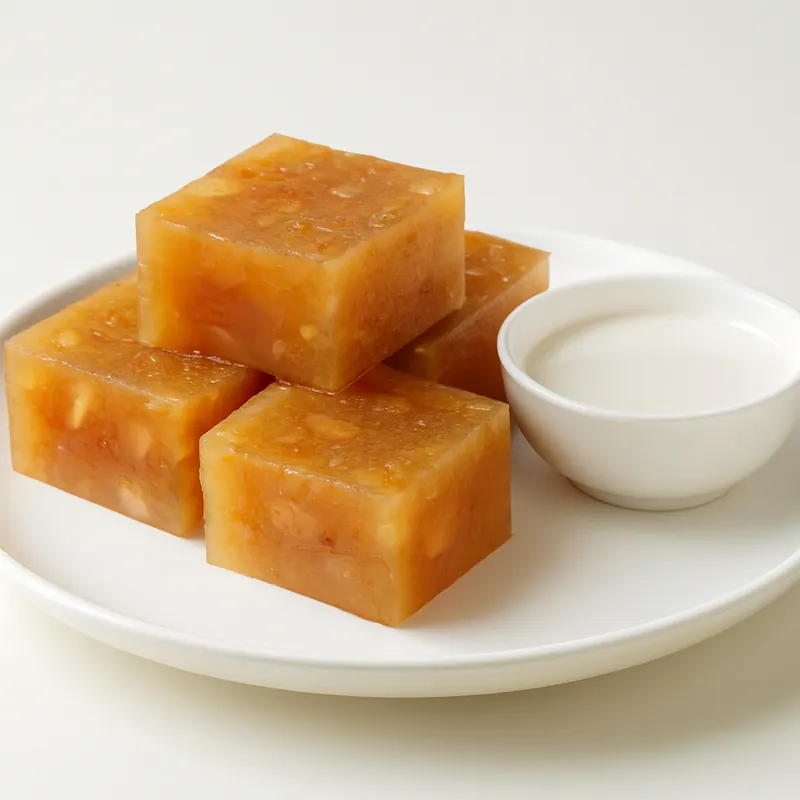
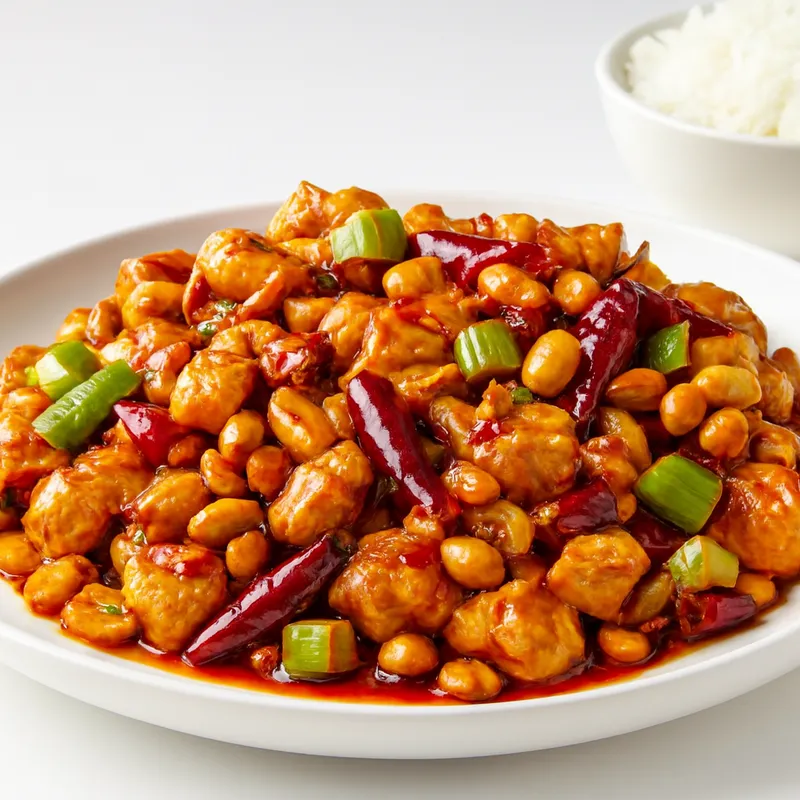
Tianshui guagua (呱呱) is the signature cold snack of Tianshui in eastern Gansu. It is a dense, soft curd made from the starch settled out of buckwheat: buckwheat groats are ground and steeped, the fine starch sediment is separated, then cooked down with constant stirring into a thick, pale-gold mass that is left to set. Cooked, it is broken up by hand into rough pieces — never knife-cut — and dressed cold with chili oil, mashed garlic in water, vinegar, sesame paste and salt. It is eaten at room temperature, most often for breakfast, and is fiercely local: long-running Tianshui shops such as 常记 sell it by the bowl from early morning.




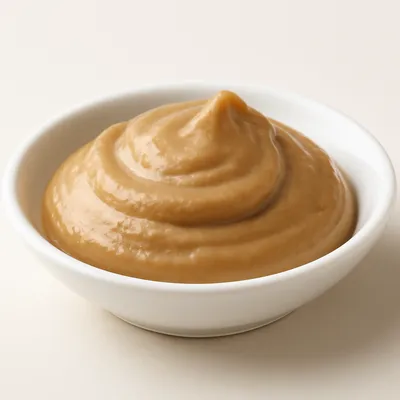

Guagua is a long-established bowl-snack of Tianshui (old 秦州), where it is sometimes called the city's foremost food. By local tradition it traces to the end of Wang Mang's Xin and the early Eastern Han: 隗嚣 held the Longyou region around Tianshui, and his mother is said to have favored the dish, so that a court cook later settled in Tianshui and opened a shop selling it — but this is folklore, and the exact origin and date are unrecorded. What is documented is the method and the trade: the snack is built on buckwheat starch and survives as a living street food carried by named houses, the best known being 常记呱呱, a shop run for some forty years and now with several branches across the city.
Picked up in a torn, irregular lump, guagua is soft and dense, yielding like a firm pudding but with body — it should hold its rough shape, not slump into paste. The buckwheat itself is mild, faintly nutty and a touch bitter, a quiet base for the dressing that carries the dish: the heat and fragrance of chili oil first, then the sharp pungency of raw garlic water, the lift of vinegar, and the rounding nuttiness of sesame paste, all clinging to the porous torn surfaces. It is eaten cool, never hot. Good guagua is tender yet cohesive and deeply red with chili oil; poor guagua is either rubbery and over-firm or wet and falling apart, and tastes flat when the chili oil is stale.
The dish is a starch gel. Steeping ground buckwheat and letting it settle separates the heavy starch granules from the lighter protein and husk; that washed starch sediment is what is cooked. Stirred constantly in water over heat, the starch granules absorb water and swell, then burst and gelatinize, the freed amylose and amylopectin chains tangling into a continuous network so the liquid thickens to a heavy paste. Poured out and cooled, the network sets — the amylose retrogrades — into a soft but cohesive solid that can be torn rather than spooned. Constant stirring during cooking is essential: it prevents lumps and scorching and works the starch evenly so the set is smooth, not grainy. Tearing rather than cutting matters too, because the ragged, porous surfaces grip far more of the chili-and-garlic dressing than a clean knife face would.
Variations
Tianshui cooks make guagua from several starches, and the type is named accordingly: 荞麦呱呱 from buckwheat is the classic and most prized, while 淀粉呱呱 (from potato or other starch), 玉米呱呱 from corn and 洋芋呱呱 from potato are common cheaper versions. The dressing is fixed in spirit — chili oil, garlic water, vinegar, sesame paste — but each house guards its own chili oil, the point on which shops like 常记 and 吴家 are judged. Guagua sits within Tianshui's wider family of cold buckwheat- and starch-curd snacks alongside 面皮 (cold skin noodles), 然然 and 锅鲰, all eaten the same dressed, room-temperature way.
On the Palate
Where Tianshui Guagua sits in the Chinese flavor cloud
Ingredients
Serves 4How it's made
7 steps · 10 hours
- 1540 min
Grind buckwheat groats coarsely, then steep the meal in cold water; let it stand so the heavy starch settles to the bottom, changing the water periodically over the better part of a day.
- 220 min
Pour off the upper water and lighter solids and keep the dense starch sediment at the bottom; thin it back to a pourable slurry with clean water.
- 310 min
Pour the slurry into a heavy pot and cook over medium-low heat, stirring constantly and firmly with a stick or paddle as it heats.
Watch outStir constantly and firmly as it heats — the moment you stop, the gelatinizing starch scorches and clumps on the bottom.
- 440 min
Keep stirring as the starch gelatinizes and the mass thickens to a heavy, glossy, pale-gold paste that pulls away from the pot, about 40 minutes.
Watch outCook until the paste turns glossy pale-gold and pulls cleanly from the pot — that's fully gelatinized and will set into a tearable curd.
- 520 min
Scrape the cooked mass into a shallow basin or bowl, smooth the top, and leave it to cool and set to a soft, cohesive curd.
- 610 min
Separately prepare the dressing: chili oil, mashed raw garlic steeped in water, vinegar, thinned sesame paste, and salt.
- 75 min
To serve, break the set guagua into rough pieces by hand into a bowl, spoon the dressings over and toss; eat at room temperature.
Archive tool suggestions — not reviewed
These legacy suggestions have not been evidence-reviewed and are not presented as required tools.