A trembling, slate-grey jelly made from Lijiang's high-altitude black peas (兵豆), served cold in summer with chili oil, pickled vegetables, and sesame, or sliced and pan-fried golden in winter. A Naxi street staple whose recipe is documented in Qing dynasty records as "食黑豆腐" and whose craft has been passed through one family for six unbroken generations.


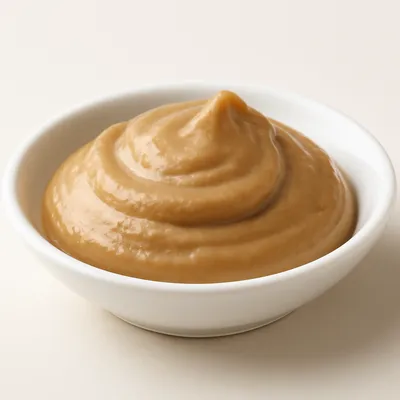

The earliest written record of Lijiang black pea jelly appears in the Qing dynasty Lijiang Prefectural Gazetteer (《丽江府志》, Qianlong period), which lists it simply as "食黑豆腐" — black tofu food. The ingredient — locally called 鸡豆 (literally chicken pea) or 兵豆 — is a variety of lentil (Lens culinaris) grown at elevations of 1,700–2,450 metres in Lijiang's Yulongshan foothills, known for its dark skin and high protein content. One family lineage, the He (和) family of Yulongxian's Mingyin township, has documented six consecutive generations of 鸡豆凉粉 production, with the family's earliest recorded ancestor in the trade serving under the jurisdiction of the Mu-clan tusi (木氏土司) during the Qing dynasty. In 2018, He Zhixing (和之星) was formally recognised as the municipal-level intangible cultural heritage representative inheritor of "纳西族鸡豆凉粉制作技艺."
The cold version arrives as a tangle of slate-blue-grey strands with the quiet wobble of set custard. A chopstick press reveals surprising firmness. The jelly itself is gently earthy and faintly sweet — the pea's personality understated but distinct. The chili oil brings heat and colour, the pickled vegetable a cutting sourness, and sesame paste a nutty depth. In winter, the pan-fried version is a different creature entirely: crisp gold shell encasing a molten, almost creamy interior.
The jelly sets through starch gelatinization: lentil starch granules (primarily amylose and amylopectin) absorb water and swell when heated to 65–80°C, then form a continuous three-dimensional gel network as the suspension cools. The dark skin of the 兵豆 leaches anthocyanins into the slurry during soaking, giving the finished jelly its characteristic blue-grey hue — a colour marker of authenticity that paler substitute legumes cannot replicate. The traditional stone-grinding method (rather than steel blades) preserves more intact starch granules, producing a smoother, more elastic gel; high-speed blending damages granule structure, weakening set.
Variations
Pan-fried version (煎鸡豆凉粉): slices browned in oil on both sides until a golden crust forms, served with a dipping chili sauce — the winter staple. Frost-set 霜结凉粉: a He-family innovation in which the jelly is set outdoors overnight at sub-zero temperatures, producing a more porous, delicate texture that absorbs dressings more readily. Noodle-form 凉粉皮: the same slurry pressed through a mould into broad, flat ribbons, eaten like rice noodles in broth.
On the Palate
Where Lijiang Black Pea Jelly sits in the Chinese flavor cloud
Ingredients
Serves 4
How it's made
7 steps · 8 hours
- 1480 min
Soak dried 兵豆 (black peas/lentils) in cold water for 8–12 hours (overnight) until fully hydrated and skins are softened.
- 210 min
Drain and grind in a stone mill or high-powered blender with fresh cold water (ratio 1:3 bean to water) until a fine, smooth slurry forms.
- 35 min
Strain through a fine cheesecloth or muslin, squeezing out all liquid; discard the remaining dry pulp.
- 45 min
Pour the strained slurry into a heavy-bottomed pot over medium heat; stir constantly with a wooden paddle to prevent settling and scorching.
- 520 min
As the mixture thickens and turns from opaque grey to translucent blue-grey (about 15–20 minutes), maintain stirring and reduce heat slightly.
Watch outStir constantly until it turns from opaque grey to translucent blue-grey — that shift to translucent is the starch fully cooking; stop early and it won't set firm.
- 6180 min
Pour the hot, thickened paste into lightly oiled trays or moulds; smooth the surface and allow to cool at room temperature for 1 hour, then refrigerate for 2 hours until fully set.
Watch outRefrigerate until fully set and springy before slicing — a soft, wobbly jelly tears instead of cutting into clean strips.
- 710 min
For cold service: slice into strips or cubes; dress with chili oil, minced pickled vegetables, sesame paste, and vinegar. For pan-fried service: slice 1.5 cm thick and fry in vegetable oil over medium-high heat until both sides are golden and crisp.
Archive tool suggestions — not reviewed
These legacy suggestions have not been evidence-reviewed and are not presented as required tools.

