Hand-chopped freshwater fish balls, simmered in clear broth — the benchmark test of a Hangzhou master cook. Unlike machine-ground fish balls, 斩鱼圆 preserves visible granules of fish flesh; they should float at the surface when properly made, snow-white, springy, and tasting unmistakably of the living river.



Hangzhou and Shaoxing, Zhejiang. 斩鱼圆 (listed as 清汤鱼圆 in the 2022 Hangzhou Classic Dishes Competition organized by Hangzhou municipal cultural authorities) is among the 36 classic Hangzhou dishes recognized by Zhejiang provincial authorities in 1956. Qing-dynasty gastronome Yuan Mei recorded 鱼圆 in the 'Scaled Aquatic Creatures' chapter (水族有鳞单) of his 《随园食单》 (1792), describing the technique of using live white fish or grass carp, scraping and chopping the flesh fine (斩化), mixing with bean starch and lard, forming balls, boiling and then finishing in chicken broth — one of the earliest surviving written records of the fish-ball method. In Hangzhou culinary tradition, 斩鱼圆 has long been a test-piece for apprentice cooks: the buoyancy of the finished ball in water is the objective measure of skill — correct salt-to-water ratio causes myosin gel to match water density, making the balls float gently at the surface.
A gentle press of teeth meets a springy resistance, then yields to a grainy, distinctly fibrous fish texture — nothing like a factory fish ball. Clean, sweet river flavor lingers with no fishiness.
Chopping fish flesh by knife rather than grinding by machine tears muscle fibers rather than shearing them uniformly, preserving coarser fiber bundles and scattering myosin throughout the mass. Adding salt in stages draws myosin out of ruptured muscle cells; vigorous hand-mixing unfolds and cross-links these proteins, forming a sticky gel network that traps water and air. The buoyancy test is physics: when protein gel density approaches that of water (approximately 1 g/cm³), the ball floats — over-salted balls are denser and sink; under-mixed ones disintegrate. Cooking at 90°C rather than a full boil prevents the turbulence that would deform the balls before the gel has fully set, producing a smooth, uniformly white surface.
Variations
Shaoxing cooks often mix a small amount of pork fat into the fish mince for a richer, glossier finish. A banquet-grade version garnishes clear broth with thin-sliced Jinhua ham and blanched bamboo shoots, elevating the dish to a full soup course. Some modern versions use bream or silver carp for economy.
On the Palate
Where Clear-Broth Fish Balls sits in the Chinese flavor cloud
Ingredients
Serves 4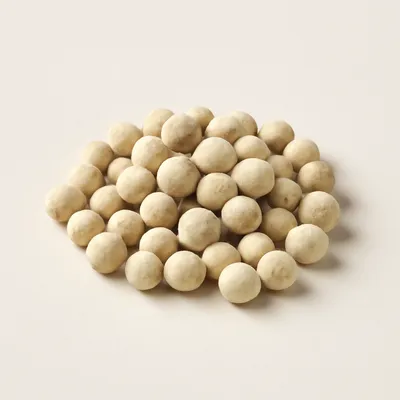
How it's made
8 steps · 50 min
- 110 min
Select a live freshwater fish (mandarin fish or grass carp); fillet, removing skin, and carefully pick out all red sinew
- 215 min
Use the flat of a knife or a cleaver to chop fish flesh steadily until pieces reach mung-bean size — do not over-mince into paste; the coarse texture is the point
Watch outChop the fish only to mung-bean-sized bits, not a smooth paste — the coarse texture is the whole point of these balls.
- 35 min
Transfer to a bowl; add salt in three separate additions, mixing firmly with the hand between each addition until the mixture becomes noticeably sticky and tacky
- 45 min
Slowly add cold water or ice water in small amounts, beating and folding continuously after each addition until the mixture is cohesive, glossy, and clings to the back of the hand without falling
- 53 min
Test buoyancy: pinch off a small ball, roll gently, and drop into cold water — it should float just at the surface; if it sinks, add a pinch more salt and mix; if it disintegrates, add a small amount of water
Watch outTest one ball in cold water — it should float right at the surface; if it sinks it's over-salted, if it falls apart it needs more water.
- 65 min
Bring a pot of water to 90°C (small bubbles rise at the bottom; no rolling boil); using the thumb-and-forefinger squeeze (虎口法), push walnut-sized balls into the water
- 710 min
Maintain 90°C, cooking fish balls until they float and the surface turns smooth and glossy, about 8–10 minutes
Watch outHold the water at 90°C, small bubbles only — a rolling boil batters the balls apart before they set smooth.
- 82 min
Transfer to seasoned clear broth or chicken stock; add a few drops of scallion oil; serve immediately in soup bowls
Archive tool suggestions — not reviewed
These legacy suggestions have not been evidence-reviewed and are not presented as required tools.



