Westfälischer Schinken is the air-dried, cold-smoked raw ham of Westphalia, made from a pork leg dry-cured with salt and seasonings and then smoked slowly over beechwood, traditionally with juniper added to the fire. Cut into thin, dark-red slices, it is dense and firm with a sweet, smoky, lightly resinous aroma, and is eaten with Pumpernickel — the regional black rye bread — and butter. The bone-in form is protected at EU level as 'Westfälischer Knochenschinken'. It is one of Germany's most famous cured meats and a fixture of the Westphalian Vesper, the cold supper plate.




Cured ham has been made in Westphalia since the early Middle Ages and was already traded through Cologne by the 12th century; for centuries it has counted among the best-known German hams. The tradition rests on the region's oak forests, where pigs were fattened on acorn mast (Eichelmast), and on dense beech woodland that supplied the smoking wood. The bone-in ham was entered in the EU register of Protected Geographical Indications as 'Westfälischer Knochenschinken' on 25 November 2013. By custom the hams were cut in May 'when the cuckoo called', which is why the spring pairing of ham with white asparagus became a Westphalian institution.
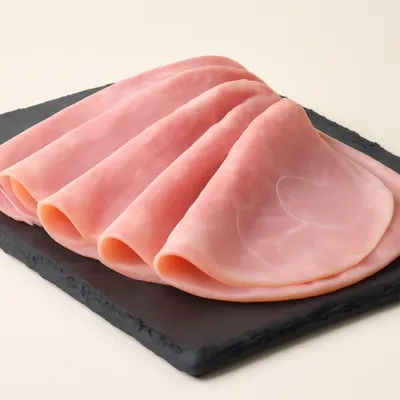
Sliced paper-thin across the grain, the meat is a deep wine-red shading to near-mahogany at the edges, rimmed with firm white fat. It is dense and slightly chewy rather than melting, drier than an Italian prosciutto, and tastes of salt, smoke and a faint sweet resin from the juniper. Laid on a slab of dark, moist Pumpernickel with cold butter, the sweet-sour rye and the salty smoke set each other off. A good slice is supple, not brittle, and not greasy.
Curing is preservation by water removal and salt. Rubbed repeatedly with a salt-and-nitrate mix (sugar is usually added), the leg loses moisture by osmosis while the salt and nitrite suppress spoilage bacteria and fix the meat's stable pink-red colour. After the salt has equalised through weeks of resting, the ham is cold-smoked: held below about 25°C, well under the temperature that would cook the meat, so the beechwood smoke only flavours, dries and further preserves the surface, depositing phenols and other antimicrobial compounds. Juniper wood or berries in the fire add resinous aromatics. Long maturing then concentrates flavour and firms the texture as more water leaves.
Variations
The flagship bone-in PGI form 'Westfälischer Knochenschinken' is cured and smoked on the bone; boneless hams of the same style are also widespread. Smoke recipes vary — beechwood alone, or beech with added juniper wood and berries, gives a sweeter, more resinous result. Beyond the classic Pumpernickel-and-butter service, the ham is shaved over white asparagus in May, wrapped around melon or asparagus spears, or laid on a Westphalian Vesper board with rye bread and a Korn schnapps. Related dark-smoked German raw hams include Schwarzwälder Schinken from the Black Forest, which is more strongly smoked over fir.
On the Palate
Where Westfälischer Schinken sits in the German flavor cloud
Ingredients
Serves 8How it's made
6 steps · 1 hour
- 160 min
Rub the whole pork leg thoroughly with a mix of salt, a little nitrite curing salt, sugar and crushed juniper berries and pepper, and pack it in salt.
- 240320 min
Cure cold (around 4°C) for several weeks, re-rubbing and turning the leg so the salt draws out moisture and penetrates evenly.
Watch outCure cold around 4 degrees for weeks, re-rubbing and turning so the salt draws moisture and penetrates evenly — warm or uneven curing risks the leg spoiling inside.
- 310080 min
Rinse off the surface salt, then hang the ham in a cool, airy place for a week or more to rest and let the cure equalise and dry.
- 47200 min
Cold-smoke over smouldering beechwood (with juniper wood and berries added) below 25°C in repeated sessions over many days, resting the ham between them.
Watch outCold-smoke below 25 degrees over smoldering beechwood — well under any temperature that would cook the meat, so the smoke only flavors, dries and preserves the surface.
- 52880 min
Mature the smoked ham in a cool cellar for several weeks to months until it is firm, dark and aromatic.
- 615 min
Slice paper-thin across the grain and serve on Pumpernickel with butter, or with white asparagus.
Archive tool suggestions — not reviewed
These legacy suggestions have not been evidence-reviewed and are not presented as required tools.