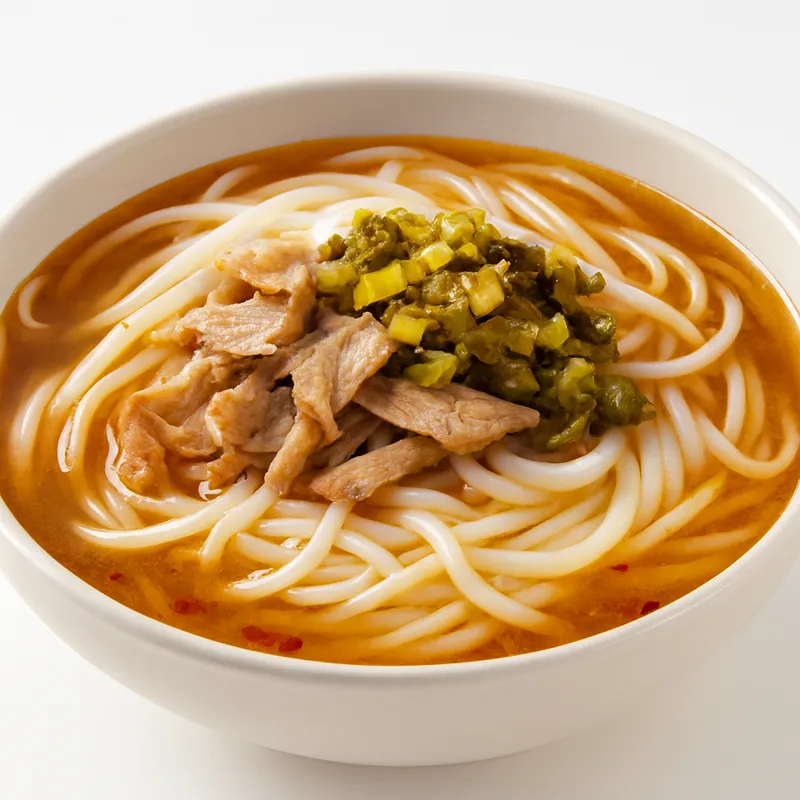
Fuling preserved mustard tuber is made from knob-stemmed mustard (Brassica juncea var. tumida), locally called qingcai tou, grown at the Yangtze–Wujiang confluence in Fuling district of Chongqing. The tubers are wind-dried on bamboo racks for two weeks, then triple-salted and triple-pressed before being seasoned with Sichuan peppercorn and chili and sealed in ceramic crocks to ferment. The result is amber-brown, tender-crisp, and layered — salt-savory with a murmur of spice and the quiet depth of lactic fermentation. Recognized alongside German sauerkraut and European pickled gherkins as one of the world's three great pickled vegetables, it is China's most internationally traded preserved vegetable, and its traditional craft was inscribed on China's national intangible cultural heritage list in 2008.


Fuling preserved mustard tuber was created in 1898, the twenty-fourth year of the Guangxu era. A bumper mustard-tuber harvest at the Qiu family compound in Fuling that year prompted Qiu Shouan's pickling specialist, Deng Bingcheng — originally from Zizhong, Sichuan — to adapt the method used for pickling large-headed mustard (da-tou cai). He threaded the tubers on bamboo strips, racked them on the Yangtze riverbank to wind-dry, then salted them in rounds, pressed out the brine in the wooden box used for pressing tofu, mixed in Sichuan peppercorn and chili, and sealed the results in ceramic jars to ferment. Because the process required pressing (榨) out the brine, Qiu Shouan named the product 'zha cai.' The first eighty crocks were shipped down the Yangtze to Yichang and sold out at once. A Shanghai specialty shop opened in 1912; in 1915 Fuling zha cai won a gold medal at the Panama-Pacific International Exposition and went on to reach Southeast Asia, San Francisco, and Western Europe. From around 1905, Fuling farmers shifted from opium cultivation to mustard tubers, and the zha cai industry became the region's economic backbone.
Opening the crock, a composed fermentation-tempered saltiness comes first — nothing sharp or pungent. Sliced into slivers or thin rounds, the initial sensation is decisive crunch, audible and clean, quite unlike the yielding softness of most pickles. A quiet Sichuan peppercorn buzz and low chili warmth run underneath the savory without competing. Set beside plain congee or wheat noodles, one dish of zha cai makes a meal; stir-fried with shredded pork or simmered with fresh fish, it withdraws to the background and quietly lifts the main ingredient.
Zha cai's signature crunch is built at the very first stage: wind-drying. Hung on bamboo racks in the Yangtze riverbank breeze for roughly fifteen days, the tubers lose 30–40% of their cellular moisture slowly enough that cell walls remain intact. This gradual dehydration densifies the fiber matrix, giving it the structural resilience to resist the osmotic pressure of repeated salting without collapsing. The subsequent triple salting and triple pressing further reduce water activity while promoting the hydrolysis of glucosinolates naturally present in the mustard stem; the breakdown products — isothiocyanate compounds — account for much of zha cai's distinctive pungent-savory aroma. Sealed in ceramic crocks, lactic acid bacteria drive a mild anaerobic fermentation that converts residual sugars to lactic acid, producing the quiet sourness in the finish, and partly degrades proteins into free glutamate, multiplying the umami. Fuling's position at 30°N at the Yangtze–Wujiang confluence, its Jurassic sandstone soils, and its winter river fog extend the mustard tuber's growing season to over a hundred days, producing knobs of unusual density that cultivars elsewhere cannot replicate.
Variations
Whole-form zha cai (全形榨菜) preserves the entire cured tuber at high salinity — the original and most traditional form — and must be soaked and rinsed before eating; it remains the preferred form on Chongqing tables. Since 1987, small-bag pre-seasoned zha cai has been pre-rinsed, flavored, and portioned for immediate consumption, and now dominates both domestic and export sales. Flavor variants include mala (numbing-spicy), chili, mild, and reduced-sodium; some brands offer wasabi and fermented-soy editions. Dishes built around zha cai include: zha cai pork-thread soup (a Sichuan home-kitchen staple), stir-fried zha cai with shredded pork, zha cai-steamed fish (where the condiment replaces salt and adds savory depth simultaneously), and zha cai fish hotpot — a Chongqing Lunar New Year fixture.
On the Palate
Where Fuling Preserved Mustard Tuber sits in the Chinese flavor cloud
Ingredients
Serves 10How it's made
7 steps · 30 min
- 115 min
Select firm, unblemished mustard tubers (qingcai tou). Peel off the tough outer skin, pare away fibrous veins, trim the base, and rinse thoroughly. Thread the tubers onto bamboo strips or sturdy twine so each hangs freely.
- 230 min
Hang the threaded tubers on an outdoor rack or under eaves in a well-ventilated spot. Allow them to wind-dry for 10–15 days until they lose 30–40% of their original weight, the skin is lightly wrinkled, and the flesh is pliable but not brittle.
Watch outWind-dry slowly until the tubers lose a third of their weight and turn pliable — rush it and the cell walls collapse, killing the signature crunch.
- 310 min
Layer the wind-dried tubers into a clean crock, scattering salt between layers at roughly 5% of the vegetable weight. Press down firmly with clean hands to work the salt in evenly, then weigh down with a clean stone. Leave to cure for 3 days.
- 420 min
Remove the tubers from the brine. Pack them into a cloth-lined wooden box or wrap in cheesecloth and press under a heavy weight for 30–60 minutes to expel the accumulated brine. The tubers should feel noticeably firmer after pressing.
Watch outPress until the tubers feel noticeably firmer and the brine runs out — leftover water dilutes the cure and invites spoilage.
- 515 min
Combine the pressed tubers with ground Sichuan peppercorn, dried chili, and sugar. Toss to coat evenly, then layer back into the crock with a second, lighter application of salt. Weigh down and cure for a further 7 days.
- 615 min
Remove the tubers again and press for a second time as in Step 4. The extracted liquid should be nearly colorless by this point, indicating salt concentration has stabilized and most free moisture has been expelled.
Watch outThe liquid pressed out should come away nearly colorless — that's the sign the salt has balanced and the moisture is gone.
- 720 min
Mix the tubers with the remaining ground Sichuan peppercorn and chili seasoning. Pack tightly into a clean, dry ceramic jar, pressing out all air pockets. Seal the mouth firmly and store in a cool, dark place for 7–14 days to finish fermenting. The zha cai will keep for several months sealed.