A thick, spongy yeasted griddle cake from Xiamen and across Minnan. The batter ferments until honeycomb-bubbled, then pours onto a cast-iron pan to form a round pancake; just before the surface sets, a generous blanket of brown sugar, crushed peanuts, and toasted sesame goes in. The finished cake folds over its filling and is sliced into wedges at the stall.



The Minnan griddle cake belongs to a long tradition of fermented wheat pancakes along the Fujian coast. A popular account — circulated widely since the late Qing — credits General Zuo Zongtang, who stationed troops at Fuzhou's Mawei area around 1855 and supposedly sweetened the soldier's standard bing with Fujian sugarcane and peanuts for easier transport. Historians treat this as legend: no contemporaneous document corroborates the attribution, and fermented pancake forms predate it in the region. By the late Qing the cake was sold from morning stalls across Quanzhou and Xiamen, and it travelled to Taiwan with Minnan emigrant communities. Today landmark stalls such as Zhong Lijun at Xiamen's Baishi market (八市) draw queues of visitors.
The first pull reveals spongy, honeycombed crumb — yielding but not dense — then a pocket of caramelised brown sugar melts against shards of toasted peanut and sesame, leaving a warm, nutty sweetness.
Yeast fermentation fills the batter with CO₂ bubbles that bake into an open crumb structure. On the 180°C griddle, Maillard reactions brown the underside while steam locks the bubble architecture above. Brown sugar layered onto the soft surface melts and concentrates as the cake folds, delivering a burst of caramel flavour at every cross-section.
Variations
Some Minnan vendors substitute palm sugar or black sesame paste for the classic peanut-brown sugar filling; modern Xiamen shops offer matcha, durian, and coconut variants. The same fermented batter, spread thinner and without the sweet filling, is the base for the Malaysian and Singaporean Apam Balik (曼煎粿).
On the Palate
Where Peanut Griddle Cake sits in the Chinese flavor cloud
Ingredients
Serves 4

How it's made
7 steps · 16 min active + 1 hour waiting
- 15 min
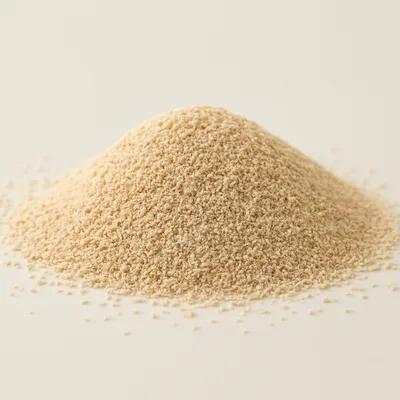
Mix 200g flour, 3g instant yeast, 20g sugar, and 280ml warm water into a smooth batter; cover and rest at room temperature for 60 minutes until the surface is dotted with bubbles.
Watch outRest the batter till the surface is peppered with bubbles — that's the yeast alive and gassing; a flat, still batter bakes dense with no honeycomb.
- 260 min
Preheat a cast-iron griddle or skillet over medium heat; brush with a thin layer of vegetable oil.
- 32 min
Pour the batter to form a round pancake about 22 cm across; rotate the pan gently to spread it evenly.
- 44 min
Cover and cook 3–4 minutes until the top surface is nearly set and pockmarked with honeycomb holes.
Watch outWait till the top is nearly set and riddled with honeycomb holes before you top it — sugar on a wet batter just sinks and sogs the crumb.
- 51 min
Sprinkle 2 tbsp brown sugar, 2 tbsp crushed roasted peanuts, and 1 tbsp toasted sesame over the surface.
- 62 min
Cover and cook a further 1–2 minutes until the bottom is golden and the sugar has melted into the cake.
Watch outCover and finish till the bottom's golden and the sugar has melted into a caramel layer — pull it early and you get grit, not that molten caramel seam.
- 72 min
Fold the pancake into a half-moon with a spatula, press lightly to seal, slide onto a board, and cut into wedges to serve.


