Slabs of spiced mung bean starch set in a sausage mold and pan-fried in lard until both sides blister into a crackling golden crust—served scalding hot with garlic water and a splash of vinegar, a Beijing street snack with a documented history stretching back to the Ming dynasty.





The earliest written record of 灌肠 appears in the Ming palace eunuch Liu Ruoyu's encyclopedic court memoir 《酌中志》 (Zuozhong Zhi), written during the Chongzhen era (1629–1641) and later excerpted into 《明宫史》, which lists it among palace provisions—making it one of the most historically documented Beijing street foods. During the Guangxu reign (1875–1908), the Fuxing Ju restaurant earned citywide renown for its version, and its proprietor was nicknamed 'Guanchang Pu' (Sausage Pu). It is widely recounted that the Empress Dowager Cixi favored the Fuxing Ju preparation, though this story appears in local food chronicles rather than verified palace archives and should be treated as tradition. The original Ming form used pork large intestine stuffed with minced meat and starch; by the Republican era, the casing was dropped and the spiced starch block alone remained, pan-fried in lard.
The slice arrives sizzling, its surface blistered and snapping under the teeth while the centre gives a bouncy, slightly starchy chew; the garlic-vinegar dip cuts straight through the richness of the lard.
Mung bean starch is composed predominantly of amylopectin (approximately 75%), which gelatinizes fully in boiling water to form a smooth, translucent paste. On cooling, the amylopectin chains partially recrystallize through retrogradation, creating a firm, cohesive gel that can be sliced cleanly. Pan-frying in lard raises the cut surface above 140°C, triggering Maillard browning between residual reducing sugars and amino acids in the starch paste, producing a blistered, fragrant crust while the interior—held at around 70–80°C—keeps the amylopectin in its softened, chewy gelatinized state.
Variations
The Ming original stuffed pork large intestine with minced pork and starch; the Qing era added red yeast rice for a rosy color; today's version uses only five-spice-seasoned mung bean starch without casing. Some vendors add a few drops of sesame oil to the dipping sauce.
On the Palate
Where Fried Starch Sausage sits in the Chinese flavor cloud
Ingredients
Serves 4How it's made
8 steps · 15 min
- 15 min
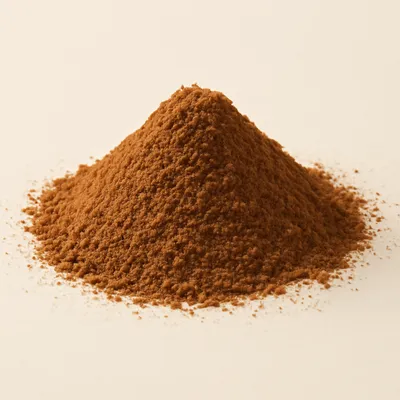
Combine 200g mung bean starch with 1 tsp five-spice powder, 1 tsp salt, and 50ml cold water; stir until completely dissolved and lump-free.
- 25 min
Bring 500ml water to a rolling boil in a pot; pour the starch mixture in a thin, steady stream while stirring constantly until the paste turns thick and translucent.
Watch outPour the starch slurry into the boiling water in a thin stream while stirring constantly until thick and translucent — dump it in and it clumps into lumps.
- 320 min
Pour the paste into a lightly oiled loaf tin, smooth the surface, and steam over high heat for 20 minutes until fully set and opaque throughout.
- 4120 min
Remove from the steamer, cool to room temperature, then refrigerate uncovered for at least 2 hours until the block is completely firm.
Watch outChill the block until completely firm before slicing — a soft warm block won't cut clean or hold together in the pan.
- 55 min
Unmold and cut into slices approximately 5mm thick.
- 63 min
Heat 2 tbsp lard in a flat-bottomed pan over medium heat; arrange slices in a single layer and fry undisturbed for 3 minutes until the underside blisters and turns golden.
Watch outFry undisturbed until the underside blisters and turns golden — moving it too soon tears the surface before the crust forms.
- 73 min
Flip and fry the second side for 2–3 minutes until equally crisp and blistered.
- 82 min
Serve immediately with garlic water (crushed garlic mixed with a pinch of salt and cold water) and rice vinegar on the side.
Archive tool suggestions — not reviewed
These legacy suggestions have not been evidence-reviewed and are not presented as required tools.


