A Teochew street staple of steamed glutinous rice slab, sliced into rectangles and pan-fried in pork lard until golden-crisp, then topped with lard-stir-fried salted dried radish and garlic. 'Zhu lo' is Teochew for 'lard,' naming both the cooking medium and the waxy-white, translucent look of the uncooked cake. Also sold as 豆糕粿 when mung beans are pressed into the surface before steaming.

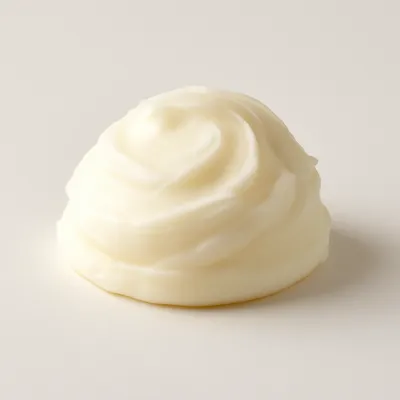



猪朥粿 is among the oldest and most elementary of Teochew rice snacks, originating from the practice of using surplus rice milk (米浆) produced when grinding grain for other preparations. For centuries it has been sold from push carts in the morning markets of Chaozhou and Shantou. The name — Teochew 'zhu lo gue' — describes both the lard used in finishing and the waxy, white appearance of the set cake, which resembles solidified pig fat. The accompanying 菜脯 (salted dried radish) topping became the signature pairing because it was affordable, shelf-stable, and kept in every Teochew household as a year-round condiment. The two elements — neutral starch body and aggressively savory topping — embody the Teochew aesthetic of contrast within simplicity.
A crisp golden crust shatters to reveal dense, chewy glutinous interior; the salty-caramelized radish and sharp garlic cut through the neutral starchiness, and lard leaves a round, savory finish on the palate.
Glutinous rice flour is composed almost entirely of amylopectin, whose densely branched molecular structure creates a cohesive, elastic gel upon gelatinization. Unlike regular rice starch, amylopectin is slow to retrograde — the cake stays cohesively chewy rather than crumbling after cooling. Pan-frying in lard (smoke point approximately 190°C) at medium heat rapidly dehydrates the surface, triggering Maillard browning to create a golden crust, while the amylopectin-rich interior retains its characteristic sticky-soft texture. Lard's high saturated-fat content and its lipid crystallization at room temperature coat the mouth with a clean, round richness distinct from vegetable oils.
Variations
豆糕粿: cooked mung beans pressed into the surface of the batter before steaming, adding nutty depth and visual texture. A sweeter dessert variant stirs sugar into the batter and serves without the radish topping. Salted egg yolk crumbled into the batter before steaming produces a richer, more saline cake.
On the Palate
Where Lard-Fried Sticky Rice Cake sits in the Chinese flavor cloud
Ingredients
Serves 4How it's made
8 steps · 20 min
- 115 min
Soak 50 g mung beans in cold water for 1 hour, then simmer in fresh water for 15 minutes until just tender but not mushy. Drain and set aside.
- 23 min
Whisk 200 g glutinous rice flour with 300 ml cold water and ½ tsp salt until completely smooth and lump-free.
- 33 min
Grease a 20 cm round or square baking pan with lard. Pour in the batter; scatter cooked mung beans evenly over the surface.
- 425 min
Steam over high heat for 25 minutes until the batter is fully set and no longer opaque. A skewer inserted in the center should come out clean.
Watch outSteam until the slab turns from milky to no longer opaque and a skewer comes out clean — pull it early and the center stays raw, gummy paste.
- 525 min
Remove from steamer; cool at room temperature for 25 minutes until the slab is firm enough to slice cleanly.
Watch outLet it cool and firm right down before slicing — cut it warm and the soft cake tears and smears instead of holding clean edges.
- 65 min
Cut the slab into rectangles approximately 4 × 6 cm and 1.5 cm thick.
- 78 min
Heat 3 tbsp lard in a cast-iron or heavy non-stick pan over medium heat. Fry the slices for 3–4 minutes per side until golden-crisp on both surfaces.
Watch outDon't flip until a hard golden crust has set on the base — nudge it too soon and the sticky cake grabs the pan and pulls apart.
- 83 min
In a separate small pan, heat 1 tbsp lard over medium heat; stir-fry 60 g finely diced salted dried radish and 2 cloves minced garlic for 3 minutes until fragrant and lightly caramelized. Spoon over the fried cakes and serve immediately.
Archive tool suggestions — not reviewed
These legacy suggestions have not been evidence-reviewed and are not presented as required tools.