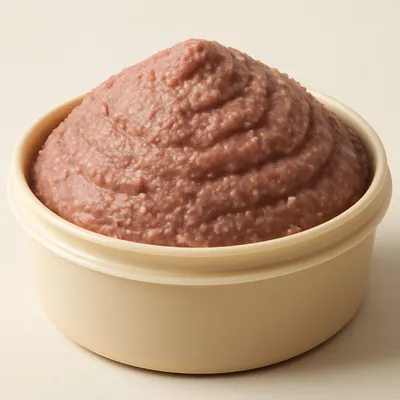
A fisherman's pairing from the Dalian coast: dry-salted sea fish soaked and pan-fried until crackling, served beside thick cornmeal cakes whose scorched underside shatters at the first bite. A small dish of fermented shrimp paste completes the table.




Before refrigeration reached the Liaoning coast, fishing fleets relied on dry-salting to preserve each autumn's catch through the long northeastern winter. Fatty sea fish — pomfret, yellow croaker, and smaller mackerel — were packed in coarse salt immediately after landing and stored in clay jars. Corn (maize) entered China via Silk Road and maritime trade routes around the mid-Ming dynasty (16th century) and by the Qing era had become a primary grain of the northeastern plains. The combination was pure practicality: two pantry-stable staples that kept without refrigeration and sustained fishermen through ice-season months. The pairing survived refrigeration's arrival not as hardship food but as a nostalgic fixture — Dalian market stalls still sell it for roughly fifteen yuan a plate, its salt-and-starch logic as satisfying as it was three centuries ago.
The fish has a crackling, caramelized exterior that gives way to moist, intensely savory flesh — saltier and more concentrated than fresh fish, with a depth that only curing can produce. The cornmeal cake is dense and gently sweet, its charred underside absorbing every drop of brine that leaks from the fish.
Dry-salting draws moisture from the fish through osmosis, concentrating proteins, fats, and free amino acids (particularly glutamate) while suppressing bacterial growth. Prolonged curing also activates the fish's own endogenous cathepsin enzymes, which slowly hydrolyze muscle proteins into free amino acids and flavour-active peptides — deepening umami far beyond that of fresh fish. During pan-frying, the concentrated free amino acids and residual sugars undergo Maillard reactions at the fish's surface, generating hundreds of aromatic volatile compounds that account for the characteristic crackling crust. On the griddle, the cornmeal's starch gelatinizes and traps steam within the cake body while the underside undergoes caramelization, forming the signature 嘎巴 (crispy bottom crust).
Variations
Yellow croaker version (黄花鱼饼子): salt-cured yellow croaker has a more delicate flavour and finer flesh than heavier saltfish, making a gentler pairing. Cold-smoked saltfish variant: some Dalian fishing families cold-smoke the cured fish after the initial salting, adding a woodsy layer on top of the brine.
On the Palate
Where Salt Fish with Cornmeal Cake sits in the Chinese flavor cloud
Ingredients
Serves 2
How it's made
7 steps · 40 min active + 1 hour waiting
- 160 min
Rinse the salt-cured fish under cold running water; submerge in fresh water and soak for 1 hour, changing the water once halfway, to reduce the salt to a palatable level. Pat thoroughly dry.
Watch outSoak the salt fish an hour, changing the water once, and taste before you stop — too salty and no cooking saves it, too soaked and the flavour's gone.
- 23 min
Score the fish skin diagonally on both sides at 2 cm intervals — this prevents the skin from curling during frying and helps heat penetrate to the bone.
- 310 min
Mix yellow cornmeal with a small handful of all-purpose flour, a pinch of salt, and enough warm water to form a firm, just-moldable dough; shape into thick oval cakes about 1.5 cm deep.
- 413 min
Heat a cast-iron pan or flat griddle over medium heat; brush lightly with oil. Lay the cornmeal cakes flat, cover with a lid, and cook for 8 minutes until the bottom turns deep golden. Flip once; cook uncovered for 5 more minutes until both sides are set.
- 54 min
Remove the cakes; increase heat to medium-high. Add a thin layer of oil and place the fish skin-side down; press gently with a spatula for the first 2 minutes to ensure full contact. Fry 3 minutes until the skin is crackling.
Watch outLay the fish skin-down and press the first two minutes so it fully contacts the pan; fry until the skin crackles before you flip.
- 65 min
Flip the fish and reduce heat slightly; cook for 4 minutes until the flesh is just cooked through. In the final minute, splash a little rice wine around the edge of the pan to lift the fond and add fragrance.
- 75 min
Plate the fish beside the cornmeal cakes; serve with a small dish of fermented shrimp paste (虾酱) for dipping.


