Fist-sized chunks of free-range high-altitude pork (or beef) boiled in mountain spring water and eaten with bare hands — the only seasoning a pinch of highland chili, Sichuan pepper powder, and wood ginger. The Yi call the dish 色觉泽菩 (sè jué zé pú) in their own language, meaning 'pork chunks,' and have served it at every wedding, funeral, and ancestor rite for centuries. Nothing is cut smaller. Nothing is dressed further. The pig does all the talking.



The Yi people's ancient oral epic Chamu (查姆) contains passages describing the mythic transition from raw to cooked food — oral tradition recounts how fire lit beneath a stone brought water to the boil, and how fruits placed in that boiling water became cooked. This origin narrative places the boiling of food at the centre of Yi cultural identity — and the tradition of cooking meat in large, uncut chunks has remained unchanged. The preferred animal is the Liangshan Wujin (乌金) black pig, a highland breed raised at 1,500–2,500 metres in the Liangshan mountains of Sichuan and across Yunnan's Chuxiong and Honghe prefectures. Centuries of high-altitude free-range grazing have given the Wujin pig a fine, even fat distribution through the lean muscle that survives hard boiling without becoming greasy. The dish spans the entire Yi diaspora — Liangshan (Sichuan), Chuxiong, and Honghe (Yunnan) — with minor regional differences in which animal is used (nursing piglet, grown pig, sheep, bull), but the technique is invariant. The governing social code is equally strict: at the highest funeral ritual, the 打牛 ceremony, an entire bull is slaughtered and its beef tuotuorou distributed according to Yi social hierarchy — liver and heart to elders, the head to the senior male of the guest household, legs to children. If there is not enough, adults drink only the clear broth.
Each piece is the size of a closed fist — you pick it up with both hands. The skin is tight and faintly tacky, the fat rendered to something translucent and yielding. The chili powder lands on the back of the palate with a dry, highland burn; the wood ginger adds a citrus-pine ghost that lingers long after you swallow. Underneath, the pork itself is clean, direct, and deeply sweet — this is a pig that ate cold air and mountain grass. No distractions, no ornament. Eating tuotuorou is an act of trust in the animal.
Cold-water starting is the critical technical choice: placing meat in cold rather than boiling water allows connective tissue collagen to denature slowly and evenly over 30–35 minutes, producing uniformly tender texture throughout each large chunk. Starting in boiling water contracts surface myosin proteins immediately, trapping moisture inside a rubbery shell while leaving the interior underdone. The skin — dense in type-I structural collagen — gelatinises fully into silky, lip-sticking gelatin during the long simmer. Wood ginger (木姜子, Litsea cubeba) contains citral and linalool, terpenoid volatiles also present in lemongrass and bergamot; these heat-labile compounds vaporise instantly on the hot meat surface, masking the animal's deeper barnyard notes with a citrus-pine brightness. The combination of dry highland chili's capsaicin burn against litsea's cool citrus creates a layered sensory push-pull that makes an otherwise stark preparation feel complex.
Variations
Piglet tuotuorou (崽猪坨坨肉): made from a nursing piglet — the skin is paper-thin, the fat barely set, the flesh almost milky. Considered the most prized and expensive version; reserved for the most honoured guests. Beef tuotuorou (牛肉坨坨): reserved for the 打牛 mourning ceremony; the clear bone broth becomes a secondary course, drunk with highland wild herbs. Roasted version: after boiling, the chunks are skewered and seared over pine-branch embers for extra smokiness — the hunter's version from mountain camps where salt is the only seasoning.
On the Palate
Where Yi Chunky Boiled Meat sits in the Chinese flavor cloud
Ingredients
Serves 4How it's made
7 steps · 10 min
- 15 min
Select bone-in free-range pork with skin (belly slab or shoulder), skin on. Cut into 8–10 cm fist-sized chunks across the grain, keeping bone in — do not remove the skin.
- 22 min
Place all pork chunks in a large pot; cover generously with cold water (do not use hot or boiling water). The cold start is essential for even texture.
Watch outStart the pork in cold water, not hot — the cold start lets the collagen soften slowly and evenly so the big chunks cook tender all the way through.
- 35 min
Bring to a vigorous boil over high heat; skim the foam and grey blood residue thoroughly as it rises — this is the only cleaning step.
- 433 min
Reduce to a firm simmer; cook uncovered for 30–35 minutes until the skin turns fully translucent and a chopstick pressed into the thickest part meets only slight resistance.
Watch outSimmer 30–35 minutes until the skin turns fully translucent and a chopstick meets only slight resistance at the thickest part — that's the doneness mark.
- 53 min
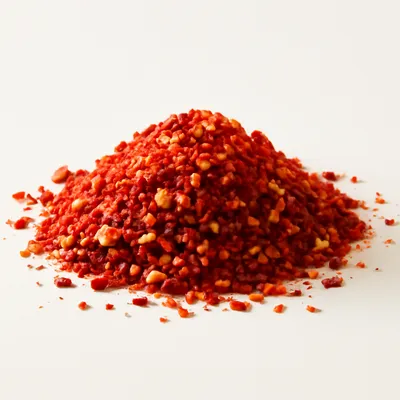
While the meat simmers, toast dried highland chili flakes in a dry pan over medium heat for 60 seconds until fragrant. Combine with Sichuan pepper powder and wood ginger (木姜子) powder in a small bowl.
- 62 min
Lift chunks from the pot with tongs; arrange in a wide bamboo winnowing basket or deep platter. Sprinkle the spice mix immediately over the hot meat so rising steam carries the aromatics into the surface.
Watch outSprinkle the spice mix over the meat the moment it's lifted out — the rising steam carries the aromatics into the surface, so don't let it cool first.
- 75 min
Bring to the table while steam is still rising; guests eat directly with their hands. Ladle the clear broth into bowls separately — it is drunk alongside the meat as a plain soup.
Archive tool suggestions — not reviewed
These legacy suggestions have not been evidence-reviewed and are not presented as required tools.