
A chilled rice pudding set soft and eaten under brown-sugar syrup, the signature summer sweet of Yibin in southern Sichuan. Long-grain rice is soaked, ground to a milk, cooked to a thick paste, set with a trace of food-grade limewater, then cooled in bowls until it firms into a pale, tender block. Turned out and flooded with thick brown-sugar syrup, it is smooth, cool and lightly sweet, eaten by the spoonful to beat the heat. With bingfen and liangxia it makes the Sichuan-Chongqing "summer three."


Liang gao is most strongly tied to Shuanghe in Yibin, southern Sichuan, where it has been made for over a century with the water of the Grape Well (Putao Jing) — a spring whose stone surround dates to the eighth year of the Tongzhi reign, 1869 — and the craft, "Shuanghe liang gao making technique," is listed as a provincial intangible cultural heritage of Sichuan. The well's water is the point: it holds a constant temperature around 16 degrees Celsius and is naturally rich in calcium hydroxide, the very thing that sets the rice paste, so the local sweet and the local spring are bound together. Pinning a precise founding date beyond the well is not honest; what is documented is the long Shuanghe lineage and its protected-heritage status. The dish later spread across Yibin and the wider Sichuan-Chongqing region as a street sweet for the hot months.
Turned out of the bowl it stands in a pale, faintly trembling block, smoother and denser than jelly, softer than any steamed cake. The spoon parts it cleanly and it nearly melts on the tongue, cool and milky with the gentle savor of rice. Over it runs dark brown-sugar syrup, thick and caramel-toned, and that is most of the sweetness — the cake itself is barely sweet. Served straight from cold spring water or the fridge, the whole pleasure is its cold, slippery softness against the summer heat.
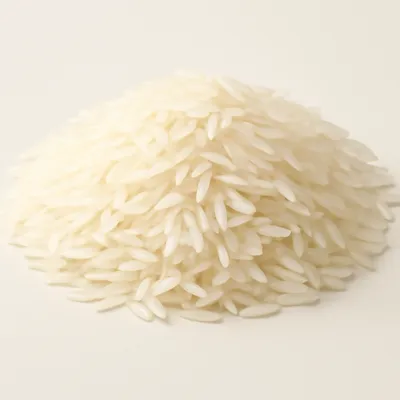
The base is long-grain rice, not glutinous, because its lower stickiness gives the clean, sliceable softness wanted; cooking the rice milk gelatinizes the starch, the granules swelling and bursting into a thick colloidal paste. The setting agent is the trick, and it is the same chemistry as bingfen run on a different base: a trace of food-grade limewater supplies calcium ions, which bridge the free carboxyl groups on the rice's pectin-like polysaccharides into an "egg-box" cross-linked network, locking water into a gel so the paste firms into a tender, cohesive block as it cools, while the alkali also neutralizes the rice's faint sourness. Too little and it will not set; too much turns it chalky and faintly bitter, so only the clear settled water above the slaked lime is used. Note this is not the same as bingfen, whose pectin is rubbed cold from apple-of-Peru seeds and never cooked, nor liangxia, the same rice milk dropped through a ladle into droplets; some modern shops set liang gao instead with gypsum or with added starch or agar.
Variations
The classic serving is plain liang gao under brown-sugar syrup, often from the Grape Well at Shuanghe; shops dress it up with mashed red bean, raisin, peanut, sesame, osmanthus or rose syrup, and pair it in a bowl with its summer kin. The setting agent varies with the era: the documented Yibin tradition is limewater, while modern kitchens may set it with gypsum or with starch or agar for convenience. It is worth keeping the cold-sweet family apart: bingfen is a clear jelly set cold from apple-of-Peru seed pectin and calcium, not cooked; liangxia is the same rice milk pushed through a ladle into little shrimp-shaped droplets; liangfen is a savory starch gel cut into strips. Liang gao is the cooked rice milk set into soft blocks — distinct from all three.
On the Palate
Where Liang Gao sits in the Chinese flavor cloud
Ingredients
Serves 4How it's made
7 steps · 40 min active + 4 hours 20 min waiting
- 1240 min
Rinse long-grain rice and soak it until a grain crushes easily between the fingers, several hours or overnight.
- 212 min
Prepare the limewater: stir a little food-grade slaked lime into water, let it settle, and reserve only the clear liquid on top.
- 310 min
Grind the soaked rice with fresh water to a fine, smooth milk.
- 425 min
Cook the rice milk over low heat, stirring constantly so it does not catch, until it thickens to a paste about three-quarters cooked.
Watch outCook the rice milk on low, stirring constantly so it never catches, until it thickens to a three-quarters-done paste — let it scorch on the bottom and the whole batch tastes burnt.
- 520 min
Stir in the clear limewater in two or three additions, then keep stirring on low heat until the paste is glossy and fully cooked.
Watch outStir the clear limewater in a little at a time — the calcium is what cross-links the starch into a tender set block; add too much and it turns bitter and hard.
- 68 min
Ladle at once into bowls or a tray and leave to cool and firm into a tender block.
- 7240 min
Chill in cold spring water or the fridge, turn out, and flood with thick brown-sugar syrup to serve.
Archive tool suggestions — not reviewed
These legacy suggestions have not been evidence-reviewed and are not presented as required tools.


