A highland Zhuang specialty from Debao County in Guangxi's Baise region — pig blood blended with rice batter and local star anise powder, stuffed into cleaned small intestines, slow-simmered until set, then sliced and pan-fried until the exterior blisters into a brittle crust over a dark, silky custard interior.


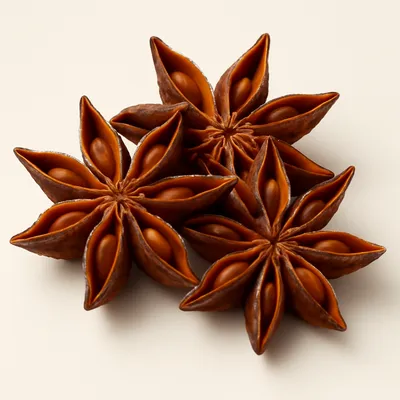


Debao County (historically called Tianbao) sits at the southern fringe of the Yunnan-Guizhou Plateau in Baise and is one of China's foremost star anise producing regions — celebrated by the saying that 'without Tianbao fennel oil, Paris perfumes would be less fragrant.' Blood sausage entered the local banquet table as a way to make full use of the pig at festivals and year-end slaughter, a cultural imperative in resource-limited highland communities. The exact founder and date are unrecorded; one account holds that the Qing-dynasty origins trace back to an accidental mixture of fresh blood into sausage casing. The preparation technique is locally celebrated as a hallmark of Debao's distinctive culinary identity.
The crust shatters at first bite with a faint caramel crackle; inside, the blood-and-rice custard is dense and deeply savoury, warmed by star anise and white pepper, with a lingering iron-sweetness that fades into mild rice starch.
Mixing rice batter and blood at 80:20 creates a two-phase gel system: as temperature rises toward 70°C, amylopectin in the rice starches gelatinises, forming a network that traps haemoglobin molecules. Continued heating to 80°C denatures the haemoglobin into a solid matrix — the characteristic firm-yet-yielding blood custard. Pan-frying then raises the surface above 150°C, triggering Maillard reactions between amino acids in the blood proteins and reducing sugars in the rice starch, generating pyrazines and furans responsible for the caramel-brown crust and roasted aroma.
Variations
Some Debao households substitute a portion of the rice batter with corn flour for extra crunch; others fold in minced pork fat for richness. A charcoal-grilled variant exists in rural villages where whole sausages are held over open fire until the skin splits open.
On the Palate
Where Baise Debao Blood Sausage sits in the Chinese flavor cloud
Ingredients
Serves 4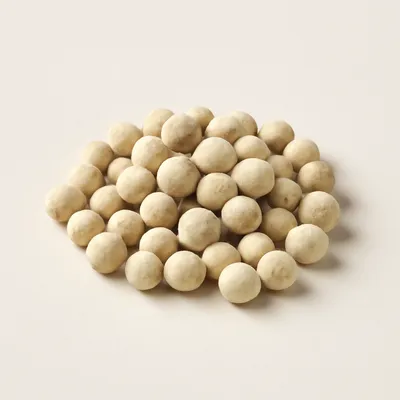

How it's made
6 steps · 30 min
- 14 min
Soak 200g long-grain rice in cold water for 3–4 hours, drain, and grind to a smooth batter. Combine with 50g fresh pig blood and mix vigorously. Season with 1g star anise powder, ½ tsp white pepper, 1 tsp salt, 1 tsp melted pork lard, and 2 tbsp sliced scallion.
- 25 min
Rinse 400g pork small intestine under cold running water inside and out. Rub thoroughly with 1 tbsp flour and 1 tbsp white vinegar to remove odour, then rinse clean and drain.
- 35 min
Cut intestines into 15cm segments and knot one end. Use a funnel to fill each segment with the rice-blood batter, leaving 2cm of space at the top. Knot the open end tightly — the batter expands during cooking.
Watch outLeave two centimetres of slack and knot the ends tight — the rice-blood batter swells as it cooks and a full, loose casing bursts.
- 430 min
Place stuffed sausages in a pot of cold water. Bring slowly to a gentle simmer (approximately 90°C) over medium-low heat. Maintain this temperature without a rolling boil and cook for 30 minutes, turning occasionally. Remove and cool to room temperature.
Watch outHold the water at a gentle ninety-degree simmer, never a rolling boil — a hard boil splits the casings before the blood custard sets.
- 56 min
Slice cooled sausages into rounds about 1cm thick. Heat 2 tbsp cooking oil in a flat-bottomed pan over medium-high heat. Pan-fry the rounds until both sides are deep golden-brown and crispy, about 2–3 minutes per side.
Watch outPan-fry the rounds until both sides are deep golden and crisp — that seared crust against the silky interior is the whole point.
- 62 min
Transfer to a warm plate, garnish with sliced fresh chili, and serve immediately while the contrast between the crispy shell and silky interior is at its best.

