




Cornish saffron cake is a distinctive sweet bread of Cornwall, where saffron has been used in baking since the medieval period, when the spice reached the county through its Atlantic trade links with Spain and the Mediterranean. Cornwall's position on the trade routes made saffron more available there than in much of inland England, and the spice coloured and flavoured the rich yeasted fruit loaves baked for feasts and teatime. The cake is a slow-risen enriched dough of flour, butter, milk and eggs, deeply coloured and aromatically flavoured with a strong infusion of saffron, and studded with currants, raisins and chopped citron or candied peel. The closely related saffron bun, smaller and shaped into rounds, is the Cornish 'tea treat bun', baked for Methodist chapel tea meetings in the 19th century. The saffron gives both the colour and a hay-and-honey flavour that defines the bake.
A dense, golden-yellow crumb, fragrant with saffron's hay-and-honey note, sweet and buttery, flecked with currants and chewy citron peel. Eaten in slices with butter, or toasted, with a cup of tea.
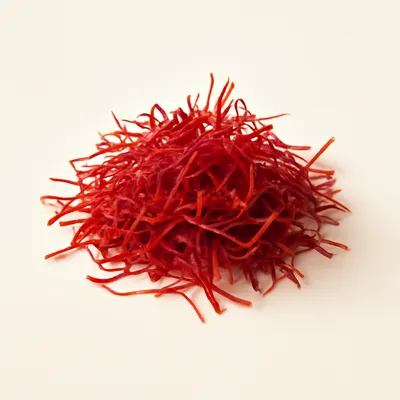
The defining technique is the saffron infusion. A generous quantity of saffron threads, more than would be used in savoury cooking, is steeped in hot, just-boiled milk for at least 30 minutes, sometimes overnight, to draw out the maximum colour and the volatile aroma compounds. This golden milk goes into an enriched dough of strong flour, butter, sugar and eggs, risen slowly with yeast, with currants and candied peel folded in. The saffron's carotenoid pigments colour the crumb deep yellow, and its compounds, picrocrocin and safranal, give the hay-honey flavour. The dough is proved twice for a light but close texture, then baked as a round or in a tin at around 180 degrees C. The cake keeps and improves for a few days as the saffron flavour permeates, and is traditionally sliced and buttered.
Variations
The saffron bun is the smaller, round individual version, often with a cross scored on top. Some recipes add a little mixed spice or nutmeg. Devon and Cornwall versions differ slightly in sweetness and fruit content.
On the Palate
Where Cornish Saffron Cake sits in the British flavor cloud
Ingredients
Serves 10

How it's made
7 steps · 30 min
- 15 min
Steep 1 tsp crumbled saffron threads in 200ml hot just-boiled milk for 30 minutes until deep golden; cool to lukewarm.
Watch outSteep the saffron in just-boiled milk thirty minutes until it's deep golden — this draws out the color and hay-honey aroma that define the cake; a quick steep gives a pale, flavorless crumb.
- 24 min
Mix 500g strong white flour with 1 tsp salt, 75g caster sugar and 7g instant yeast; rub in 75g softened butter.
- 38 min
Add the saffron milk and 1 beaten egg, mix to a soft dough, then knead 8 minutes until smooth and elastic.
- 46 min
Work in 200g currants and 50g chopped candied peel; prove in an oiled bowl for 1.5 hours until doubled.
Watch outProve in an oiled bowl until doubled, about ninety minutes — an enriched, fruit-heavy dough rises slowly, so wait for real volume or the cake bakes up dense.
- 55 min
Knock back, shape into a round, place on a lined baking sheet, cover and prove 45 minutes until puffy.
- 68 min
Bake at 180 degrees C for 35 to 40 minutes until golden and hollow-sounding underneath; brush with a little warm milk for a soft crust.
Watch outIt's done when it's golden and sounds hollow tapped underneath — brush a little warm milk over the top straight from the oven for a soft crust.
- 73 min
Cool on a wire rack; slice and serve buttered.
Archive tool suggestions — not reviewed
These legacy suggestions have not been evidence-reviewed and are not presented as required tools.


