Pig trotters from Wanluan township in Pingtung, ice-water-plunged before braising in soy and herbs so the skin turns chewy and crisp-edged, the meat tender. A southern-Taiwan specialty credited to a Fuzhou-born cook who settled there in 1947.
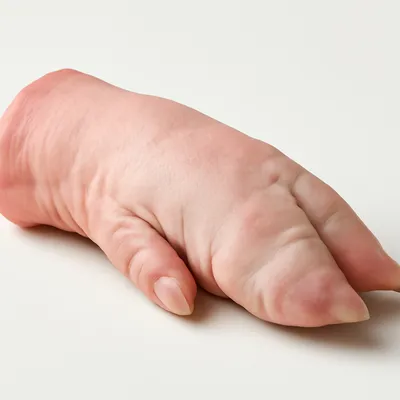





Wanluan pig trotters, wan luan zhu jiao, is a specialty of Wanluan township in Pingtung county, the deep south of Taiwan. It is traditionally credited to Wang Yi-ti, a Fuzhou-born cook who settled in Wanluan around 1948 and opened a diner where he braised pork knuckles; the Lin family's Hai-hong restaurant, founded around 1949, and other local families then spread the dish, which was later made nationally famous by visiting politicians. The technique that distinguishes Wanluan trotters is the ice-water plunge, the cleaned trotters are plunged into ice water before braising, which tightens the skin and gives it a uniquely chewy, slightly crisp texture that holds even after the long braise. The trotters are then braised for hours in a master stock of soy sauce, rock sugar, rice wine and a herbal bundle of star anise, cinnamon, fennel, licorice and angelica, the meat turning tender while the skin keeps its bounce. Sliced and served with a sweet-savoury garlic-soy dip, often with thin vermicelli, Wanluan pig trotters became the edible souvenir of Pingtung.
Slices of braised trotter with a chewy, gelatinous, slightly crisp-edged skin and tender, soy-and-herb-perfumed meat beneath, dipped in a sweet-savoury garlic soy sauce. The skin is the pleasure, bouncy and gelatinous; eaten with vermicelli to soak the sauce.
The defining technique is the ice-water plunge before braising. Cleaned pig trotters are blanched, drained, and immediately plunged into a bath of ice water, the rapid chilling tightening and firming the skin's collagen so it sets with a chewy, slightly crisp texture that survives the long braise without turning soft and falling apart. The plunged trotters are then braised for 2 to 3 hours in a master stock of soy sauce, rock sugar, rice wine and an aromatic bundle of star anise, cinnamon, fennel, licorice, dried citrus peel and angelica, the slow braise tenderising the meat and flavouring it through while the skin keeps its distinctive bounce, the cold-set collagen holding its structure. The trotters are rested in the stock to absorb flavour, then sliced and served with a dip of soy sauce, garlic paste, sugar and a little rice vinegar, the garlic essential to cut the richness of the skin. Thin vermicelli, often served alongside, soaks up the braising liquid. The ice-plunge-then-braise is the only way to get the Wanluan texture, simple braising gives a soft, falling-apart trotter instead.
Variations
Some versions add dong-quai for a deeper herbal note. The dip is sometimes made with chili. Cold sliced trotters are served as a cold dish with the dip.
On the Palate
Where Wanluan Pig Trotters sits in the Taiwanese flavor cloud
Ingredients
Serves 8How it's made
5 steps · 30 min
- 18 min
Clean and blanch 4 pig trotters in boiling water for 5 minutes; drain and plunge at once into a bowl of ice water for 10 minutes.
Watch outPlunge the blanched trotters straight into ice water — the shock tightens the skin's collagen so it stays springy and doesn't fall apart in the long braise.
- 25 min
In a large pot, combine 200ml soy sauce, 50g rock sugar, 100ml rice wine, 2 litres water, and a herbal bundle of 3 star anise, 1 cinnamon stick, 1 tsp fennel, 1 tsp licorice root and 1 slice dried tangerine peel.
- 38 min
Add the trotters, bring to a boil, skim, then simmer gently for 2.5 to 3 hours until the meat is tender but the skin still holds its bounce.
Watch outSimmer gently, never boil — a rolling boil turns the skin flabby and the meat off the bone before the braise flavours it.
- 45 min
Rest the trotters in the stock off the heat for 30 minutes; lift out and slice.
- 54 min
Mix the dip: 3 tbsp soy sauce, 1 tsp sugar, 1 tbsp rice vinegar and 1 tsp minced garlic; serve with the sliced trotters and thin vermicelli.
Archive tool suggestions — not reviewed
These legacy suggestions have not been evidence-reviewed and are not presented as required tools.

