



From Yongzhou in the south of Hunan. Native histories trace the blood-duck technique to Jiangxi migrants who carried it across the Luoxiao mountains into Hunan; the dish's documented origin legends are tied to the Song patriot Wen Tianxiang (1276), to Hong Xiuquan's Taiping army taking Yongzhou, and to a retired Ming imperial cook. The dish is locked to the region — outside Yongzhou it's mostly served by transplants. The best-known legend ties it to Hong Xiuquan's Taiping troops feasting after capturing Yongzhou — a cook hid un-plucked down by stirring raw blood into the duck — but the technique spread along the route of Jiangxi-to-Hunan Han migration, with blood-duck cousins in Youxian, Chaling, Hengdong, Shaoyang and Chenzhou.
Yongzhou specialty from southern Hunan; Tang-dynasty records mention duck cooked in its own blood. The wok comes off the heat before the blood goes in — residual ~80°C denatures albumin without scrambling it into liver curds. Salt and rice wine in the collection bowl stop fibrin clotting.
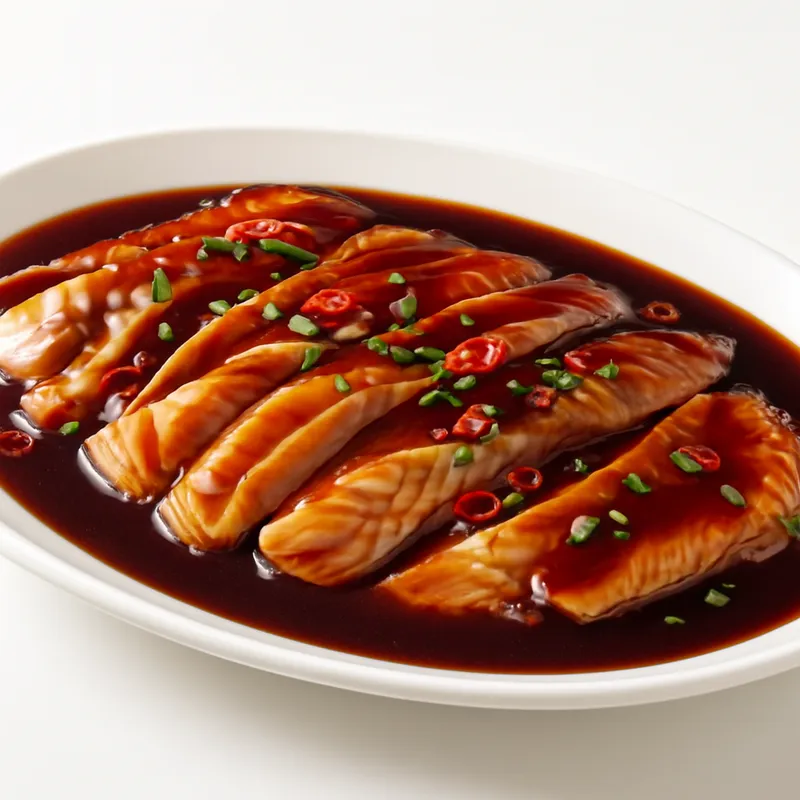
Dark, glossy duck pieces under a sauce so reduced it looks lacquered. The blood reads not as iron but as depth — it rounds out the chile heat and the rice-vinegar sharpness, the way demi-glace rounds a French sauce. You bite through crisp browned skin, render-soft fat, then meat that fell off the bone twenty minutes ago. Ferocious with cold beer and white rice. Polarizing if you're not used to it; canonical in Yongzhou.
The blood is plasma plus suspended cells — when you add it off the heat to a hot pan, the residual ~80°C is enough to denature albumin and bind the sauce, but not so hot it scrambles into liver-textured curds. That's why the wok comes off the burner first. Salt and rice wine in the collection bowl prevent fibrin from clotting in the 20 minutes between slaughter and finish; without them you can't pour the blood at all.
Variations
Yongzhou city version runs heavier on chili and garlic; Yao mountain villages keep it plainer with just salt and rice wine; Changsha restaurant adaptations dial down the blood for outsiders and miss the point.
On the Palate
Where Yongzhou Blood Duck sits in the Chinese flavor cloud
Ingredients
Serves 4


How it's made
6 steps · 50 min active + 10 min waiting
- 15 min
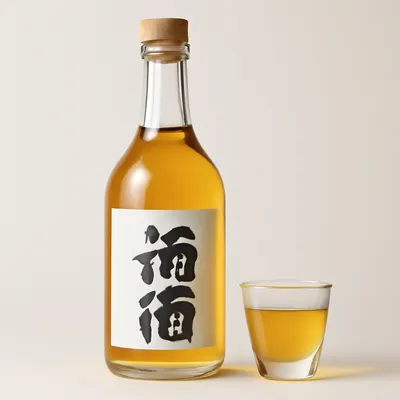
When slaughtering a 1.5kg fresh duck (or asking the butcher), collect the blood in a bowl with 30ml rice wine and 5g salt, stirring constantly so it doesn't clot. Cover and reserve at room temperature.
Watch outStir the blood the whole time you collect it — the salt and wine keep it pourable; the moment it starts to gel it's ruined for the glaze.
- 210 min
Chop the duck through the bone into 3cm pieces. Rinse briefly to remove bone shards. Pat dry — water in the wok ruins the sear.
Watch outEnsure the duck pieces are thoroughly dried to achieve a proper sear.
- 39 min
Heat 60ml oil in a heavy wok until smoking. Add ginger, garlic, dried chiles and the white parts of scallions. Add duck and stir-fry hard over high heat for 8 minutes — the skin must brown and the fat must render.
Watch outStir-fry the duck hard until the skin browns and the fat visibly renders out and pools — that rendered fat is where the flavor comes from; pale skin means keep going.
- 422 min
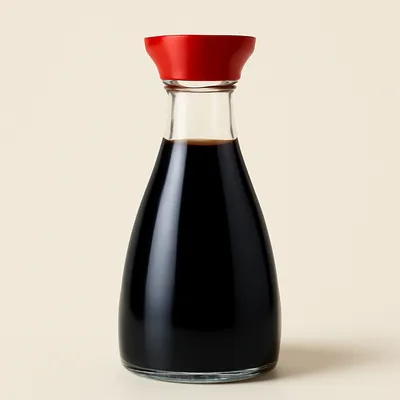
Splash in 60ml rice wine, then 2 tbsp light soy and 1 tbsp dark soy. Add 200ml hot water, fresh red and green chiles, a stick of bruised lemongrass and a bay leaf. Cover and simmer 20 minutes until duck is tender.
Watch outEnsure the water is hot to maintain the cooking temperature during braising.
- 54 min
Uncover, raise heat, reduce sauce until 4 tbsp remain in the wok. Add a splash of rice vinegar.
Watch outWatch the sauce closely to prevent it from reducing too much and becoming too salty.
- 62 min
Take wok off the heat. Stir the duck blood once and pour in slowly while tossing — it will set into a glossy mahogany glaze in 30 seconds. Do not return to high heat or it curdles. Scatter scallion greens and serve with rice.
Watch outPan off the heat, drizzle the blood in while tossing — it sets to a glossy mahogany glaze in about 30 seconds; put it back on high heat and it curdles into grainy curds.