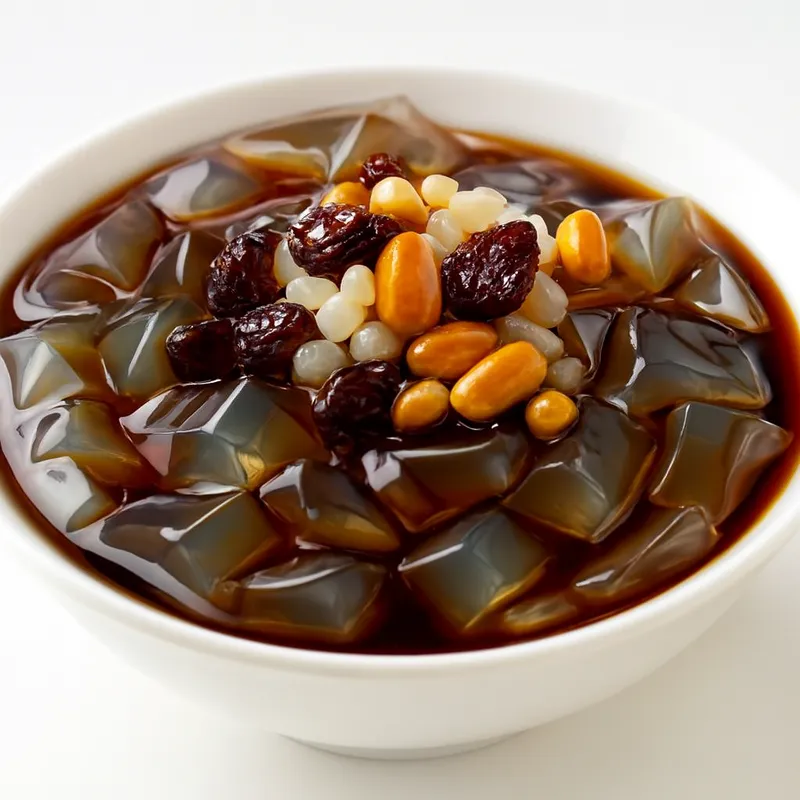
A bowl of clear, trembling jelly set from ice-jelly seeds, drowned in brown sugar syrup with peanuts, raisins and sago.
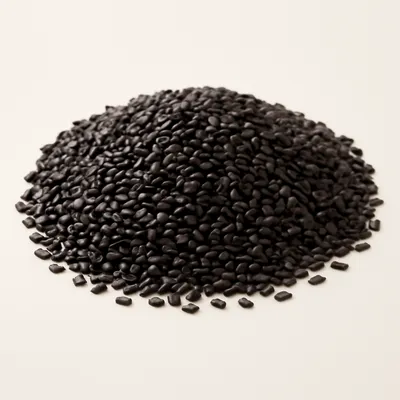




The seeds come from Nicandra physalodes, a wild lantern-fruit plant common across southwest China; the dish is generally traced to Pengshan (old name Wuyang) in Sichuan in the late-Ming/early-Qing period, where a woman named Wang Weiyuan is said to have discovered it after the fruit fell into a sachet that set into jelly when washed; Chengdu's street vendors later made it famous, and a similar version is eaten in Yunnan. The Yunnan version stays closer to the original — fewer toppings, sweeter syrup, a piece of raw ginger in the pot.
Lijiang street vendors made it from Nicandra physalodes seeds rubbed in cold mountain water long before Chengdu took the credit. The pectin gels only with calcium — 2 grams of food-grade lime to 1.5 liters. Skip it: cloudy water. Overdo it: tastes like plaster.
Spoon goes in and the jelly cleaves like cold glass — clear, almost weightless, the texture of a soft contact lens. Brown sugar hits first, then ginger warmth, then the crunch of peanuts and the chew of raisins underneath. It's eaten in summer at hutong-side stalls in Lijiang and Chengdu both. If the jelly tastes of anything besides cold water and syrup, it sat too long or had too much lime.
The setting agent is the trick: the polysaccharides in the seed coat (mostly pectin-like polygalacturonans) only gel in the presence of divalent calcium ions, which is why a pinch of food-grade lime water (calcium hydroxide) is mandatory. Skip it and you get cloudy water; add too much and the jelly turns chalky and tastes faintly of plaster. 2 grams to 1.5 liters is the line.
Variations
Lijiang version stays sweeter and adds raw ginger; Chengdu street tilts toward brown-sugar syrup with peanuts and raisins; modern Chengdu shops add red bean, mochi cubes and osmanthus.
On the Palate
Where Bingfen sits in the Chinese flavor cloud
Ingredients
Serves 4
How it's made
6 steps · 15 min active + 3 hours 45 min waiting
- 12 min
Place 30g ice-jelly seeds (冰粉籽, Nicandra physalodes) in a clean cloth bag. Submerge in 1.5L cold spring or filtered water at 20°C.
- 28 min
Knead the bag underwater for 8 minutes until the water turns slightly cloudy and viscous — a clear gel is releasing from the seeds. Discard the bag.
Watch outKnead the bag underwater until the water turns milky and feels slippery-thick between your fingers, about 8 minutes — that slick is the gel coming out; thin water means keep going.
- 32 min
Whisk in 2g food-grade calcium hydroxide (石灰水) dissolved in 30ml water. The liquid will start to set within 90 seconds. Pour gently into a flat tray.
Watch outStir the lime water in fast and pour right away — it starts setting within a minute and a half; measure it exactly, too much and the jelly goes chalky and tastes of plaster.
- 4180 min
Refrigerate at 4°C for at least 3 hours, ideally 4, until firm enough to hold a spoon mark but still wobbling.
Watch outChill until it holds a spoon mark but still trembles when you nudge the tray — set past that and it goes rubbery, short of it and it won't cube.
- 56 min
Make brown sugar syrup: simmer 100g dark brown sugar with 80ml water and a small piece of crushed ginger for 4 minutes until thick. Cool.
Watch outWatch the syrup closely to prevent burning as it thickens.
- 64 min
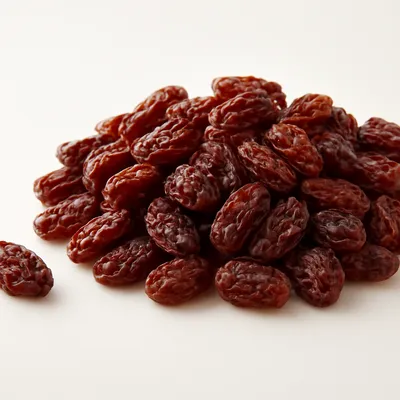
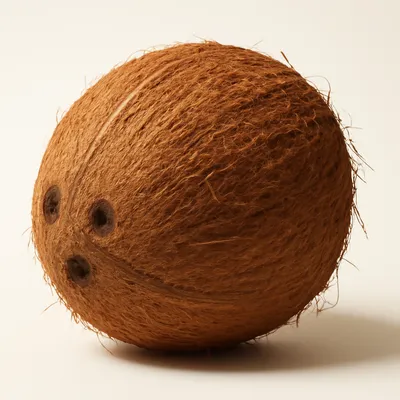
Cube the jelly with a spoon directly into bowls. Pour syrup over, scatter chopped peanuts, raisins, cooked sago and a little shredded coconut. Serve cold.
Archive tool suggestions — not reviewed
These legacy suggestions have not been evidence-reviewed and are not presented as required tools.


