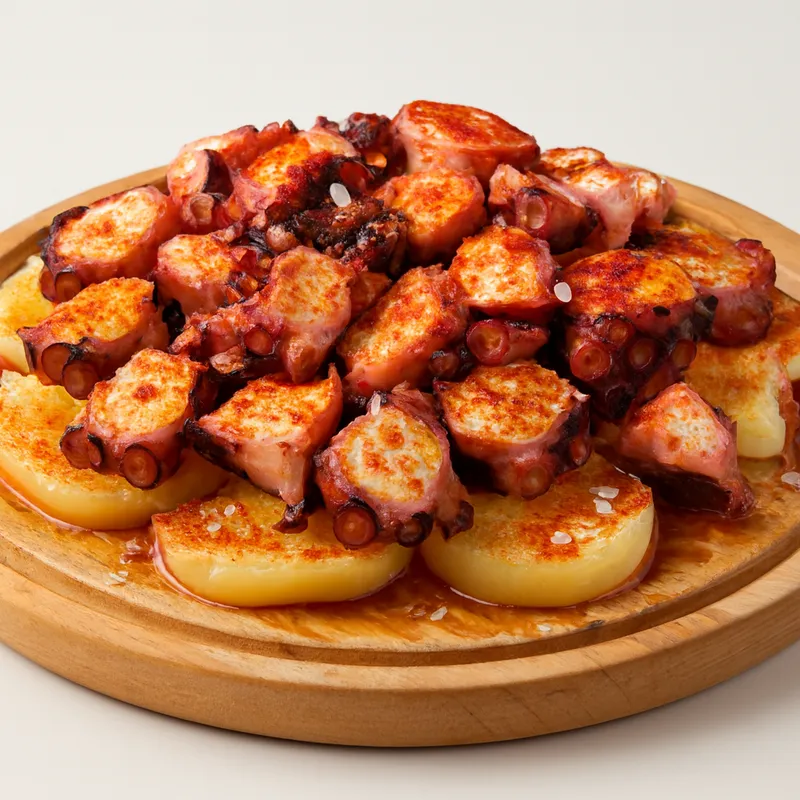
Small fried corn-flour griddle cakes from Asturias and Galicia, topped with chorizo, picadillo, or a fried egg — tavern snack eaten with the hands.






Tortos de maíz are pre-industrial Asturian and Galician peasant food — corn arrived in northwestern Spain in the 16th century from the Americas and rapidly displaced millet and rye in the wet, cool, acid-soiled regions where wheat struggled. Tortos were the daily staple of mountain villages, eaten with milk for breakfast or with cured pork at noon. The fried-and-topped tavern version emerged in 19th-century cider houses and remains the standard sidrería plate.
Pre-industrial mountain-village food from Asturias and Galicia — corn arrived in northwestern Spain in the 16th century and rapidly displaced millet in the wet acid-soiled regions. Wheat flour goes in at 20-25% just for cohesion; the 10-minute rest lets the corn starch granules absorb water and partially gelatinize so the cake puffs.
A round of fried corn no bigger than your palm, edges rough, surface blistered with deep-gold pockets. Bite through and the outside is crisp like a fresh tortilla chip; the inside is soft, faintly sweet, slightly chewy from the cornmeal. The chorizo on top is rust-red and oily, the egg yolk breaks and runs into the corn. You eat them with your hands, the way they're served in sidrerías. Stale tortos are leather; fresh ones are airy.
Cornmeal contains no gluten, so wheat flour is added at 20-25% just to give the dough cohesion when rolled. The 10-minute rest is non-negotiable: corn starch granules need that time to absorb water and gelatinize partially when fried, which is what makes the torto puff. Frying at 175°C drives water out of the surface in steam (the puff) before the interior dries — at lower temperatures the cake just absorbs oil.
Variations
Sidrería standard with chorizo and fried egg; rural Cangas del Narcea adds cabrales blue; some Cantabrian cooks fold them small and stuff with picadillo; tortos de morcilla swap the chorizo for blood sausage.
On the Palate
Where Tortos de Maíz sits in the Spanish flavor cloud
Ingredients
Serves 4
How it's made
5 steps · 25 min active + 10 min waiting
- 18 min
In a bowl combine 200g fine yellow cornmeal (not polenta — finer, like maseca), 50g wheat flour, 1 tsp salt. Pour in 250ml warm water and 1 tbsp olive oil; mix to a soft dough. Knead 2 minutes until smooth. Cover and rest 10 minutes — the corn flour needs to hydrate.
Watch outDough should be like soft Play-Doh — too dry it cracks when flattened, too wet it sticks.
- 25 min
Divide dough into 8 walnut-sized balls. Flatten each between two squares of parchment, pressing with a flat plate to a 10cm disc, 4-5mm thick. Cornmeal has no gluten so it tears easily — handle gently.
- 38 min
Heat 3cm sunflower oil in a wide pan to 175°C. Slide in 3-4 tortos at a time. Fry 60-90 seconds first side until they puff slightly and turn deep gold; flip and fry 60 seconds more. Lift to a rack.
Watch outIf they don't puff, oil is below 165°C; if the outside browns too fast, it's above 185°C.
- 46 min
Meanwhile, in a small pan over medium heat brown 200g picadillo (loose chorizo meat) for 6 minutes, breaking up clumps. Drain off excess fat. Reserve hot.
- 54 min
Top each torto with a spoonful of picadillo and a small fried egg with a runny yolk. Sprinkle a pinch of pimentón. Eat immediately — tortos go leathery within 5 minutes of standing.
Watch outAlways serve hot. A cooled torto is a different and worse food.
Archive tool suggestions — not reviewed
These legacy suggestions have not been evidence-reviewed and are not presented as required tools.