



A Galician fair-day dish (feria) traditionally cooked outside by women called pulpeiras over copper cauldrons in the inland market towns of Lugo and Ourense — Carballiño, an inland town, is the spiritual capital despite being far from the sea. Octopus came up from the coast as dried/salted stock; the cauldron-and-plank format codified by the 18th century around saints' days and livestock fairs.
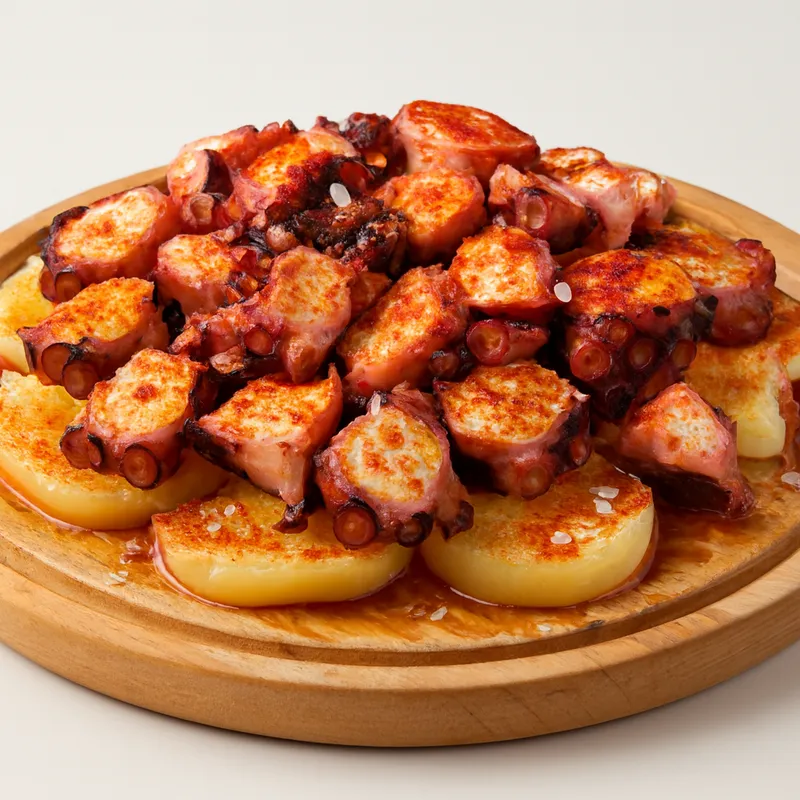
Galician boiled octopus on wooden plate — the cooking water needs no salt because the octopus releases it; the trick is dipping the leg three times in boiling water before submerging it (asustar, 'to scare' the octopus). Pimentón, olive oil, sea salt, that's it.
Boiled octopus tentacle, sliced into coin-thick rounds with kitchen scissors, fanned on a wooden board over a bed of soft potato. Doused with grassy olive oil, dusted with sweet and hot pimentón (traditionally unsmoked — Galician pulpo á feira uses plain sweet/hot paprika, never smoked), finished with coarse salt. Eat with a wooden toothpick, no cutlery. The flesh should yield like firm custard — chewy means undercooked, mush means over.
Texture turns on shock and rest. Tradition: dunk the octopus three times in boiling water (asustar — "scare it") before fully submerging — the head curls the tentacles tight and the skin sets so it won't slough off. Then ~30–45 minutes at a bare simmer for a 2 kg specimen, plus a 10-minute rest off heat. A copper pot is the regional tell — copper conducts evenly enough that the bath never spikes.
Variations
A feira (festival) version is served on wood (canonical); Lugo's San Froilán festival is the seasonal reference; some Pontevedra cooks add boiled potato underneath; Andalusian pulpo a la brasa grills the leg over coals first; modern Madrid bars sometimes plate with potato puree.
On the Palate
Where Pulpo a la Gallega sits in the Spanish flavor cloud
Ingredients
How it's made
4 steps · 17 min active + 45 min waiting
- 10 min
Fill a large pot with water and bring it to a boil. Add the octopus and cook until tender, about 45 minutes. The tentacles should be easily pierced with a fork.
Watch outA fork should slide into the thick part of a tentacle with no resistance — that's your doneness cue, not the clock.
- 210 min
Remove the octopus from the pot and let it cool slightly. Slice the tentacles into bite-sized pieces.
Watch outLet it cool just enough to handle before slicing on the bias into coins about a finger thick.
- 35 min
Arrange sliced potatoes in a single layer on a serving platter. Place the octopus pieces on top of the potatoes.
- 42 min
Drizzle generously with olive oil and sprinkle with paprika and salt to taste. Serve warm, allowing the flavors to meld.
Watch outDust the paprika while the potatoes and oil are still warm so it blooms and releases its color and aroma.
Archive tool suggestions — not reviewed
These legacy suggestions have not been evidence-reviewed and are not presented as required tools.