New Jersey breakfast sandwich: thick slices of Taylor pork roll (a smoked pre-cooked pork product) griddled until edges curl, stacked with American cheese and a fried egg on a Kaiser roll, salt-pepper-ketchup or SPK to order.




Taylor Pork Roll was created by John Taylor in Trenton, New Jersey, in 1856 — predating the federal definition of "ham" by decades, It was sold as "Taylor's Prepared Ham" until the 1906 Pure Food and Drug Act forced him to relabel it "pork roll"; "Taylor Ham" survived only as the colloquial name in North Jersey. The product is uniquely Jersey: it never spread far beyond the state. The North Jersey / South Jersey naming feud ("Taylor Ham" in the north, "pork roll" in central and south Jersey — a 2016 NJ.com poll of 70,000+ respondents put the dividing line near the Union–Middlesex border in the east and along I-78 in the west) is real and politically symbolic — there have been state legislative resolutions on the matter. The breakfast sandwich form solidified at diner counters in the 1950s.
John Taylor invented it in Trenton in 1856. After the 1906 Pure Food and Drug Act forced him to relabel «Taylor Ham» as «pork roll», the name split the state — Taylor Ham north of I-195, pork roll south.
First impression is salt — pork roll is heavily cured, somewhere between Spam and ham, with a smoky-tangy edge that bacon doesn't have. The notched slice fries up with deeply browned crispy edges that crunch against a yielding melted-cheese-and-runny-yolk middle. Kaiser roll is sturdy enough to absorb yolk without falling apart. Eaten standing at a deli counter at 8 a.m. with a coffee. Benchmark: if there's no yolk on your hand by bite three, the egg was overcooked.
The notch cuts are the non-obvious move. Pork roll is held together by collagen and connective tissue that contracts violently when heated; without radial cuts at the edges, a thick slice cups upward into a bowl shape, leaving a domed center that won't lay flat against bread or melt cheese. Four cuts at compass points let the slice expand outward instead of curling. American cheese is also load-bearing — its high emulsifier content (sodium citrate) makes it melt smoothly into the egg yolk without breaking, which a sharp cheddar would.
Variations
Trenton-style with salt-pepper-ketchup (SPK) on a hard roll; North Jersey diner version with American cheese and egg on a kaiser; Jersey Shore boardwalk version griddled inside a long roll with hash browns.
On the Palate
Where Jersey Pork Roll Sandwich sits in the American flavor cloud
Ingredients
Serves 2How it's made
5 steps · 12 min active + 3 min waiting
- 13 min
Slice 4 oz (115g) Taylor Pork Roll into 4 slices, each 1/4 inch (6mm) thick. Make 4 small radial cuts at the edges of each slice — without these, pork roll bowls into a curled-up coin and won't sit flat.
Watch outThe notches are non-negotiable — Jersey deli move. Skip them and the slice cups so badly the cheese won't melt onto it.
- 24 min
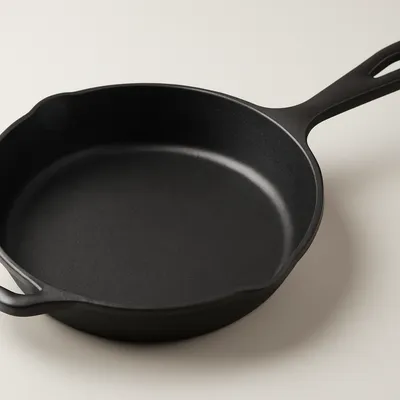
Heat a flat-top or heavy skillet over medium-high. Lay slices flat, no oil — pork roll has plenty of fat. Sear 2 minutes per side until edges are deeply browned and the surface goes glossy. Transfer to a plate.
- 33 min
In the same pan, fry 2 large eggs over-medium — yolks barely set, whites fully cooked, no rubbery edge. Salt and pepper.
Watch outDon't blow out the yolk — the runny center is half the sandwich.
- 42 min
Split 2 Kaiser rolls and toast cut sides on the griddle 1 minute until just gold. Lay 1 slice American cheese on each bottom half, top with 2 hot pork roll slices to melt it, then the egg, then 1 more slice cheese on the egg.
- 51 min
Squeeze a thin line of ketchup on the top bun (this is the SPK — salt, pepper, ketchup configuration). Close the sandwich, press lightly with a spatula. Cut diagonally and eat hot, before the egg sets all the way.
Archive tool suggestions — not reviewed
These legacy suggestions have not been evidence-reviewed and are not presented as required tools.