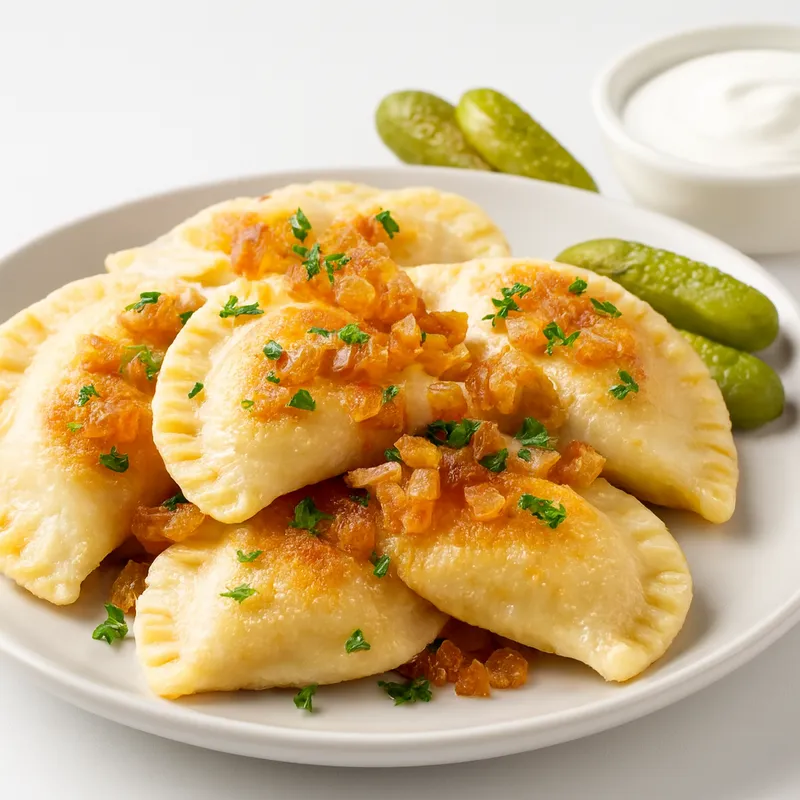
Half-moon dough dumplings filled with mashed potato, farmer's cheese, and onion, boiled, then pan-fried in butter with caramelized onions until the edges crisp — Pittsburgh-Cleveland-Chicago Polish church-hall canon.



Pierogi reached the American Midwest with the great Polish migration from Galicia and Russian Poland between 1880 and 1914, settling in industrial cities — Pittsburgh, Cleveland, Chicago, Buffalo, Detroit — for steel, coal, and meatpacking work. Polish parishes (St. Stanislaus, St. Mary's, Our Lady of Czestochowa) anchored neighbourhoods and ran weekly pierogi sales as fundraisers; the Pittsburgh Pierogi Race at PNC Park is now part of Pirates baseball. Mrs. T's (founded 1952 in Shenandoah, Pennsylvania) made the frozen supermarket pierogi a national category. The Polish-American version diverges from the Polish original in two ways: sour cream is added to the dough, and the boil-then-pan-fry-with-onions finish is more standardized than in Poland.
Polish migrants from Galicia 1880–1914 anchored the pierogi in Pittsburgh, Cleveland, Chicago. Sour cream in the dough is the American divergence; boil-then-pan-fry-with-onions is the standardized finish. Mrs. T's (1952, Shenandoah PA) made it a freezer category.
Fork-side first: the bottom is mahogany-crisp from the butter fry, almost like a potsticker; flip and the top is pillowy boiled dough. Inside, hot mashed potato and farmer's cheese — warm, milky, gently seasoned. The caramelized onion on top is sweet and silky, the cold sour cream cuts the butter. Each pierogi is about three bites. Pittsburgh church Lenten suppers serve them in dozens. Frozen-then-fried supermarket pierogi (Mrs. T's, since 1952) are the universal weeknight benchmark; from-scratch is a Saturday project.
The dough is what separates great pierogi from mediocre. Sour cream's fat coats gluten strands and produces a softer, more tender wrapper than water-and-egg dough — Polish-American grandmothers will check texture by pulling a corner; it should stretch like an earlobe. The boil-then-fry sequence is structural: boiling fully cooks the dough and starches the filling; the butter fry then caramelizes the surface starch and adds the load-bearing crisp contrast. Skip the boil and the dough is gummy in the middle; skip the fry and you've made dumplings, not the Polish-American pan-fried pierogi.
Variations
Pittsburgh's St. John the Baptist church Lenten suppers are the parish reference; Mrs. T's frozen ruskie (potato-cheese; "ruskie" means Ruthenian, after the historically Polish western-Ukrainian region, not Russian) is the supermarket default; Chicago's Pierogi Wagon and Cleveland's Sokolowski's run the restaurant lines; the Pittsburgh Pierogi Race at PNC Park is the cultural marker.
On the Palate
Where Pierogi (Polish-American) sits in the American flavor cloud
Ingredients
Serves 4

How it's made
6 steps · 1 hour 30 min active + 1 hour waiting
- 138 min
Make dough: in a bowl, whisk 350g (2.75 cups) all-purpose flour with 1 tsp salt. Add 1 large egg, 80g (1/3 cup) sour cream, and 120ml warm water. Mix to a shaggy mass, then knead on a lightly floured counter 8 minutes until smooth and elastic. Wrap in plastic, rest 30 minutes at room temperature.
Watch outSour cream is the canonical Polish-American addition — produces softer dough than the egg-and-water Old World version. Don't skip the rest or the dough fights you when rolling.
- 225 min
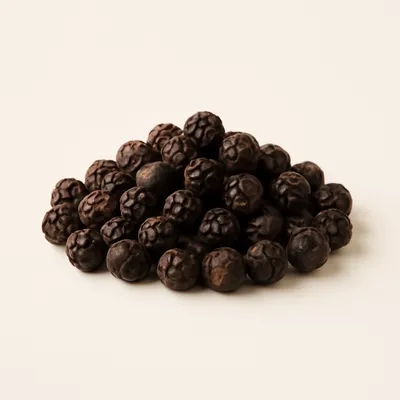
While dough rests, make filling: boil 600g peeled russet potatoes in salted water 15 minutes until fork-tender. Drain, mash smooth. Stir in 200g farmer's cheese (or dry cottage cheese pressed of liquid), 1 small yellow onion finely diced and sweated in 30g butter until soft, 1/2 tsp salt, 1/2 tsp black pepper. Cool to room temperature — hot filling tears dough.
Watch outFilling must be cool and dry — wet filling steams the seam open during boiling.
- 325 min
Roll dough on a floured surface to 2-3mm thickness. Cut 8cm circles with a glass or biscuit cutter. Place 1 heaping tablespoon of filling slightly off-centre on each disc. Fold in half, press edges together firmly, then crimp with a fork or pinch into a rope edge. About 30 pierogi.
Watch outWet your fingertip and dampen the edge before sealing if dough has dried out — otherwise seam splits in the boil.
- 420 min
Caramelize 2 large yellow onions, sliced, in 60g butter over medium-low heat 20 minutes until deep golden and jammy. Set aside; keep warm.
- 512 min
Bring a large pot of salted water to a gentle boil — not a hard rolling boil, which tears pierogi. Drop in 8-10 pierogi at a time. They sink, then float to the surface within 3-4 minutes; cook 1 more minute floating. Lift out with a slotted spoon.
Watch outGentle boil only. A hard boil ruptures the seal and the filling escapes.
- 66 min
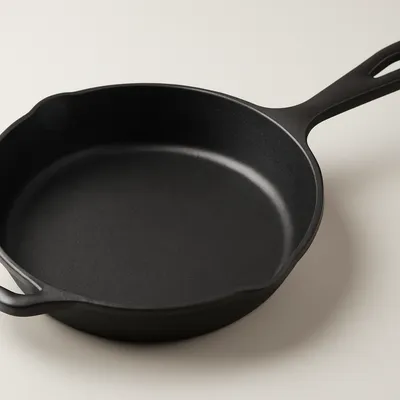
Heat 30g butter in a wide skillet over medium-high. Add boiled pierogi in a single layer, fry 2-3 minutes per side until edges are deep golden and crisp. Plate, top generously with caramelized onions and a dollop of sour cream. Serve immediately.
Watch outThe boil-then-fry sequence is the canonical Polish-American move — it's what gives the contrast between soft top and crispy bottom.
Archive tool suggestions — not reviewed
These legacy suggestions have not been evidence-reviewed and are not presented as required tools.