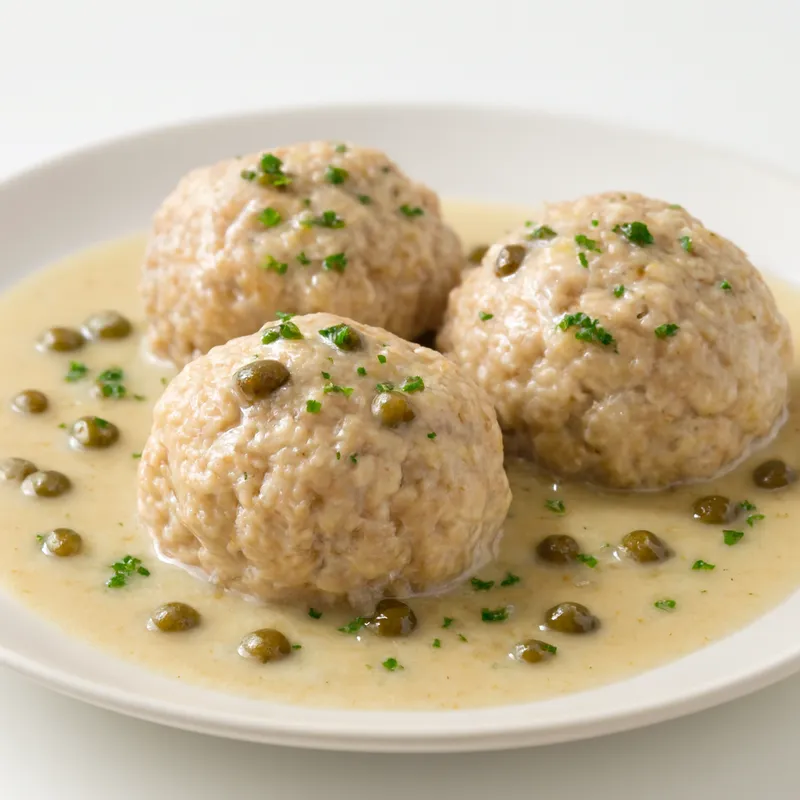
Frankfurt seven-herb cold sauce — a cold creamy sauce blended from exactly seven specific fresh herbs (borage, sorrel, watercress, parsley, chives, chervil, salad burnet) with sour cream, yogurt, mustard, hard-boiled eggs and oil, served over boiled new potatoes — Frankfurt's most distinctive green dish, traditionally eaten on Maundy Thursday.





Grüne Soße (Frankfurter Grie Soß in Hessian dialect) is Frankfurt's most distinctive culinary creation — protected by a regional designation that requires exactly 7 specific herbs from the Frankfurt-Mainhessen area: Borretsch (borage), Sauerampfer (sorrel), Kresse (watercress), Petersilie (parsley), Schnittlauch (chives), Kerbel (chervil), and Pimpinelle (salad burnet). The dish dates to at least the early 19th century in Frankfurt records, the first published recipe appeared in Wilhelmine Rührig's 1860 cookbook, and the herb composition received EU protected geographical indication (PGI) status on 9 March 2016. A popular legend holds that Grüne Soße was the favourite dish of Frankfurt-born Goethe, supposedly created by his mother, but there is no evidence for this — and the first known recipe (1860) appeared almost 30 years after Goethe's death. The dish is traditionally eaten on Gründonnerstag (Maundy Thursday, the Thursday before Easter), tied to spring herb harvests and Christian fasting traditions. The Frankfurt outskirts cultivate Grüne Soße herbs commercially; you can buy the 7-herb bundle ready-cut at Frankfurt supermarkets during the herb season (April-October). The dish is naturally vegetarian, gentle, and herbal — built on fresh spring produce.
Grüne Soße is dramatically green — almost shockingly so, like spring distilled into a sauce. The first taste: cool creamy sour-cream base, then a chorus of herbs — parsley's grass, sorrel's lemony tang, chives' onion sharpness, borage's cucumber freshness, watercress's peppery bite, chervil's anise undertone, salad burnet's slight cucumber-and-nut. Each herb adds a layer; no single herb dominates. The chopped hard-boiled egg adds richness and body. The warm potato underneath provides starchy contrast. Frankfurt apple wine on the side resets the palate. On Maundy Thursday in Frankfurt, every restaurant serves it; if you're in Frankfurt in April-October, you must eat Grüne Soße.
The 7-herb requirement is not arbitrary — each herb provides a different volatile compound family: borage = cucumbery aldehydes, sorrel = oxalic acid (lemony), watercress = phenethyl isothiocyanate (peppery), parsley = apiole/myristicin (grassy), chives = sulfides (onion), chervil = methyl chavicol (anise), salad burnet = unique cucumber-and-nutty. Substituting any one disrupts the complete flavor coverage that 7 herbs provide. Sour cream + yogurt + crème fraîche together give the sauce its texture: sour cream is the body, yogurt adds tang, crème fraîche adds richness. The hard-boiled egg fat in the blender helps emulsify the oil into the dairy base, creating a stable sauce that doesn't separate.
Variations
Frankfurt-Mainhessen canonical with exactly 7 herbs; some restaurants offer 'Goethes Grüne Soße' (Goethe's favorite — claimed historical recipe); Kassel variant uses different herb proportions (more parsley, less borage); commercial pre-made Grüne Soße sold in Frankfurt supermarkets is acceptable but lacks the freshness; outside Frankfurt, the 7 herbs are nearly impossible to source — Grüne-Soße-inspired sauces with 4-5 herbs are common but not authentic; the dish is naturally vegetarian; the seasonal nature (April-October) means it can't be eaten properly in winter (frozen herb mixes exist but lose vibrancy).
On the Palate
Where Grüne Soße sits in the German flavor cloud
Pulse the sauce just enough to chop the seven herbs into a flecked, still-textured green cream — over-blending kills both the color and the fresh herb bite that define Grüne Soße.
Ingredients
Serves 6




How it's made
9 steps · 20 min active + 10 min waiting
- 15 min
Acquire the 7 herbs: ideally a Frankfurt-Mainhessen 'Grüne Soße Mischung' (mix) sold at supermarkets in the herb season — 200g total of 7 herbs mixed. Outside Frankfurt: borage, sorrel, watercress, parsley, chives, chervil, salad burnet — about 30g of each. If some are unavailable, substitute: borage = cucumber leaves (close); sorrel = arugula + lemon (not perfect); salad burnet = young dill (approximate). The result is 'inspired by' Grüne Soße but not authentic.
- 25 min
Wash and dry the herbs thoroughly. Pick leaves from any tough stems. Chop coarsely.
- 314 min
Hard-boil 4 eggs: place in cold water; bring to boil; simmer 9 min; transfer to ice water; cool; peel. Roughly chop 2 of the eggs (these go in the sauce); reserve the other 2 for garnish (sliced).
Watch outSimmer the eggs 9 minutes then straight into ice water — the yolks should be just set, not chalky, so they emulsify cleanly.
- 44 min
In a food processor or blender, combine: all 7 herbs + the 2 chopped hard-boiled eggs + 250g sour cream (Schmand) + 200g full-fat yogurt + 100g crème fraîche + 2 tbsp Dijon mustard + 2 tbsp white wine vinegar + 2 tbsp neutral oil + 1 tsp sugar + 1 tsp salt + 1/2 tsp white pepper.
- 52 min
Pulse 8-10 times until the herbs are finely chopped and integrated into a smooth pale-green sauce. DO NOT over-process — the texture should be slightly chunky from the herbs, not a smooth puree. Some hand-chopped herbs can be folded in at the end for texture.
Watch outStop pulsing while the sauce still looks flecked and pale green, not a uniform smooth paste.
- 665 min
Cover; refrigerate at least 1 hour (ideally 2-3 hours) for flavors to meld. The sauce will deepen in color and the herbs will release their full aroma during the rest.
- 722 min
Meanwhile, boil 1.2kg small waxy new potatoes (skins on) in salted water 18-22 min until tender. Drain. Keep warm.
Watch outCook the waxy potatoes just until a knife slides in — they must stay firm enough to fork and dip.
- 84 min
Plate: place 4-5 warm potatoes on each plate (peeled or unpeeled by diner preference). Ladle a generous portion of cold Grüne Soße over or alongside the potatoes. Top each portion with sliced hard-boiled egg from the reserved 2 eggs. Garnish with extra fresh chives.
- 93 min
Serve immediately with dark rye bread, fresh-baked Brötchen, and a glass of Frankfurt Apfelwein. Eat by cutting the warm potatoes with a fork and dipping into the cold green sauce — the temperature contrast is part of the experience.
Archive tool suggestions — not reviewed
These legacy suggestions have not been evidence-reviewed and are not presented as required tools.