
An oil-enriched Herati breakfast bread — a yeasted wheat dough made rich with oil or ghee (and often milk), baked into a soft, pillowy, lightly-sweet flat round noticeably more tender than everyday naan. Shaped into a single circle, brushed with milk or egg, and topped with nigella and sesame seeds before baking. Served warm at breakfast with cream (qymaq), butter, honey, or jam.




A western-Afghan and northern-Iranian breakfast bread from Herat — distinguished from the everyday naan by the oil or ghee worked into the dough (roghan in Dari means oil/fat), which makes it softer and richer. Herat sits against the Iranian border and is the more Persianate, refined branch of Afghan cooking, and even its bread is held to a finer standard. Eaten with the dairy-and-jam tradition of the Persian-Afghan breakfast — cream (qymaq), butter, and honey. Often baked on Friday mornings as a special-occasion and hospitality breakfast bread.
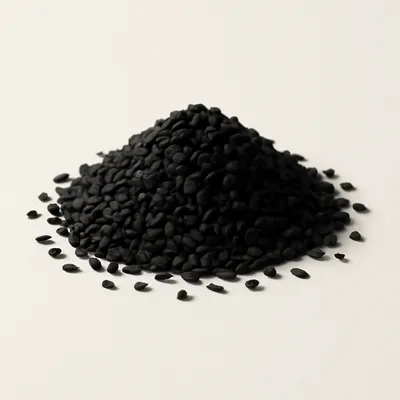
Soft enough to tear into wide pillowy strips with your fingers. The crumb is tender and close, not layered — rich with the flavor of oil and milk and just barely sweet; nigella seeds add their distinctive oniony note. Slather with butter and honey for the canonical breakfast bite, or stack with feta and a sprig of mint. Best within a few hours of baking; firms up overnight.
The bread's tenderness comes from enrichment, not lamination. Oil or ghee worked into the dough coats the gluten so the strands can't develop a tough, chewy network — the crumb stays soft and rich instead. Milk (its lactose and a little sugar) adds the faint sweetness and helps the surface brown to a deep gold. Because the fat is mixed into the dough from the start rather than folded in as layers, the result is a single soft, thick round — pillowy throughout, with no flaky leaves. A final brush of milk or egg seals the surface so the bread doesn't dry out as it cools.
Variations
Herati classical (yeast + milk + ghee, topped with nigella and sesame); a sweet version doubles the sugar and adds 1 tsp ground cardamom; modern Kabul cafes use butter instead of clarified ghee (richer but less shelf-stable).
On the Palate
Where Naan-e Roghani sits in the Afghan flavor cloud
Ingredients
Serves 6


How it's made
9 steps · 40 min active + 1 hour 50 min waiting
- 112 min
Activate yeast: in a small bowl combine 1 cup warm milk (40°C), 1 tbsp sugar, and 2.25 tsp active dry yeast. Let stand 10 minutes until foamy.
Watch outWait for the yeast to foam up thick on top — no foam means dead yeast and flat bread, so start over.
- 24 min
In a large bowl combine 4 cups all-purpose flour, 1 tsp salt. Make a well; pour in the yeast mixture and 3 tbsp oil. Mix to a soft dough.
- 3100 min
Knead by hand 10 minutes until smooth and slightly tacky. Place in an oiled bowl; cover; let rise 90 minutes in a warm place until doubled.
Watch outKnead until the dough turns smooth and just sticks to your fingers — that slight tack is what keeps the crumb soft.
- 44 min
Melt 6 tbsp clarified butter (or ghee) for layering. Keep slightly warm and liquid.
- 57 min
Punch down dough. Divide into 4 portions. On a floured surface, roll one portion into a thin 25 cm circle. Brush generously with melted butter. Sprinkle with a tiny pinch of sugar.
- 65 min
Roll up jelly-roll style into a tight cylinder. Coil the cylinder into a flat spiral (like a snail shell). Press flat with the palm. Roll out again to a 22 cm circle (now layered).
Watch outRoll tight, coil like a snail shell, then press and re-roll gently — the trapped butter layers give the puff, so don't squeeze it all out.
- 722 min
Repeat with the other 3 portions. Place breads on parchment-lined baking sheets. Cover with a damp cloth; let rest 20 minutes.
- 85 min
Preheat oven to 220°C with a baking stone or steel inside. Brush each bread with milk; sprinkle with 1 tsp nigella seeds and 1 tsp sesame seeds.
- 911 min
Slide breads onto the hot stone; bake 10 minutes until puffed and golden. Brush with a final layer of melted butter the moment they come out. Wrap in a clean cloth to keep soft.
Watch outPull the breads when puffed and deep gold, then brush with butter and wrap in cloth the moment they're out to trap steam and stay soft.
Archive tool suggestions — not reviewed
These legacy suggestions have not been evidence-reviewed and are not presented as required tools.

Flat rectangular metal pan (sheet pan, half-sheet, quarter-sheet), 33×23 cm to 45×33 cm, with a low rim. The flat surface gives even heat for cookies, biscuits, roasted vegetables, sheet-pan dinners. Heavy aluminum sheets conduct heat fastest; non-stick coatings make cleanup easier but can warp over 200°C; rimmed half-sheet is the modern American restaurant standard.

Cylindrical wooden, marble, or silicone roller for flattening dough — pie crust, pasta, dumpling skins, naan, tortilla, pizza. French-style is tapered (no handles, the cook holds the wood itself); American-style has fixed handles with rotating barrel; marble pins stay cool for laminated doughs (croissant, puff pastry). The right pin depends on the dough's stickiness and lamination needs.


