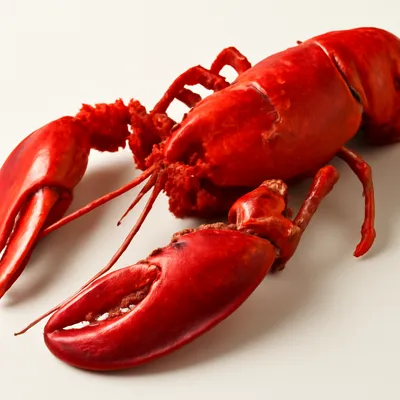



Caribbean spiny lobster (Panulirus argus) — clawless, sweeter than Maine cold-water lobster — is the local species; harvest seasons are regulated by each island's fisheries to protect breeding stocks. The garlic-butter-bake format is European-derived, brought to the islands through British and French colonial cooking and adopted into resort and home kitchens through the 20th century. Lime and scotch bonnet are the Caribbean adjustments.
Caribbean spiny lobster (Panulirus argus) — clawless, denser tail meat than Maine cold-water — cooks faster. Internal target 60–63°C; past that the proteins squeeze out water and the tail seizes rubbery in 90 seconds.
Lobster tails split lengthwise, meat lifted onto the shell, brushed with melted butter heavy on garlic, parsley, and lime, baked until the meat goes opaque white and the shell turns coral. Caribbean versions add scotch bonnet to the butter and finish with a squeeze of lime — the heat plays against the sweet meat. Eaten with the fingers, shell as plate. Overcook by 90 seconds and it goes rubbery.
Spiny lobster cooks faster than clawed lobster — no claw mass to slow heat, and the tail meat is denser. Internal temperature target is 60–63°C / 140–145°F; past that, proteins squeeze out water and the meat seizes. The split-and-lift technique exposes meat to direct heat while the shell shields the underside, so the top browns and the bottom stays moist. Don't pre-heat the butter long enough to burn the garlic — bitter garlic ruins the dish.
Variations
Bahamian split-and-grill over coal with thyme; Cuban langosta enchilada simmers tail meat in tomato-sofrito; Jamaican grilled lobster gets a jerk-butter baste at Hellshire Beach shacks.
On the Palate
Where Baked Lobster with Garlic Butter sits in the Jamaican flavor cloud
Pull the lobster tail at 60–63°C / 140–145°F — past that the proteins wring out their water and the sweet meat turns rubbery, so the whole dish rests on stopping the bake the moment it turns opaque.
Ingredients
How it's made
5 steps · 30 min
- 15 min
Preheat the oven to 400°F (200°C). Meanwhile, cut the lobster shells lengthwise and gently pull the meat out, leaving it attached at the tail end.
- 23 min
Melt butter in a small saucepan over low heat. Add minced garlic and chopped parsley, stirring until the garlic is fragrant but not browned.
Watch outButter foams gently and the garlic just smells sweet — no color, no sizzle-crackle, or it's turning bitter.
- 35 min
Place the lobster meat back on top of the shells and brush generously with the garlic butter mixture. The meat should glisten with the butter.
- 412 min
Arrange the lobsters on a baking sheet and bake in the preheated oven until the meat is opaque and firm, about 12 minutes.
Watch outPull it when the meat turns from glassy to opaque white and springs back to a light press — around 12 minutes, sooner if the tails are small.
- 55 min
Serve the baked lobsters hot, drizzled with any remaining garlic butter and a sprinkle of fresh parsley for a burst of color and flavor.
Archive tool suggestions — not reviewed
These legacy suggestions have not been evidence-reviewed and are not presented as required tools.

Flat rectangular metal pan (sheet pan, half-sheet, quarter-sheet), 33×23 cm to 45×33 cm, with a low rim. The flat surface gives even heat for cookies, biscuits, roasted vegetables, sheet-pan dinners. Heavy aluminum sheets conduct heat fastest; non-stick coatings make cleanup easier but can warp over 200°C; rimmed half-sheet is the modern American restaurant standard.

Round metal pot, 14-26 cm diameter, with vertical walls and a long handle, designed for sauces, soups, oatmeal, rice, boiled vegetables. The vertical walls minimize evaporation (vs. a sauté pan). Sizes: 1 qt for melting butter, 2-3 qt for sauces, 4 qt for soups. Stainless-steel-clad aluminum or copper is best for conduction; cast-iron is too thick for delicate sauces.