
Sweet yeasted dough balls made with flour, sugar, eggs, butter, nutmeg, and warm milk; the dough rises for 90 minutes, then is dropped by spoon into hot oil and fried until deep golden — Congo's everyday sweet pastry. Sold from street vendors with chilled bisap (hibiscus drink) or hot milk-tea. Crispy outside, soft-airy inside, with a tropical-spice aromatic. The morning kiosk treat from Kinshasa to Brazzaville.






Mikate (the French co-name in DRC is beignet) is the everyday Congolese sweet. The word means 'small cake' in Kikongo and Lingala and 'bread' in Swahili and Tshiluba — four of the DRC's official languages (Lingala mokate singular, mikate plural). It belongs to a pan-African family of yeasted fried-dough snacks — puff-puff in Nigeria/Sierra Leone, mandazi on the Swahili coast, bofrot in Ghana, micate/bolinho in Angola — traditionally leavened with yeast or, very traditionally, palm wine. Though often likened to French beignets, the name and the yeasted technique are Bantu rather than borrowed; the Congolese version is sweeter, scented with nutmeg, and chewier inside. Sold at every street vendor stand in Kinshasa, Brazzaville, and Pointe-Noire from 5 am — the smell of frying mikate fills the morning air. For many Congolese it is the only sweet food of the day, taken with chilled hibiscus juice or hot ginger tea.
Bite a hot mikate — the outside crackles, the inside is soft, airy, slightly chewy, and warmly aromatic with nutmeg. The sweetness is moderate, not cloying. The yeast gives a subtle bread-like richness; the eggs make it richer than a typical doughnut. With chilled hibiscus juice alongside, the contrast of hot-sweet-pastry and cold-tart-fruit drink is the perfect Congolese morning. Or with hot ginger tea, the warming spices echo each other. The Kinshasa breakfast.
Yeast fermentation produces CO2 + ethanol; the long rise (90 min) develops gluten and flavor compounds. The dough's eggs and butter contribute to a richer crumb than a plain bread dough. Frying at 175°C creates a crisp exterior via Maillard reaction while steam pressure from the water content inflates the interior. Dropping by spoon gives the irregular dumpling shape characteristic of mikate (vs. shaped beignets). The nutmeg volatile oils survive frying and provide aromatic complexity.
Variations
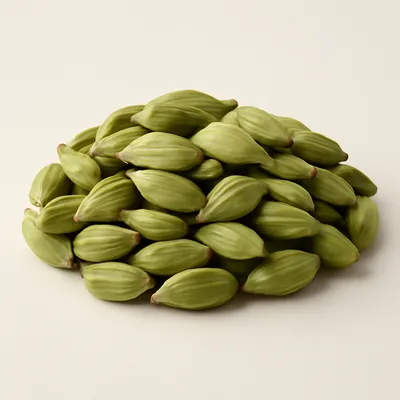
Coconut mikate adds 50 g shredded coconut to the dough — distinctly coastal-Congolese variant. Vanilla mikate adds 1 tsp vanilla extract — luxe sweet version. Plain mikate omits nutmeg and cardamom — simpler everyday version. Plantain mikate replaces some flour with mashed plantain — denser and sweeter. Diaspora mikate is often eaten as the Congolese diaspora's homecoming bite, no recipe adaptation needed.
On the Palate
Where Mikate sits in the Congolese flavor cloud
Ingredients
Serves 6


How it's made
11 steps · 30 min active + 1 hour 30 min waiting
- 16 min
Activate yeast: in a bowl, dissolve 7 g instant yeast + 2 tbsp sugar in 250 ml warm milk (about 38°C). Let foam 5 min.
Watch outThe yeast-milk should froth and dome within five minutes; if it stays flat, the yeast is dead or the milk was too hot — start over or the dough won't rise.
- 22 min
Make dough: in a large bowl, combine 500 g all-purpose flour + ½ tsp salt + 1 tsp ground nutmeg + ¼ tsp ground cardamom (optional but recommended).
- 33 min
Add 2 lightly beaten eggs + 40 g melted butter + 80 g sugar to the yeast-milk mixture. Whisk.
- 411 min
Pour wet into dry; stir to combine. Knead 6 min in stand mixer (or 10 min by hand) until smooth, elastic, and slightly sticky.
- 592 min
First rise: cover dough; let rise 90 min at room temperature until doubled (or refrigerate overnight if making ahead).
- 65 min
Heat 5 cm of vegetable oil in a wok or deep pot to 175°C.
Watch outHold the oil at a steady medium-hot — a scrap of dough should sizzle and rise in a few seconds; too cool and the mikate drink oil, too hot and they brown raw inside.
- 74 min
Punch down dough lightly. Wet a spoon with cold water; scoop tablespoon-sized portions; drop carefully into hot oil. Fry 5-6 at a time (don't crowd).
- 85 min
Fry 3-4 min per batch, turning, until deep golden brown all over. The mikate will puff and float.
Watch outThey're done when they've puffed round, floated up, and gone deep golden all over; pull one and break it — the middle should be cooked through, not doughy.
- 92 min
Drain on paper towels.
- 103 min
Dust with extra sugar while still hot (optional). Serve warm — within 30 min for best texture.
- 111 min
Pair with chilled hibiscus juice (bisap), hot ginger tea, or coffee. Eat with fingers.


