

Standardized in late-19th-century England, with the first published recipe for the steak-and-kidney combination appearing in Mrs Beeton's Book of Household Management (1859), sent to her by a correspondent in Sussex. It evolved from earlier "steak puddings" wrapped in suet crust; the all-pastry pie form became Victorian pub standard. Kidney was the cheap offal that stretched expensive beef — a working-class economy that became aspirational once the dish entered gentlemen's clubs.
Victorian-era pub staple — chuck and ox kidney braised in stout for hours, sealed under suet pastry. The kidney's iron-funk is the load-bearing flavor; modern kitchens that skip it for all-steak miss the whole point.
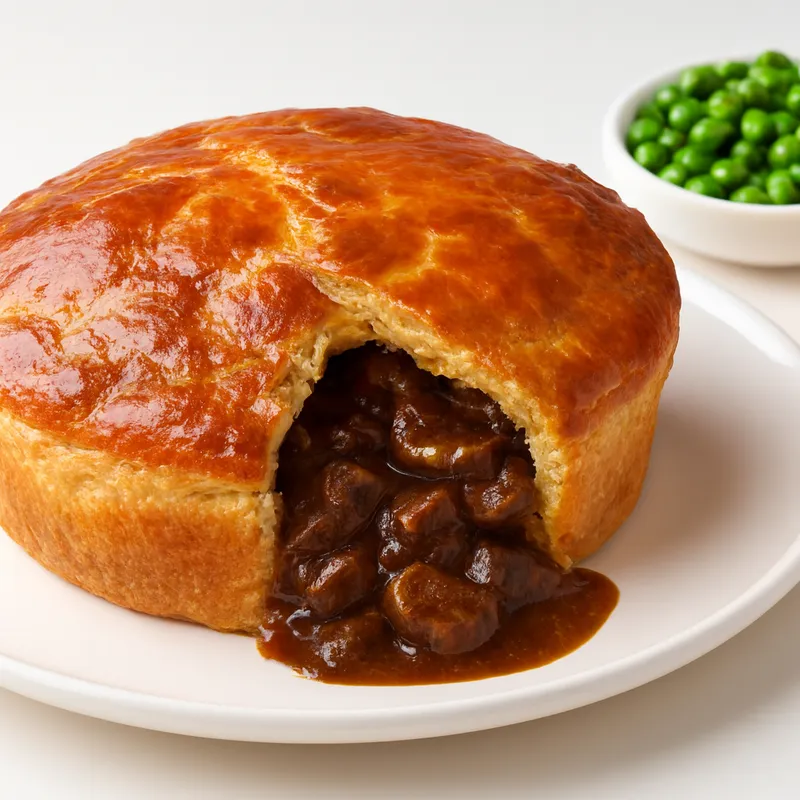
A puff-pastry lid lifts to release steam over a deep filling: chunks of stewed beef and lamb or ox kidney in a glossy, near-black gravy thickened by reduction and a splash of stout. The kidney is the divisive ingredient — iron-rich, slightly metallic, gamier than the beef. Served with mash or chips and peas. If the kidney tastes ammoniac, it wasn't soaked in milk first.
Soaking the kidney in milk for an hour pulls out the urea that makes it taste of ammonia — skip this step and no spice mix can save the pie. The filling is cooked completely separately and cooled before the pastry goes on top — wet hot filling under raw pastry produces a soggy underside. Stout (Guinness) gives the gravy its near-black depth via maltose; red wine doesn't substitute.
Variations
Steak and kidney pudding (Sussex) is steamed, not baked, in a suet basin; Lancashire 'butter pie' drops the kidney for potato and onion; Aussie meat pie is the colonial descendant minus the offal.
On the Palate
Where Steak and Kidney Pie sits in the British flavor cloud
Ingredients
How it's made
6 steps · 1 hour 18 min
- 110 min
Dice the beef and kidneys into bite-sized pieces, ensuring even sizes for consistent cooking. Finely chop the onion until translucent in appearance.
- 28 min
In a heavy-bottomed pan, brown the beef and kidney pieces over medium-high heat until they develop a rich, caramelized exterior. The meat should sizzle as it hits the pan, releasing a savory aroma.
Watch outThe meat should hit the pan sizzling and stay put until a deep brown crust forms — crowding it makes it steam and go gray.
- 35 min
Add the chopped onion to the pan, stirring occasionally until it softens and turns golden, melding its sweetness with the meat.
- 410 min
Pour in the gravy, stirring to combine. Let it simmer gently until the mixture thickens slightly and the flavors meld, filling the kitchen with a hearty aroma.
Watch outLet the gravy simmer until it coats the back of a spoon and darkens; it should be glossy, not watery.
- 515 min
Roll out the pastry to fit your pie dish. Line the dish with pastry, fill with the meat mixture, and cover with another layer of pastry. Seal the edges by pressing with a fork.
- 630 min
Bake in a preheated oven at 200°C (390°F) until the pastry is golden brown and flaky, and the filling is bubbling hot.
Watch outPastry is done when it's deep golden and flaky and the filling bubbles up through the vents.
Archive tool suggestions — not reviewed
These legacy suggestions have not been evidence-reviewed and are not presented as required tools.