
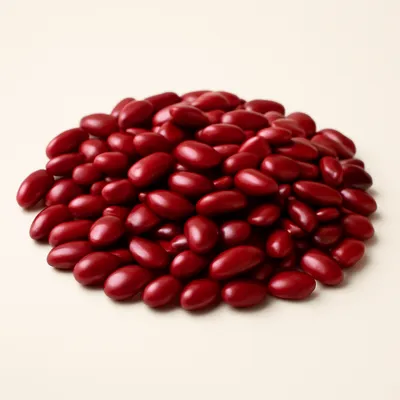
A glutinous steamed bun from China's Northeast, traditionally made from yellow glutinous millet flour (黄米面, milled from waxy proso millet) or, increasingly, glutinous rice flour (糯米面). The dough is mixed, left to ferment until faintly sour, then pinched around a sweet filling of cooked red adzuki or red kidney beans and steamed sitting on perilla leaves (苏子叶) or corn husks to keep it from sticking. In the old farmhouse rhythm the buns were made in large batches at the start of winter and frozen outdoors, then re-steamed a few at a time through the cold months and eaten warm, often rolled in sugar. It is one of the defining glutinous foods of the Manchu and the wider Northeast, especially around the small New Year (小年) and Spring Festival.





Sticky bean buns are the best-known of the粘食 — glutinous foods — of the Manchu and the Northeast, a people for whom dense, slow-to-digest grain food suited the long cold and a life of farming and hunting; such food kept the body warm and was easy to carry afield. The buns belong to the run-up to winter and to the small New Year and Spring Festival, when households made them in bulk. Two accounts of their origin circulate and are not mutually exclusive: many sources trace them to the millet-and-bean cookery of the Jurchen and later Manchu, the northern ancestors of whom were eating yellow-millet cakes for centuries; others point to the 'yellow steamed cake' (黄蒸) of Shanxi's Changzhi region, said to have been carried into the Northeast by Shandong-and-Shanxi migrants during the 闯关东 settlement of the Qing and late-imperial period and there reworked into the bun known today. No firm founding date or named inventor is recorded for either thread. What is consistent across accounts is the winter practice that defines the dish — large batches steamed at the onset of cold and frozen outdoors in the natural deep-freeze of the Northeast, then re-steamed as needed.
Hot from the steamer the skin is soft, dense, and stretchy, clinging to the teeth the way good glutinous-grain food does, with a faint clean sourness from the fermented dough that keeps the sweetness from cloying; the millet version is deeper in color and a touch grainier and more fragrant than the whiter, smoother rice version. Inside is a warm band of sweet bean filling, a little coarse and earthy. Dipped in sugar each bite is soft, sticky, and sweet, never hard or dry. A bun re-steamed from frozen comes back nearly as supple as fresh; one left to cool and sit unheated turns firm, tough, and chewy as the starch sets, which is exactly why it is eaten hot.
The chew comes from waxy starch. Yellow millet (from waxy proso millet) and glutinous rice are very high in amylopectin, the heavily branched starch, with little amylose, so when the flour is hydrated and steamed the granules swell and the paste sets into a dense, elastic, sticky mass that stays soft and holds together. The same chemistry causes the buns to harden once cold: as they cool the amylopectin chains slowly re-associate and crystallize — starch retrogradation — squeezing out water and turning the soft dough firm and rubbery, so they are eaten hot and re-steaming, which re-gelatinizes the starch, restores the soft texture. Freezing is the preservation trick: at the deep-cold temperatures of a Northeast winter the water is locked as ice and microbial and enzymatic spoilage all but stops, so a batch keeps for months. The dough is first left to ferment until faintly sour; acid-producing microbes lower its pH, and the acidic, partly enzymatic environment debranches some of the amylopectin and disorders the starch, which in practice yields a denser, more cohesive gel — a softer, stickier, springier bun — and lends the cooked dough its characteristic mild tang. The bean filling, cooked soft and mashed with sugar, supplies the sweet core, and the perilla leaf or corn husk underneath keeps the sticky dough from welding to the steamer.
Variations
The first divide is the dough: the old way uses yellow glutinous millet flour (黄米面) for a deeper color and a coarser, more fragrant grain, while many households today use glutinous rice flour (糯米面), or cut the millet with a little corn flour (玉米面). Fillings range from smooth sweet red-bean paste (红豆沙) to a coarser mash of whole red adzuki (红小豆) or red kidney beans (红芸豆), sometimes sweetened only lightly. For steaming, perilla leaves (苏子叶) are the classic liner in much of the Northeast, but corn husks (玉米叶) or cabbage leaves are used interchangeably. A fried version, 油炸黏豆包, takes a cooled, set bun and deep-fries it crisp and golden. The dish is close kin to other Northern glutinous-millet sweets — 豆面卷子 and Beijing's 驴打滚, both built on the same steamed waxy-millet dough rolled or wrapped with bean filling.
On the Palate
Where Sticky Bean Buns sits in the Chinese flavor cloud
Ingredients
Serves 8
How it's made
6 steps · 1 hour 30 min
- 1725 min
Soak yellow glutinous millet (or rice) flour, or whole soaked-and-ground millet, into a soft dough; cover and leave it in a warm spot to ferment until it smells faintly sour, about 12 hours.
Watch outFerment the dough until it smells faintly sour, about 12 hours — that mild fermentation is what gives the buns their soft, elastic chew.
- 250 min
Rinse and cook red adzuki or red kidney beans until very soft, then mash with sugar into a thick filling and roll it into small balls; let them cool and firm up.
- 330 min
Take a piece of the fermented dough, flatten it in the palm into a small round, set a ball of bean filling in the center, and pinch the dough closed around it into a smooth bun.
- 48 min
Line the steamer with perilla leaves or corn husks and set the buns on top, leaving space between them so they do not stick together.
- 525 min
Steam over high heat about 20-25 minutes until the buns are cooked through and glossy; let them cool slightly before lifting them off the leaves.
Watch outSteam over high heat until cooked through and glossy — pull them before they go firm, and eat hot, because cold buns harden as the starch retrogrades.
- 612 min
Serve hot, dipped in sugar; to store, spread the buns out to cool completely, then freeze them, and re-steam from frozen as needed.
Archive tool suggestions — not reviewed
These legacy suggestions have not been evidence-reviewed and are not presented as required tools.


