
Cubes of pounded glutinous-rice cake, deep-fried until the outside is golden and crisp, then drizzled with melted brown-sugar syrup and dusted with toasted soybean flour. The crisp shell gives way to a chewy, stretchy interior, the syrup pulling into strands. While glutinous-rice ciba is an old festival food across southern China, this fried, syrup-and-soybean version is the signature sweet of Sichuan and Chongqing hotpot, ordered to cut the numbing heat. It is best eaten hot, since it firms up as it cools.


Ciba itself is an old festival food across the south, from Guangdong and Fujian through Guangxi, Guizhou, Sichuan, Chongqing, Hunan, Hubei and beyond, classically pounded by the whole family in the twelfth lunar month against the New Year; the Hakka are especially tied to it. The communal pounding, steamed glutinous rice beaten in a stone mortar, is the tradition. Pinning a precise date is not honest, the dish is genuinely old but its age is unrecorded, and the often-repeated tale of the Spring-and-Autumn statesman Wu Zixu storing glutinous-rice city bricks against famine is told as legend. What is solid is the modern role: in Sichuan and Chongqing, fried brown-sugar ciba is a standard hotpot and skewer-shop sweet, the cooling counter to the mala, and it spread nationwide on the back of Sichuan hotpot. Its non-fried Chengdu cousin, sanda pao, shares the same rice, brown sugar and soybean flour.
Fresh from the oil the cubes are crisp and just-charred on the outside, then chewy and stretchy within, the hot glutinous rice pulling into strands as you bite. Over them runs caramel-toned brown-sugar syrup, thick enough to draw threads of its own, and a coat of toasted soybean flour that is nutty and faintly dry. Eaten hot between bites of numbing-spicy hotpot, the sweet and the cool starchy chew drive off the lingering heat.
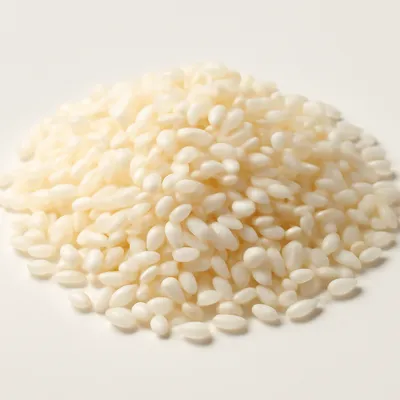
Glutinous rice is nearly all amylopectin, with under one percent amylose, and that is the whole reason for the texture: the branched starch gelatinizes on steaming into a transparent, high-viscosity paste whose entangled chains give the deep stickiness and stretch. Pounding ruptures the steamed grains into one dense, uniform mass with no whole grains left. Deep-frying drives steam off the surface and browns it, building a crisp golden crust while the moist interior stays soft. The brown sugar, sucrose carrying its molasses notes, is melted to a caramel-edged syrup, and the soybean flour is dry-toasted for aroma and to keep the cubes from sticking. As it cools the gelatinized starch slowly re-orders and firms, which is why ciba hardens cold, though amylopectin retrogrades more slowly than amylose, so it stays soft longer than ordinary rice.
Variations
The fried brown-sugar version is the hotpot signature; beyond it, Chengdu's sanda pao is hurled and slapped rather than fried, then rolled in soybean flour and brown-sugar sauce. Hunan and the Tujia areas of western Hunan favor a charcoal-grilled ciba, crisp-skinned and soft inside, and Guizhou leans to grilling and griddling where Sichuan leans to deep-frying. Leftover plain ciba is also boiled into fermented-rice soup or cooked with egg. Coatings run from soybean flour, the hotpot standard, to black sesame or crushed peanut, while the Hakka dip theirs in a mix of toasted rice, peanut and sesame.
On the Palate
Where Hongtang Ciba sits in the Chinese flavor cloud
Ingredients
Serves 4How it's made
6 steps · 25 min active + 15 min waiting
- 115 min
Steam soaked glutinous rice until soft, then pound it hot in a mortar into a dense, smooth, sticky mass with no whole grains left.
Watch outPound the rice while it's still hot until no whole grains remain — a smooth, dense, stretchy mass; if it cools it stiffens and won't come together.
- 215 min
Press the pounded rice into a flat slab, let it cool and set, then cut into cubes or strips.
- 35 min
Dry-toast soybeans until fragrant and grind them to a powder.
- 48 min
Heat oil to a medium temperature and fry the cubes until the surface is golden and crisp.
Watch outFry the cubes until the surface is golden and crisp but the inside stays soft — medium oil, or the crust burns before the center warms.
- 55 min
Melt brown sugar with a little water into a thick, just-caramel syrup.
Watch outSimmer the brown sugar just to a thick, faintly caramel syrup — push it too far and it hardens and turns bitter.
- 62 min
Pile the fried cubes in a bowl, pour over the brown-sugar syrup, and dust heavily with toasted soybean flour.


