
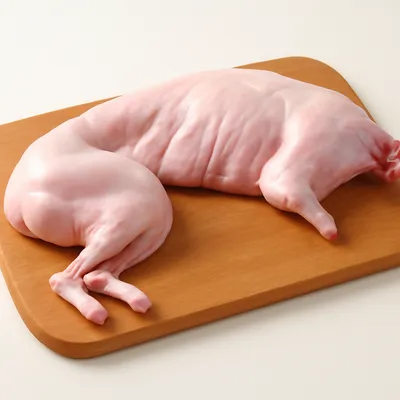
Lièvre à la royale is one of the great set-pieces of French game cookery: a whole hare, deboned and braised for hours in red wine with a heavy base of garlic and shallot, finished in a dark sauce bound with the animal's own blood. It exists in two famous schools. The Poitevin version, codified by Senator Aristide Couteaux at the end of the nineteenth century, is a civet — the meat braised until it falls apart, shredded back into the reduced sauce, and eaten with a spoon. The Périgord version is a galantine: the hare boned raw, stuffed with foie gras and truffle, rolled, braised and sliced under the same blood-thickened wine sauce. Both are demanding, both are bound with blood, and the rivalry between them is a standing argument of French gastronomy.



The name "à la royale" describes a manner of cooking fit for a king rather than the work of any particular monarch; the supposed royal origin is folklore, and no specific king's authorship is documented. Distant precursors appear in Menon's eighteenth-century court cookbook of 1755, which records a Sauce à la royale and a hot lièvre au sang. The dish's modern fame rests on two later figures. Senator Aristide Couteaux, of the Vienne, published his Poitevin recipe — attributed to his mother — in the Paris newspaper Le Temps on 29 November 1898, and the "façon Sénateur Couteaux" entered the gastronomic vocabulary almost at once. The competing Périgord galantine, stuffed with foie gras and truffle, was codified by Henri Babinski, writing as Ali-Bab, in his Gastronomie pratique of 1928. The two regions, Poitou and Périgord, have claimed the dish ever since.
This is gibier at its most concentrated. Hare is dark, lean and emphatically gamey, and the long wine braise turns that wildness deep and winey rather than sharp. In the Poitevin civet the meat has dissolved into strands you can lift with a spoon, slack in a sauce that is near-black, dense and faintly metallic from the blood, loud with garlic and shallot cooked down to sweetness. In the Périgord version a clean slice of the rolled hare shows a core of foie gras and truffle, the meat firmer, the same dark sauce poured over. Either way the sauce is glossy and clinging, rich to the edge of opulence, and the blood gives it a velvet body nothing else reproduces.
Several techniques stack here. A long red-wine marinade and braise tenderize the lean, sinewy hare and tame its strong flavor, while the slow heat converts the meat's abundant connective collagen into gelatin — which is what lets the Poitevin meat shred and gives both sauces their body. The defining step is the blood liaison: whisked in off the heat at the very end, the blood's proteins thicken the sauce to a glossy nappe much as an egg yolk would, but it must be kept below a simmer, because boiling sets those proteins into grains and the sauce splits. In the Périgord galantine, foie gras worked into the forcemeat melts during cooking and emulsifies its fat into the meat, enriching every slice; deboning and rolling the hare also let it cook evenly and be carved cleanly.
Variations
The two schools are the headline split: the Poitevin civet (Couteaux) leans on garlic and shallot with no foie gras, the meat shredded; the Périgord galantine (Babinski) stuffs foie gras and truffle and slices the rolled hare. Within each, cooks argue over the wine — a solid red, sometimes laced with a little cognac, armagnac or, in some grand versions, an essence of Chartreuse. Where the hare's blood is hard to come by, pig's blood is substituted, and some kitchens reinforce the bind with the puréed liver and heart, as Couteaux himself did. Modern chefs often plate the Couteaux civet as a refined pressed parcel rather than a loose stew, but the blood-bound sauce is the non-negotiable thread.
On the Palate
Where Lièvre à la Royale sits in the French flavor cloud
Ingredients
Serves 6
How it's made
8 steps · 3 hours active + 1 day waiting
- 130 min
Joint or bone the hare, reserving the liver, heart and all the blood (mixed with a little vinegar so it does not clot).
Watch outReserve all the blood with a little vinegar so it can't clot — it's the final thickener, and clotted blood is useless later.
- 2720 min
Marinate the hare overnight in red wine with garlic, shallot, onion and herbs.
- 325 min
Drain and pat dry; brown the meat hard in duck fat, then soften a large amount of garlic and shallot.
- 4210 min
Return the hare, deglaze with the strained marinade, and braise covered on low heat for 3 to 4 hours until falling apart.
Watch outBraise covered and low three to four hours until the hare falls apart — the lean sinewy meat only turns tender and shreddable once its collagen melts to gelatin.
- 540 min
For the Périgord version, instead bone the hare raw, stuff with foie gras and truffle, roll and tie, then braise as a ballotine.
- 620 min
Lift out the meat; strain and reduce the cooking liquid to a deep, glossy sauce.
- 78 min
Off the heat, whisk the reserved blood (and puréed liver and heart) into the sauce without letting it boil.
Watch outWhisk the blood in off the heat without letting it boil — a single hard simmer sets the proteins into grains and the sauce splits; it should go glossy and dark, not curdled.
- 810 min
Shred the civet meat back into the sauce, or slice the galantine, and nappe with the blood-bound sauce to serve.
Archive tool suggestions — not reviewed
These legacy suggestions have not been evidence-reviewed and are not presented as required tools.



