
A deep-fried sweet fritter whose surface erupts into a foam of fine, lacy bubbles as it cooks. The dough is scalded flour enriched with lard, wrapped around a sweet filling of sugar with osmanthus, rose and walnut; dropped into hot oil it blisters into a crackling, gauze-thin honeycomb crust over a soft, just-sweet center. It is best known as a snack of Sanyuan in central Shaanxi, but is also made and eaten in Shanxi, where it is counted among the local fried sweets. Pale, weightless and shatter-crisp, it is eaten the moment it leaves the oil.



Paopao yougao is most famous as a traditional snack of Sanyuan county in the Guanzhong plain of Shaanxi, but the same fried sweet is also made and eaten in Shanxi, and belongs to the broader fried-cake tradition shared across Shanxi, Shaanxi, Gansu and Ningxia; its exclusive invention is not claimed by any one place. By tradition it is said to descend from a pastry called jianfengxiao ("melts in a breath of wind"), listed as an oil-bathed cake (youyu bing) on the surviving food list of the Shaoweiyan, the lavish promotion banquet that Wei Juyuan hosted in Chang'an during the Jinglong era of Tang emperor Zhongzong, around 709. The food list itself is a genuine Tang text; the line of descent to today's fritter, and the popular tale of an imperial cook who fled to Sanyuan after the An Lushan rebellion and took the recipe into folk hands, are legend rather than documented fact.
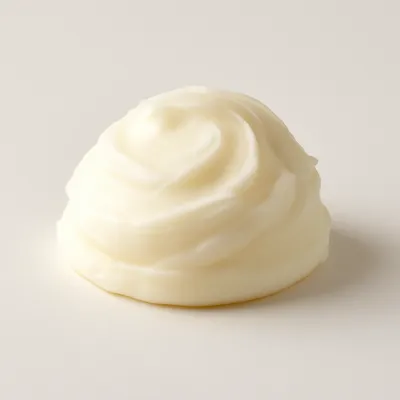
A pale dome the size of a small bun, its whole top buried under a high crust of fine bubbles — gauze-thin, lacy, looking from afar like a cap of frost-flowers or shredded silk. The crust shatters dry at the first bite and all but melts on the tongue, which is the sense behind its old name, "melts in a breath of wind." Under it the dough is soft and tender, the filling warm and just sweet, fragrant with osmanthus and rose and studded with broken walnut. It is greaseless when fried right, and it must be eaten hot off the pan; once it cools the bubbles slump and the crust goes leathery.
The lacy crust is the whole point, and it comes from scalded dough plus lard, with no alum and no alkali. Boiling water and lard are heated together, the flour is stirred in over low heat and worked until cooked: the hot water gelatinizes the starch in advance, while the fat coats the flour and locks moisture into the dough. Dropped into oil at about 180°C — roughly "sixty-percent" hot — the trapped water flashes to steam and the gas drives upward fast; at the same time the proteins denature and unfold and the gelatinized starch swells and lightly browns. Because the lard-laced, pre-cooked dough cannot fully seal against this surge, the surface keeps blistering into a foam of fine bubbles, and the heat sets that foam in place before it can collapse, fixing the gauze-thin honeycomb shell. Oil temperature is the make-or-break: too cool and the surface sets before it can blister, so no bubbles rise; too hot and it browns and burns before the foam can build and set.
Variations
Fillings mark the regional split. The Sanyuan version in Shaanxi is classically a sugar-osmanthus-rose paste with walnut or peach kernel bound by cooked flour, while in Shanxi the same fritter is often filled with sweet red-bean paste, rock sugar or red dates. Some cooks enrich the scalded dough with more lard for a higher, finer foam; the filling can be made drier or wetter to suit. The crust is the constant — every version is judged by how high, fine and crisp the bubbles rise — and across Shanxi, Shaanxi and the wider northwest the dish belongs to a family of fried cakes (yougao) that includes plainer, un-blistered scalded-dough versions sold for everyday eating.
On the Palate
Where Paopao Yougao sits in the Chinese flavor cloud
Ingredients
Serves 4

How it's made
8 steps · 40 min
- 18 min
Mix the filling: combine sugar with osmanthus sugar, rose sugar, broken walnut and a little cooked flour into a soft, just-holding paste; set aside.
- 28 min
Make the scalded dough: bring water and lard to a boil together, tip in the flour off the strongest heat and stir hard over low heat until it comes together into a cooked, smooth dough.
Watch outStir the flour into the boiling water and lard over low heat until it comes together cooked and smooth — the scald gelatinizes the starch in advance, which is what lets the crust foam into lace later; underscald it and the honeycomb won't form.
- 310 min
Knead the warm dough on a lightly oiled surface until glossy and elastic, then rest it covered until just cool enough to handle.
- 410 min
Divide the dough, flatten each piece, spoon in the filling and seal it shut, then gently pat into a small round cake.
- 53 min
Heat the oil to about 180°C (sixty-percent hot) — hot enough that a scrap of dough rises and blisters at once.
Watch outHeat the oil to about 180 degrees — a scrap of dough should rise and blister at once; too cool and it soaks up oil without erupting, too hot and it browns before the lace forms.
- 64 min
Slip in the cakes a few at a time; do not crowd, and ladle hot oil over the tops so the surface erupts into fine bubbles.
- 75 min
Fry until the whole crust has foamed into a high, gauze-thin honeycomb and set pale-gold, turning once if needed.
Watch outLadle hot oil over the tops and fry until the crust foams into a high, gauze-thin honeycomb and sets pale-gold — that lacy eruption is the whole dish, so don't let it color past gold.
- 81 min
Lift out, drain briefly, and serve at once while the crust is still crisp.


