A feathery floss of hair-fine sugar threads, light enough to dissolve the instant it touches the tongue, with a toasty, faintly nutty undertone. Unlike Western cotton candy, it is not spun by machine but pulled by hand: cooked sugar is worked around a bed of toasted flour, then stretched and folded again and again until it draws out into countless silky strands. Most often sesame-scented and snow white, it also comes tinted and flavored with saffron, rose, pistachio or cocoa. Strongly tied to the desert city of Yazd, it is sold pressed into nests or loose by the handful and given as a sweet keepsake.



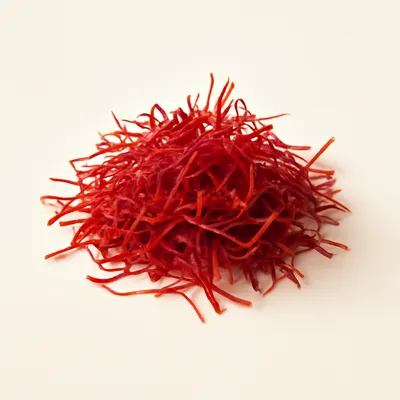

Pashmak is a traditional Persian confection most closely associated with Yazd, a desert city long celebrated for its sweets alongside gaz, baklava and qottab. Its making belongs to an old Eurasian family of hand-pulled sugar floss whose technique was recorded by around the fifteenth century, and the craft flourished as a Yazdi specialty in the Safavid era. The name means 'like wool' in Persian, after the soft fibrous mass it forms. The same pulled-sugar-over-toasted-flour method links it directly to Turkish pişmaniye and to Chinese dragon's-beard candy, kindred sweets that share both the method and the wispy result.
Impossibly light — a cloud of fine threads that collapses and melts the moment it meets the warmth and moisture of the mouth, leaving a clean wash of sweetness. The pulled sugar is delicate and dry rather than sticky, breaking into soft wisps, with a gentle roasted-grain and sesame note from the toasted flour. There is no chew and no crunch, only a brief silky cushion that vanishes.
Everything turns on the sugar stage and the geometry of folding. The syrup is boiled to the hard-crack stage, roughly 150–160°C, which drives off nearly all the water so the cooled sugar sets glassy yet briefly pliable — pullable, not pourable. Worked into a ring around toasted flour, it is then stretched and folded over itself repeatedly; each fold doubles the strand count, so a dozen pulls multiply two threads into thousands or tens of thousands of filaments — the same powers-of-two progression behind dragon's-beard candy. The toasted flour is the secret structural partner: its dry starch and a little oil coat each fresh strand, keeping the threads from fusing back together and lending the roasted aroma, so the mass holds as separate silken fibers instead of collapsing into a sticky lump.
Variations
The plain version is white and sesame-scented, but pashmak is widely tinted and flavored — saffron gold, rose pink, pistachio green, and chocolate or cocoa being the common ones. It is sold both as loose floss and pressed into firm nests or blocks for keeping. Beyond Yazd it is eaten across Iran, and its close relatives — Turkish pişmaniye and Chinese dragon's-beard candy — show the same technique dressed with different fillings, from chopped pistachios folded into the threads to a peanut-and-sesame core.
On the Palate
Where Pashmak sits in the Persian flavor cloud
Ingredients
Serves 8How it's made
8 steps · 40 min
- 110 min
Toast the flour in a dry pan or with a little oil over low heat, stirring, until it is pale golden and smells nutty; set aside to cool.
- 25 min
Combine sugar with water and a touch of acid such as a few drops of lemon, and bring to a boil without stirring.
- 310 min
Cook the syrup to the hard-crack stage, about 150 to 160°C on a candy thermometer, until a drop in cold water sets hard and brittle.
Watch outCook the syrup to hard-crack, about 150 degrees — a drop in cold water must set glassy and snap, or the floss won't pull.
- 45 min
Pour the syrup onto an oiled cool surface and let it firm just enough to handle while still warm and pliable.
Watch outLet the poured syrup firm just to the point it holds shape yet stays warm and pliable — too cold and it shatters instead of stretching.
- 55 min
Gather the sugar into a thick ring and lay it on a generous bed of the toasted flour.
- 610 min
Stretch the ring out long, fold it back on itself to double the strands, and dredge again in the flour.
- 715 min
Repeat the pull-fold-dredge many times, working quickly, until the sugar draws out into fine hair-like threads.
Watch outWork fast through each pull-fold-dredge — the sugar cools and stiffens quickly, and once it stops stretching the threads break.
- 85 min
Gently gather the floss into loose nests or light handfuls, dust off excess flour, and store airtight away from humidity.
Archive tool suggestions — not reviewed
These legacy suggestions have not been evidence-reviewed and are not presented as required tools.

