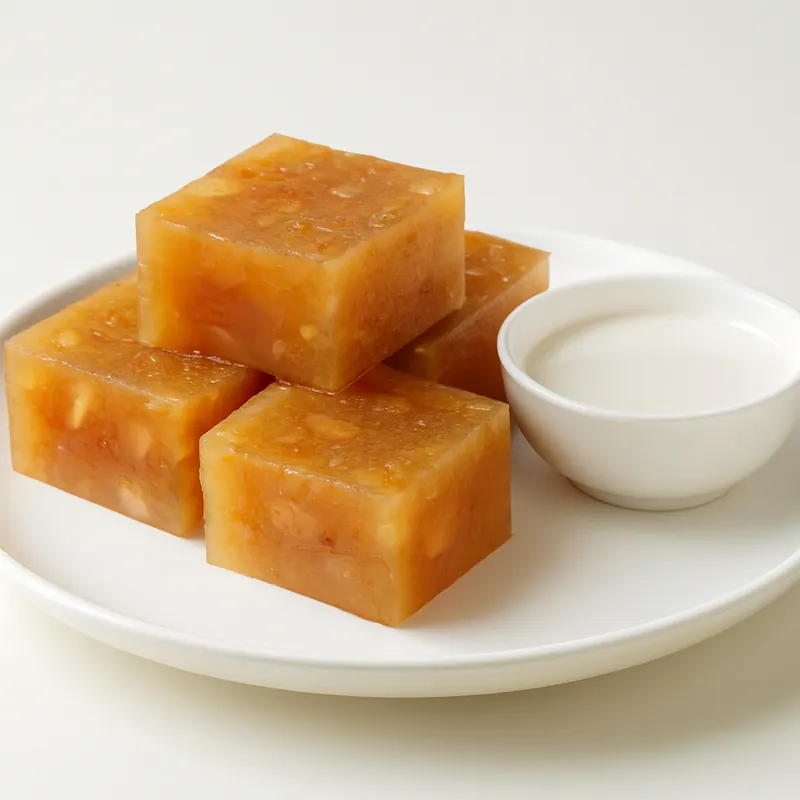
A brown, honey-sweet steamed sponge cake and a fixture of the Cantonese yum-cha trolley. The old method ferments a batter of flour, egg, lard, and butter for around three days until it deepens to amber-brown, then steams it into a tall, airy crumb laced with vertical channels and a faint malty tang. Cut into wedges and eaten warm, it pulls apart in soft, spongy threads rather than crumbs — closer to a steamed bread than a Western cake. The colour is the fermentation and the dark sugar, not cocoa.




Ma lai gou is widely said to have begun as 'Malay cake' (马来糕), a sweet favored by Malay communities in the Singapore region that passed into Hong Kong and Guangdong tea houses, the name shifting in local speech. A second account traces it to Hong Kong cooks who tasted Malaysian pandan cake, tried to reproduce it at home, could not source pandan leaf, and so dropped the pandan but fermented the batter instead — keeping the Malayan inspiration in the name. Either way it settled into the Cantonese dim-sum canon; in 2023 the craft of Cantonese ma lai gou was listed as intangible cultural heritage in Guangzhou's Tianhe district.
Warm from the steamer, a wedge gives under the fingers like a damp sponge and pulls apart in long soft shreds along the grain. The taste is gentle and round — brown sugar and a honeyed sweetness, egg richness from the yolks, a buttery, faintly malty note from the long ferment — never frosting-sweet. Steam keeps it moist all the way through, with no dry crumb. Pull a piece apart and you see the open vertical tunnels that mark a properly risen one; a dense, flat slice means the ferment or the steam fell short.
The signature open, vertical crumb comes from a long natural fermentation rather than from baking powder. Over roughly three days, wild yeasts and bacteria work through the flour-egg batter, generating gas that, under the rising steam, is driven upward to tear the open tunnels through the cake; the same fermentation darkens the batter to amber-brown and builds the faint malty tang. Lard and butter keep the crumb tender and moist. It is cooked by steam, not dry oven heat, so the surface never crusts and the whole stays soft. Modern shortcut recipes swap in baking powder or premixes to skip the wait — quicker, but paler, blander, and without the springy fermented threads.
Variations
The old three-day ferment is the benchmark; many tea houses now use a same-day baking-powder batter for speed. Brown sugar gives the classic deep colour; lighter versions use less. Some add custard powder or a little evaporated milk for richness, or a touch of alkaline water for an even more open crumb. A close relative is 'gai daan gou', the lighter, pale, sponge-cup steamed egg cake — quicker, eggier, and without the fermented depth.
On the Palate
Where Ma Lai Gou Steamed Sponge Cake sits in the Chinese flavor cloud
Ingredients
Serves 8How it's made
8 steps · 3 days 1 hour
- 18 min
Whisk eggs with brown sugar until the sugar dissolves and the mixture is smooth.
- 25 min
Sift in the flour and stir to a thick, lump-free batter.
- 34320 min
Cover the batter and leave it to ferment in a warm place for about three days, until it smells malty and has darkened to amber-brown.
Watch outThe batter is ready when it smells malty-tangy and has darkened to amber-brown — that three-day ferment, not baking powder, is what tears the open tunnels.
- 48 min
Melt lard and butter together, cool slightly, and beat them into the fermented batter until fully combined.
- 53 min
Stir in a little evaporated milk or water to loosen the batter to a thick pouring consistency.
- 65 min
Line a cake tin or bamboo steamer with paper and pour in the batter, filling well below the rim to allow rise.
Watch outFill the tin well below the rim — the batter climbs a lot under steam and needs the room to rise.
- 745 min
Steam over high heat, lid wrapped to stop drips, until the cake is risen, set, and springs back when pressed.
Watch outWrap the lid so no water drips on the surface, and steam until it springs back when pressed — a sunken center means it's not set.
- 86 min
Cool slightly, turn out, and cut into wedges; serve warm.
Archive tool suggestions — not reviewed
These legacy suggestions have not been evidence-reviewed and are not presented as required tools.