Qingdao's most celebrated braised pig trotters, slow-cooked for hours in a spiced master stock until the skin is lacquer-red and glossy, the collagen gelatinous, and the fragrance of star anise and cinnamon penetrates deep into the bone.
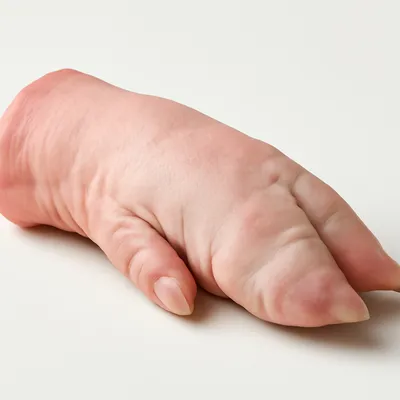




Liuting pig trotters trace to the Fusheng Restaurant (复盛饭庄), opened in 1881 during the Qing Guangxu reign by a physician surnamed Zhou whose courtesy name was Fusheng, in what is now Chengyang District, Qingdao. The restaurant opened with six celebratory cannon shots. His grandson Zhou Zhongdian refined the spice formula and braising technique, cementing the dish's regional reputation. During the early Republic era, former Qing imperial officials who retired to Qingdao became loyal patrons. In 1935, Mayor Shen Honglie and over a hundred dignitaries — reportedly including Han Fuju among prominent Shandong officials — gathered at Liuting's Guanyin Temple for a restoration ceremony and were served the trotters as the featured delicacy, propelling the dish to citywide fame. The Zhou-family preparation technique was later designated a Chengyang District intangible cultural heritage item.
The skin yields with a gentle pull, releasing a wave of warm spiced brine; the collagen-rich jelly clings to the lips while the lean meat inside stays firm and fragrant, with the faint finish of dried tangerine peel.
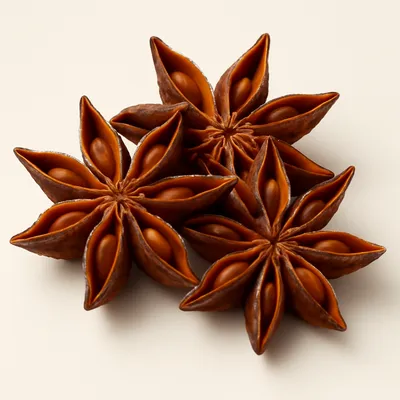
Pig trotters are rich in collagen in skin and connective tissue. Hours of braising at around 85°C cause thermal hydrolysis: the triple-helix collagen chains depolymerize into gelatin, which forms a soft, quivering gel on cooling. The spice blend — star anise, cinnamon, bay leaf, white cardamom, Sichuan pepper, dried tangerine peel — releases fat-soluble aroma compounds (anethole, cinnamaldehyde, linalool) that dissolve into the braising fat, then transfer into the collagen matrix as it sets. Prolonged low heat prevents lean muscle from toughening, as myosin denaturation plateaus before fibrous contraction tightens.
Variations
The Zhou-family Fusheng recipe uses only soy sauce, Erguotou, and twelve spices with no sugar coloring — the color comes from natural soy browning. Many Qingdao shops add caramel for deeper color and sweetness. Coastal variants sometimes fold dried shrimp paste into the master stock. Vacuum-packed versions ship nationwide but forfeit the trembling fresh-gelatin texture of the just-braised trotter.
On the Palate
Where Liuting Braised Pig Trotters sits in the Chinese flavor cloud
Ingredients
Serves 4



How it's made
6 steps · 30 min
- 110 min
Score each trotter lengthwise between the toes (about 3 cm deep); blanch in boiling water for 5 minutes, drain, chill under cold water, singe off remaining hairs with a flame, and rinse.
- 2240 min
Soak trotters in a basin of cold running water for 4 hours until no blood remains and the skin is pale white.
Watch outSoak the blanched trotters in running cold water until the skin runs pale white — leftover blood muddies the braise's color and smell.
- 33 min
Toast spices (star anise, cinnamon, bay leaves, white cardamom, Sichuan pepper, dried tangerine peel, cardamom, white angelica root) dry in a wok for 30 seconds until fragrant; tie in cheesecloth.
- 410 min
Place trotters in a large pot; add water to cover, soy sauce, Erguotou, salt, MSG, sliced ginger, knotted scallion, and the spice sachet; bring to a boil over high heat, skimming foam.
- 5210 min
Reduce to the lowest possible simmer; cover and cook for 3 to 3.5 hours, turning trotters once halfway, until a chopstick pierces the skin without resistance.
Watch outBraise at the lowest possible simmer until a chopstick pierces the skin with no resistance — a hard boil splits the skin and leaves the meat tough.
- 660 min
Turn off heat; leave trotters in the braising liquid for at least 1 hour so the gelatin sets deep into the skin; remove and serve at room temperature.
Watch outLeave the trotters in the hot brine an hour off the heat — that rest sets the gelatin deep into the skin and drives the flavor in.
Archive tool suggestions — not reviewed
These legacy suggestions have not been evidence-reviewed and are not presented as required tools.

