A signature Shanghai confection from venerable pastry houses Shen Dacheng and Qiaojiazha: a soft glutinous rice ball hiding two concentric fillings—red bean paste encircling a black sesame core—then rolled in fine shredded coconut. Each bite is a small, sweet surprise: which filling arrives first is never certain until you bite.



Double-Filled Glutinous Rice Ball emerged as a Shanghai refinement of Suzhou-style stuffed rice dumplings. Shen Dacheng—founded in 1875 by Shen Ajin as a porridge stall, expanded into a pastry shop around 1878—and rival Qiaojiazha both enshrined it as a year-round staple. The innovation of nesting two concentric fillings inside a single skin, then rolling the finished ball in shredded coconut—an ingredient that entered Shanghai kitchens along treaty-port trade routes from Southeast Asia—distinguished the Shanghai version from its Suzhou ancestor. The phrase 'Qiaojiazha's shuang niang tuan' became, for generations of Shanghainese, a fixed childhood memory: the suspense of the first bite, the layered reveal of bean paste and then sesame, became the point.
Coconut silk catches on the lip first; the dough yields in a soft bounce; then—unexpectedly—either sweet red bean or dark, oily sesame unfolds on the tongue, and a moment later the other filling arrives: two flavors in quiet succession, the order never certain, the whole thing cool and lightly sweet.
The glutinous rice skin is predominantly amylopectin, which forms a pliable, cohesive gel during boiling and holds the dual filling structure intact without tearing. The concentric design creates differential heat absorption: the outer bean paste warms faster and firms more evenly, while the black sesame core—packed with fat from lard and ground sesame—conducts heat slowly, retaining a slightly viscous, molten quality. Black sesame's fat is rich in oleic and linoleic acids; roasting the seeds before grinding drives Maillard reactions that generate sulfur-containing heterocyclic aroma compounds, producing the deep, roasted fragrance. Coconut shreds prevent the outer skin from sticking together and add a layer of medium-chain fatty acid sweetness.
Variations
Yellow bean powder (roasted soy flour) can replace the coconut coating for a nuttier, drier surface. Some vendors substitute lotus paste for red bean paste. Winter-solstice versions use date-osmanthus paste as the outer filling. Miniature shuang niang tuan, served floating in ginger syrup, appear at winter festivals as a close cousin of tangyuan.
On the Palate
Where Double-Filled Glutinous Rice Ball sits in the Chinese flavor cloud
Ingredients
Serves 4
How it's made
7 steps · 30 min
- 110 min
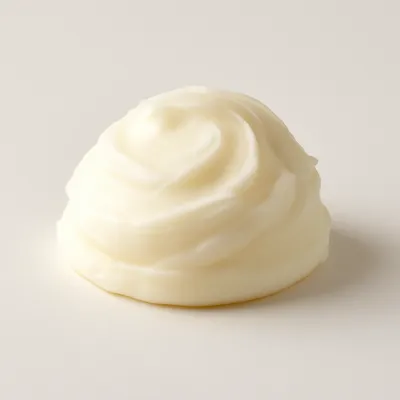
Roast 80g black sesame seeds in a dry pan over medium heat until fragrant; grind to a fine powder, then mix with 40g lard and 40g icing sugar to form a stiff paste (the inner black sesame filling). Divide into 8 small balls.
Watch outFreeze the sesame cores firm before wrapping — soft, they smear and won't sit as a clean center inside the bean paste.
- 210 min
Divide 200g smooth red bean paste into 8 portions; flatten each into a disc and wrap around one sesame ball, pinching closed to form a layered dual filling with bean paste on the outside.
- 310 min
Combine 200g glutinous rice flour with about 150ml warm water; knead until smooth and pliable with no dry patches. Rest for 10 minutes.
- 415 min
Divide the dough into 8 equal pieces; flatten each into a round wrapper, place a dual filling in the centre, gather the edges up and pinch closed, then roll gently between oiled palms to form a smooth ball.
Watch outPinch the wrapper completely closed and roll seamless — any gap and the molten filling leaks out into the boiling water.
- 58 min
Bring a large pot of water to a boil; drop dumplings in one by one. Cook until they all float, then continue for 2 more minutes so the filling is fully warmed through.
Watch outCook two minutes past floating so the double filling warms through to molten — pull too soon and the sesame core stays cold and stiff.
- 63 min
Lift out with a slotted spoon, drain briefly, and roll immediately in 80g fine shredded coconut while still warm so the coconut adheres all over.
- 71 min
Serve warm or at room temperature; best consumed within 6 hours of making.
Archive tool suggestions — not reviewed
These legacy suggestions have not been evidence-reviewed and are not presented as required tools.


