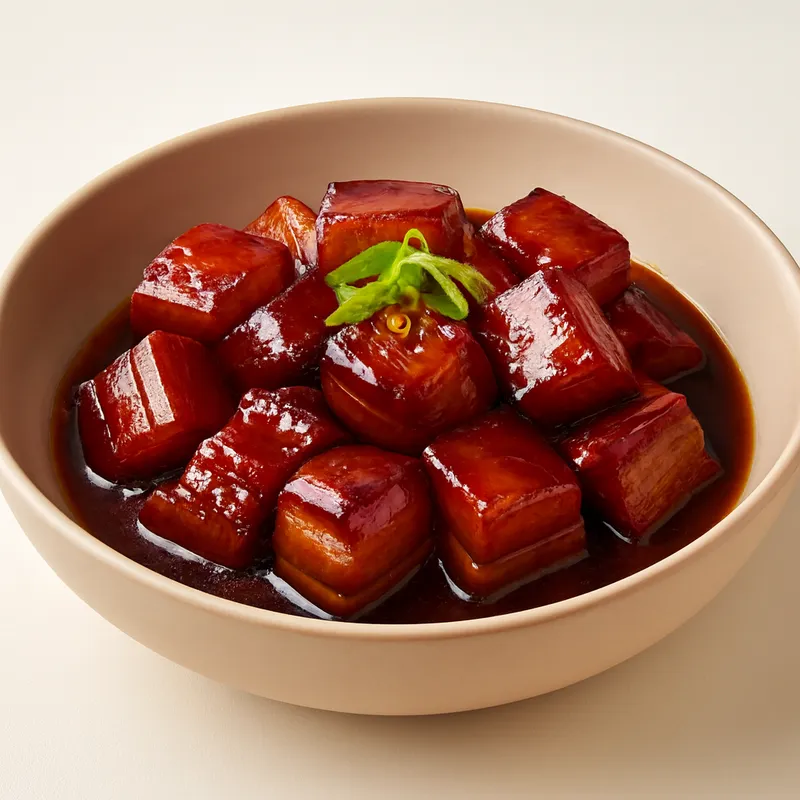
A whole square of pork leg (skin on) sealed in cloth with shiitake, dried shrimp, and chestnut and simmered for hours, unwrapped at the table — Xiamen Tongan banquet centerpiece.




Fengbao rou — sealed pork — is the centerpiece of Tongan District weddings and ancestor banquets in coastal southern Fujian. The name puns on 封: the block and its fillings are wrapped and sealed in cloth (纱布/黄巾) before cooking, and 封 also means 'imperial conferment.' By legend, when Wang Shenzhi was made King of Min in 910 (Later Liang) and granted a square seal, officials in Tongan celebrated with square pork wrapped in yellow cloth resembling the seal bound in yellow silk — hence 封肉. In Min Nan, 方 ('square') and 封 are homophones, so 方肉 ('square meat') became 封肉. It later became the banquet centerpiece (压桌菜) via the Ming jinshi Lin Xiyuan.
Tongan District wedding centerpiece — a Min Nan feng-pan whose lid is sealed with flour-water paste so no steam escapes during a four-hour cook. Inside the seal, pork-belly fat holds 90-95°C in its own juices long enough to gelatinise the collagen between fat and meat.
The lotus leaf opens and a green-perfumed steam rolls up — that smell is half the dish. Underneath: a glistening red-brown belly so soft a serving spoon cuts it. The fat has gone glassy, almost liquid, and slides off the skin in sheets. The shiitake and chestnuts at the bottom have eaten four hours of pork-belly drippings; the scallops have shredded into the sauce. Take a piece of skin, fat, and meat in one bite — separating them ruins the point.
The seal is the entire technique. Inside a tightly wrapped lotus leaf, with no steam escape, the pork-belly fat reaches and holds 90-95°C while submerged in its own rendered juices for four hours — long enough to fully gelatinise the connective collagen between fat and meat, which is what gives that liquid-glass mouthfeel. Open the leaf early and you lose the pressure; the fat firms up within a minute and you've got pot-stewed pork, not feng rou.
Variations
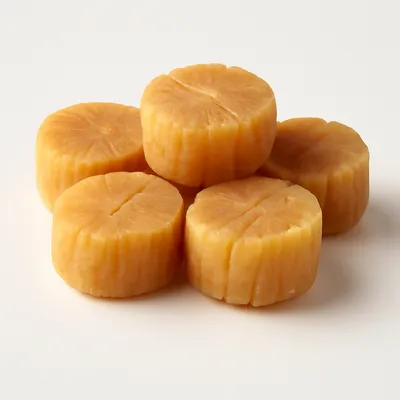
Tongan-Xindian wedding versions run heavy on dried scallop; Xiamen-Jimei shops add water chestnuts; Quanzhou-influenced southern versions push the soy darker.
On the Palate
Where Tongan Sealed Pork sits in the Chinese flavor cloud
Ingredients
Serves 6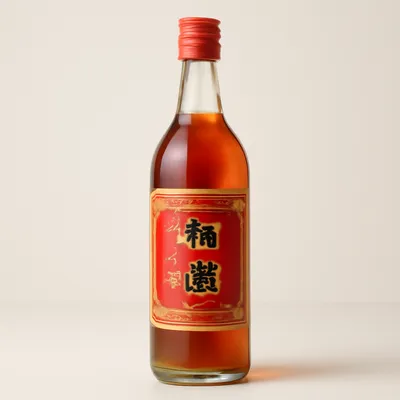





How it's made
6 steps · 1 hour
- 130 min
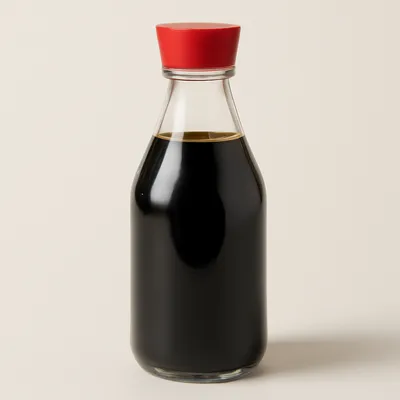
Cut a single 20cm × 20cm square of skin-on pork belly (~1.4 kg). Score the skin in a fine crosshatch. Rub with light soy, dark soy, and 1 tbsp Fujian Hong Lu jiu (red-yeast rice wine). Marinate 30 minutes.
- 260 min
Soak 8 dried shiitake in warm water for 1 hour. Soak 30g dried scallop and 20g dried shrimp in Shaoxing wine for 30 minutes. Reserve all the soaking liquids — they're the braising base.
- 36 min
Sear the pork-belly square skin-side down in a dry wok over medium heat for 4 minutes — the rendered fat colours the skin a deep red-brown. Flip and sear the meat side 1 minute. Lift out.
Watch outSear skin-side down until the fat renders out and the skin turns deep red-brown and firm — that rendered layer is what colours and protects the skin through the long steam.
- 45 min
Soften two large dried lotus leaves in boiling water for 30 seconds. Lay one in a deep heat-proof basin; pile the shiitake, scallop, shrimp, 8 peeled chestnuts, scallion knots, ginger, and a small piece of rock sugar in the centre.
- 54 min
Set the pork belly skin-up on top. Pour the strained mushroom and scallop liquid plus 100ml Hong Lu jiu around it (do not over the skin). Wrap the lotus leaf up over the pork; tie with kitchen twine to seal.
Watch outTie the leaf so it seals completely with no gap — the whole dish lives on trapped pressure; any leak and the fat firms into ordinary stewed pork.
- 6240 min
Set the basin in a steamer. Steam over medium heat for 4 hours, topping up the steamer water every hour. Lift out, rest 10 minutes. Carry to the table sealed; cut the twine and unfold the leaf in front of the guests.
Watch outKeep the steam at a steady medium and top up the water every hour — four unbroken hours at a gentle simmer is what melts the collagen to that liquid-glass texture; run dry and it stalls.