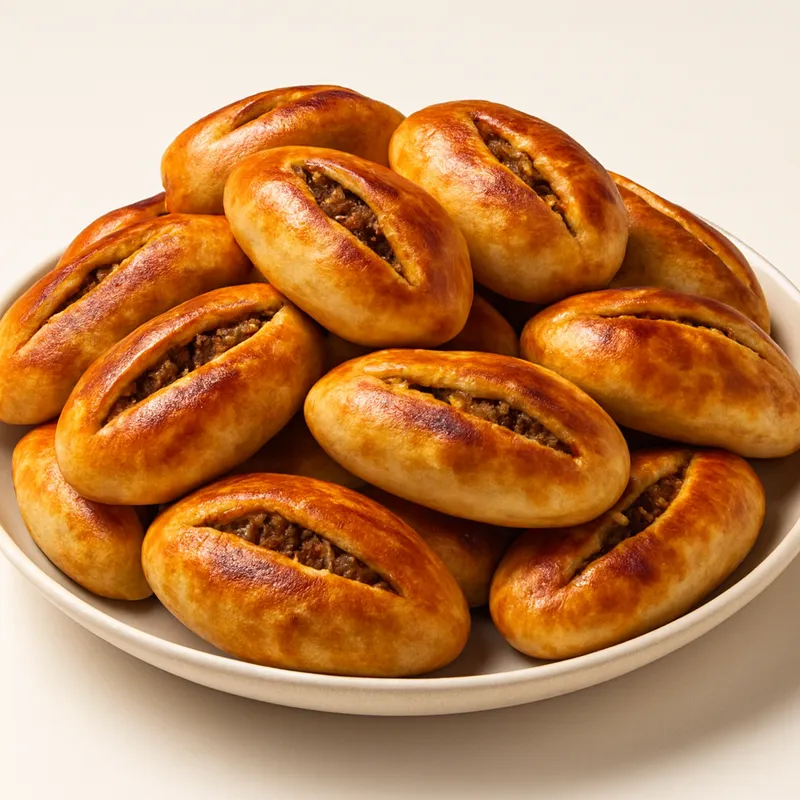



Lanzhou's Hui-Muslim community has baked these in vertical clay ovens — locally called 馕坑 nāngkēng, related to the Central Asian tandoor — for as long as the city has been a Silk Road trade post. The form differs from Xinjiang samsa: Xinjiang uses a thicker laminated pastry, while the wrapper here is the same thin unleavened wheat dough rolled flat and folded into a square.
Lanzhou's Hui-Muslim community bakes these in vertical clay ovens (馕坑, related to the Central Asian tandoor). Salt-water brushed on the bottom isn't seasoning — at 280°C it flash-evaporates and welds dough to wall, otherwise the bun falls into the coals.
Crack the top crust and steam rushes out — inside is wet with lamb juice the dough has trapped. The skin is brittle on top, chewy underneath where it touched the oven wall. Filling reads onion-sweet first, then cumin, then a clean lamb-fat finish. Eat hot; once cooled, the dough toughens and the magic is gone.
The salt-water brushed on the bottom isn't seasoning — it's adhesion. As the wet bun slaps the ~270°C clay wall, the salt-water layer flash-evaporates and the dough sears onto the wall in a second; without it, the bun falls into the coals. Inside, the chopped (not ground) lamb releases juice in chunks, steaming the wrapper from within while the outside dries. Ground meat would weep water and make the dough soggy.
Variations
The wrapper is thin unleavened wheat dough rolled flat and folded square (laminated pastry is not used); Uzbek somsa adds onion-heavy lamb; Tashkent versions are larger and triangular.
On the Palate
Where Lanzhou Roast Buns sits in the Chinese flavor cloud
Ingredients
Serves 4


How it's made
6 steps · 45 min active + 45 min waiting
- 112 min
Mix 400g high-gluten flour with 220g warm water and 4g salt. Knead 10 minutes until smooth, cover, and rest 45 minutes — the dough should pull into a sheet without tearing.
Watch outThe rested dough should stretch into a thin sheet without tearing — that's your sign the gluten has relaxed.
- 215 min
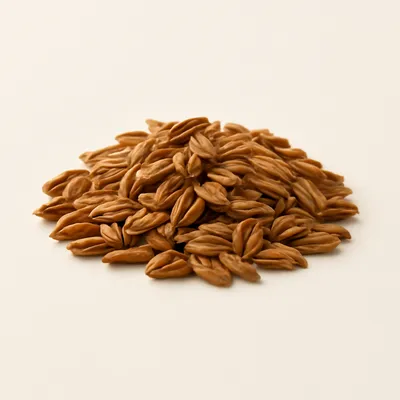
Hand-chop 350g lamb shoulder (don't grind — chopping keeps texture) with 25% fat. Mix with 200g finely diced yellow onion, 2 teaspoons cumin seeds toasted and crushed, 1 teaspoon ground white pepper, 2 teaspoons salt, 1 tablespoon vegetable oil, and 3 tablespoons cold water added in stages until the filling holds together.
Watch outAdd the cold water in stages and beat until the filling holds together and turns sticky.
- 315 min
Divide dough into 12 pieces. Roll each into a 12cm square, thinner at the edges. Place 50g filling in the center, fold the four corners to the middle to form a square parcel, pinch seams shut.
- 410 min
Heat a tandoor-style clay oven to 280°C (or a home oven with a pizza stone to its maximum, ideally 260°C+). Brush the bun bottoms with salt water so they stick to the wall.
Watch outMake sure the oven is fully preheated to achieve a good crust.
- 514 min
Slap buns onto the oven wall, or arrange seam-up on the stone. Bake 12-15 minutes until tops are deep golden and bottoms have set crusts. Brush tops with a thin film of oil halfway through for shine.
Watch outTops should go deep golden and the bottoms set into a firm crust before you pull them.
- 61 min
Serve immediately, hot enough that the steam puffs out at first bite. Eat hand-held; no dipping sauce needed.
Archive tool suggestions — not reviewed
These legacy suggestions have not been evidence-reviewed and are not presented as required tools.