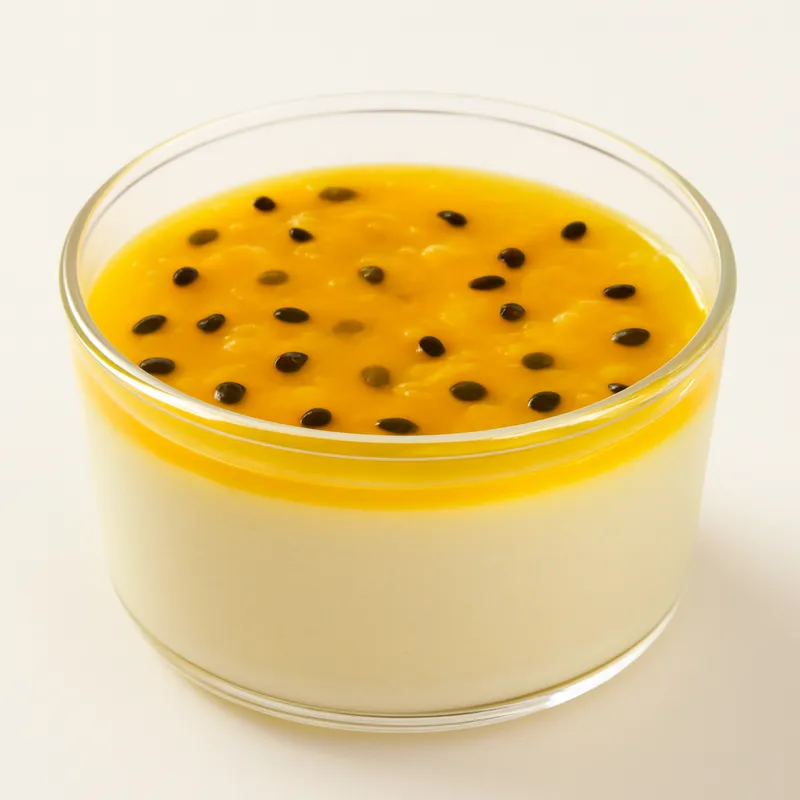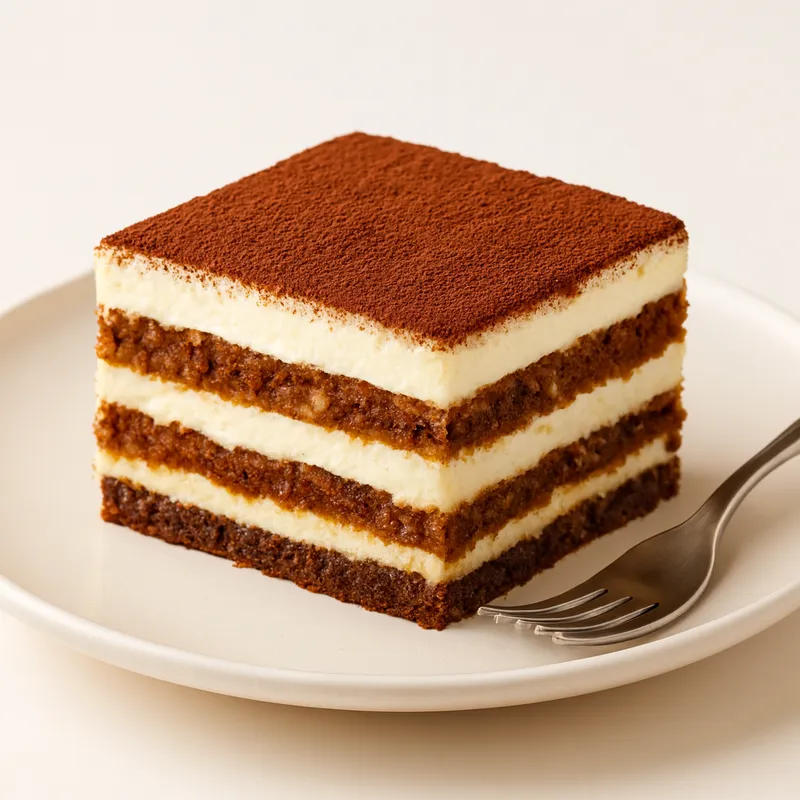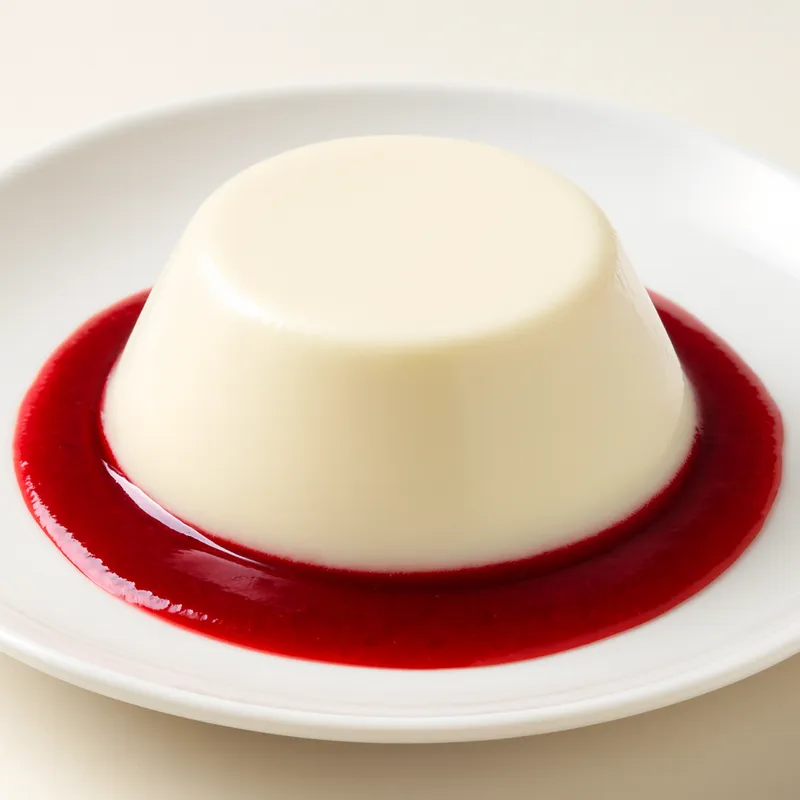
Silky Italian cream dessert set with gelatin, served with berry coulis or caramel, epitomizing elegant simplicity.


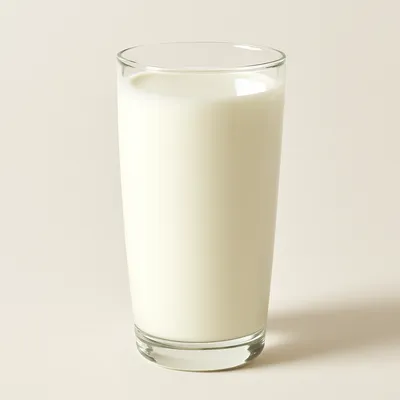

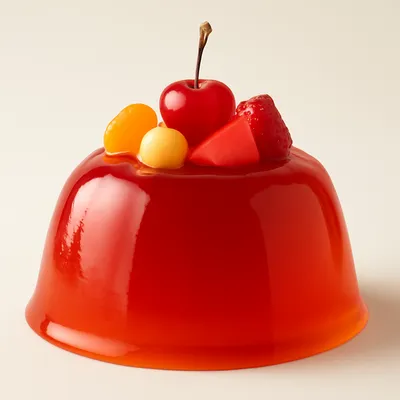
Piedmontese, in the langhe-roero hills — formal documentation is mid-20th century but the dish itself is older household cooking. Italian recipes call for «colla di pesce» ('fish glue'), which today is simply the standard name for ordinary leaf gelatin rather than true isinglass; older northern recipes sometimes set the cream with fish-bone broth. Modern recipes use ordinary pork or beef gelatin. The «cooked cream» name is literal — cream is gently heated with sugar to dissolve, never boiled, then cooled to set.
Piedmont, early 1900s — cream, sugar, gelatin, set in a mold. The wobble is the test: too firm and it’s flan, too loose and it pools. 2g gelatin per 100ml cream is the working ratio.
Pale ivory dome unmolded onto a small plate, holding shape but trembling when nudged. Spoon goes in with mild resistance, then yields. Tastes of cream and vanilla; sometimes a thin red coulis or a spoon of caramel pooled around the base. If it bounces like jelly, too much gelatin; if it slumps and pools, not enough — the dial is fine.
Gelatin ratio is the whole game: about 1.5 g of bloomed sheet gelatin per 100 ml of cream gives a panna cotta that just barely holds when unmolded — the test is the wobble. Cream goes to 80°C only, never simmer (boiled cream gets a cooked-milk skin and dulls the vanilla). Bloom gelatin in cold liquid first, then dissolve into warm cream off-heat — direct heat denatures the proteins and the set turns grainy.
Variations
Classic vanilla with caramel; coffee panna cotta (Turin coffee tradition); berry-topped (raspberry coulis); buttermilk panna cotta is the American adaptation; panna cotta is also strongly associated with the Aosta Valley as a region.
On the Palate
Where Panna Cotta sits in the Italian flavor cloud
Nail the gelatin ratio and never boil the cream: about 1.5 g of bloomed sheet gelatin per 100 ml gives a panna cotta that just barely holds and wobbles when unmolded, and cream taken only to 80°C keeps the vanilla clean — boiled cream skins over and dulls, and gelatin dropped into hot cream turns the set grainy.
Ingredients
Serves 8How it's made
5 steps · 20 min active + 4 hours waiting
- 15 min
In a saucepan, gently warm the cream and sugar over low heat, stirring until the sugar dissolves completely. The mixture should be smooth and fragrant with vanilla.
Watch outKeep it just below a simmer — you want steam and dissolved sugar, not a single bubble breaking the surface.
- 25 min
Bloom the gelatin by sprinkling it over cold milk, allowing it to soften before gently heating until fully dissolved. The liquid should be clear and smooth.
Watch outMake sure the milk is cold when blooming the gelatin to achieve the best texture.
- 33 min
Combine the warm cream mixture with the dissolved gelatin, stirring gently to ensure even distribution. The mixture should be silky and uniform.
Watch outStir the gelatin in off the heat until the mix looks silky and uniform, with no undissolved specks clinging to the spoon.
- 42 min
Pour the mixture into individual moulds, leaving space at the top. Allow them to cool to room temperature before refrigerating until fully set, about 4 hours.
- 55 min
To serve, dip each mould briefly in warm water to loosen, then invert onto a plate. The panna cotta should hold its shape, with a slight jiggle.
Watch outDip the mould in warm water for only a few seconds — too long and the outer layer melts to a slump instead of a clean, trembling turn-out.
Archive tool suggestions — not reviewed
These legacy suggestions have not been evidence-reviewed and are not presented as required tools.