

Disputed. France claims the name (crème brûlée appears in François Massialot's 1691 court cookbook), England points to Trinity Cream / burnt cream at Trinity College, Cambridge from at least 1879 with the college crest branded onto the sugar. The modern restaurant version was made famous by Sirio Maccioni at Le Cirque in 1980s New York, who used a propane torch tableside and turned it into the era's defining restaurant dessert.
Trinity College Cambridge claimed it in 1879 ("burnt cream" in the steward's accounts), but François Massialot's 1691 cookbook in Paris also describes it. The torch-shattered sugar crust is the only test that matters.
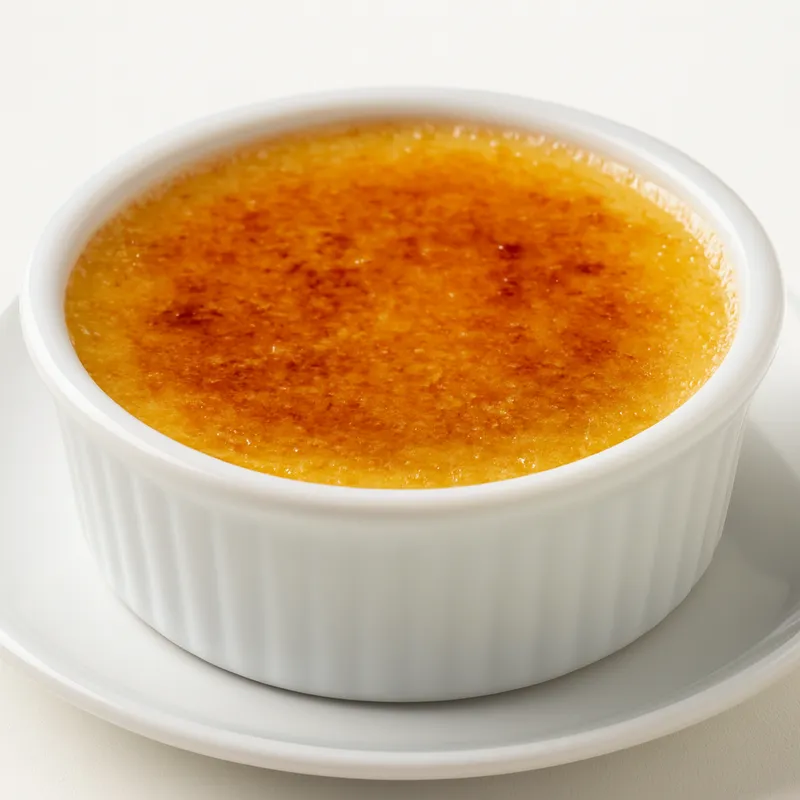
A glass-thin layer of caramelized sugar that cracks under the spoon, revealing cool vanilla custard underneath — the temperature contrast between hot brittle top and cold cream is the whole point. Custard should jiggle slightly at the center, not stand stiff. Real vanilla shows specks; if it's flecked-free and pale yellow, it's extract or paste. Served in a shallow ramekin, eaten the moment the sugar is torched.
The crust is sucrose recrystallized at 170°C — a torch (not a broiler) gives focused heat that browns the surface without warming the custard underneath. Use granulated sugar, not powdered; powdered burns before it caramelizes. Finish under 60 seconds and serve immediately — within ten minutes the moisture from the cream rehydrates the sugar from below and the crust softens into a chewy film.
Variations
Vanilla bean is canonical; coffee, lavender, and Earl Grey are common modern infusions; Catalan crema catalana is the oldest cousin (with citrus and cinnamon, no water bath); trinity cream is the British original.
On the Palate
Where Creme Brulee sits in the French flavor cloud
Ingredients
How it's made
5 steps · 53 min
- 15 min
Preheat your oven to 325°F (160°C). In a saucepan, heat cream with a split vanilla bean over medium heat until it just begins to simmer, infusing the cream with vanilla's warm aroma.
Watch outHeat the cream only until the first tiny bubbles ring the edge — a full boil would cook the vanilla flat and risk the cream catching.
- 25 min
In a bowl, whisk together egg yolks and sugar until pale and thick. Slowly pour the hot cream into the yolk mixture, whisking constantly to prevent curdling.
Watch outWhisk yolks and sugar until pale and thick, and add the cream in a thin thread — the mix should stay smooth, never scramble.
- 35 min
Strain the custard into ramekins placed in a baking dish. Pour hot water into the dish until it reaches halfway up the sides of the ramekins.
- 435 min
Bake in the preheated oven until the custards are set around the edges but still slightly wobbly in the center.
Watch outGive the dish a nudge — the edges hold but the center jiggles as one soft mass; that wobble is doneness, firmness is overdone.
- 53 min
Once cooled, sprinkle an even layer of sugar over each custard. Use a kitchen torch to caramelize the sugar until it forms a golden, glass-like crust.
Watch outMove the flame in slow circles until the sugar bubbles and turns deep amber-gold; stop before it goes dark or it tastes burnt.
Archive tool suggestions — not reviewed
These legacy suggestions have not been evidence-reviewed and are not presented as required tools.

Hand-held wire loop tool for beating eggs, whipping cream, emulsifying dressings, and incorporating air into batters. Balloon whisks (large round head) for whipping cream and meringues; French whisks (narrow tear-drop) for sauces in pots; flat whisks (gravy) for pan sauces. Stainless steel is universal; silicone-coated for non-stick pans.

Round metal pot, 14-26 cm diameter, with vertical walls and a long handle, designed for sauces, soups, oatmeal, rice, boiled vegetables. The vertical walls minimize evaporation (vs. a sauté pan). Sizes: 1 qt for melting butter, 2-3 qt for sauces, 4 qt for soups. Stainless-steel-clad aluminum or copper is best for conduction; cast-iron is too thick for delicate sauces.